

- October / 10 / 2026
Whisky Tasting Events: What to Expect and How to Choose
What if tasting events were less a test of your expertise and more a guided journey through whisky’s flavour, craft and origin? It’s natural to wonder whether you need prior knowledge or whether a tasting will feel too technical. You don’t need to arrive with the right vocabulary. A thoughtful guide can help you notice what’s in the glass and make sense of each dram at your own pace.
Whisky tasting events can take different forms, from exploring a particular style to comparing whiskies from different regions. Knowing what to expect makes it easier to choose an experience that feels engaging rather than intimidating. In this guide, you’ll learn how a guided tasting typically unfolds, what to look for when selecting an event, and simple ways to taste attentively and enjoy each sample.
As an independent whisky specialist based in Oban, Scotland, Whisky Fix hosts professional tasting events and brings knowledge of single malt Scotch and whiskies from around the world. Whether you’re new to whisky or already curious about its finer distinctions, the right tasting can leave you more confident and deepen your appreciation of every dram.
Key Takeaways
- A guided whisky tasting helps you explore aroma, flavour, production and provenance without requiring prior expertise.
- Follow the sequence of observe, nose, taste, reflect and compare to give each dram your attention.
- Choose tasting events by their learning focus and level of interaction, whether you prefer an introduction, a style-led exploration or a discussion of provenance.
- Bring curiosity, note your impressions and join the discussion at a pace that feels comfortable.
- Whisky Fix hosts professional tasting events, drawing on specialist knowledge of single malt Scotch and whiskies from around the world.
What Are Whisky Tasting Events, and What Can You Learn?
A whisky tasting event is a guided experience for sampling and understanding whisky. Rather than simply being served a dram, you’re invited to pay attention to its character and consider how it was made and where it comes from. A host can introduce each whisky, share useful context and guide the group through observations of aroma, flavour and finish.
The aim isn’t to identify one “correct” set of tasting notes. One person might find fruit or spice, while another notices smoke, sweetness or a familiar scent. Comparing impressions can reveal how differently people experience the same dram. A host can also connect what you notice to production choices, such as ingredients, maturation and cask influence, as well as the whisky’s provenance.
Based in Oban, Scotland, Whisky Fix brings specialist knowledge to its professional tasting events, drawing on experience with single malt Scotch and whiskies from around the world. For a broader reference to common tasting approaches and the visual, nose, palate and finish vocabulary, see Whisky tasting.
A guided tasting turns each dram into a subject for discovery; casual drinking is simply enjoying the whisky. You don’t need to memorise technical terms to take part. Describe what you genuinely notice in your own words, then use the host’s explanations and other attendees’ impressions to build your understanding.
What happens during a guided whisky tasting?
A tasting usually begins with an introduction to the whiskies or theme, followed by time to observe and sample each dram. The host may prompt attendees to notice appearance, aroma and flavour, then invite discussion. As the tasting develops, the presenter can connect each whisky’s character to relevant details about its production and origin. The order and emphasis depend on the event.
Who can enjoy a whisky tasting event?
Beginners can explore whisky with guidance, while experienced drinkers may enjoy comparing familiar styles or gaining fresh context. A tasting can also be a thoughtful way to explore whisky as a gift, either before choosing a bottle or as an experience to share. You don’t need polished tasting notes: curiosity and careful observation are enough to start.
Different levels of experience can enrich the conversation. A newcomer may notice an unexpected aroma, while a seasoned whisky drinker may explain how a production detail shapes the dram. Listen openly, share your impressions without worrying about being right, and let the discussion deepen your appreciation of what’s in the glass.
How a Whisky Tasting Develops from First Impression to Finish
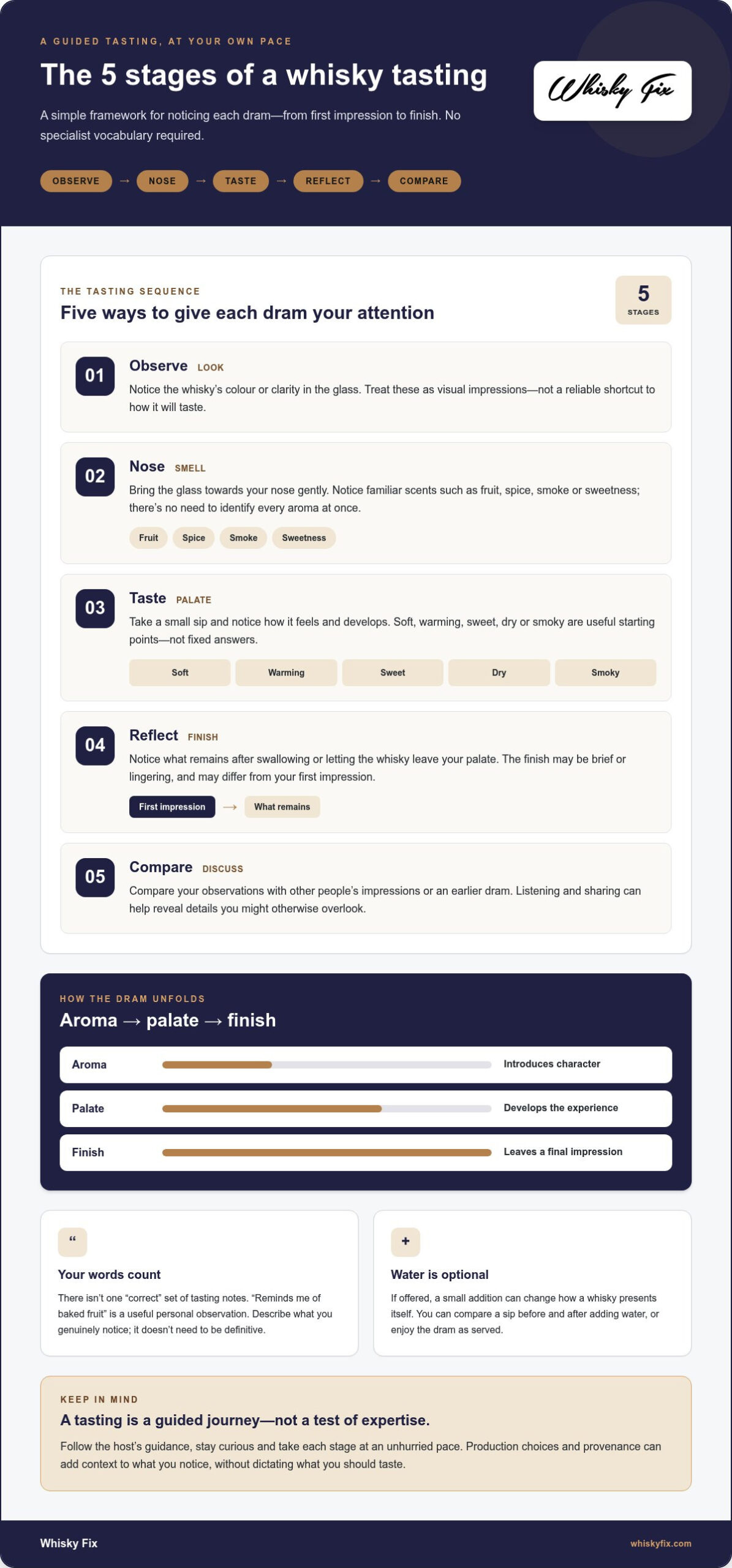
A guided tasting gives you a simple framework for paying attention to a dram without turning it into a test. Move through each stage at an unhurried pace. Your first impression matters, and it may shift as you look, smell and taste more closely.
- Observe. Look at the whisky in the glass and note its colour or clarity. These are visual impressions, not a reliable shortcut to deciding how it will taste.
- Nose. Bring the glass towards your nose gently. Notice familiar scents, perhaps fruit, spice, smoke or sweetness, without trying to identify every aroma at once.
- Taste. Take a small sip and consider how the whisky feels and develops on your palate. Is it soft, warming, sweet, dry or smoky? These are starting points, not fixed answers.
- Reflect. Notice what remains after swallowing or letting the whisky leave your palate. The finish may feel brief or lingering, and its character can differ from your first impression.
- Compare. Consider how your observations differ from those of others or from an earlier dram. Discussion can help you notice details you might otherwise overlook.
Water may be offered as an optional adjustment during a tasting. A small addition can change how a whisky presents itself, so you might compare a sip before and after adding water if the host suggests it. It isn’t a requirement; enjoy the dram as served if you prefer.
How to notice aroma and flavour without overthinking
Start with familiar associations rather than searching for specialist language. A gentle nosing can reveal different layers as you return to the glass, but people won’t necessarily perceive the same scents. Your impressions may also change as you focus on a particular quality. Stay curious and treat your notes as observations, not a verdict on the whisky.
Why whisky origin and production add context
Sensory impressions become more meaningful when you learn about a whisky’s distillery, maturation and provenance. These details offer context for its character without dictating what you should taste. Scottish whisky has a rich distilling heritage, and exploring the Scotch whisky distilleries guide can help you understand how place and production inform a dram.
Follow the host’s guidance, then give yourself room to form your own view. To put this approach into practice, explore Whisky Fix tasting events, hosted by an independent whisky specialist based in Oban, Scotland.
Which Whisky Tasting Event Format Suits Your Interests?
Whisky tasting events can be shaped around different learning aims. Some offer a welcoming introduction, while others explore a particular style or trace a whisky’s origins and production. These are broad approaches, not fixed event categories. Read the description for clues about the subject, level of detail and role of discussion, then choose what best fits your curiosity and confidence.
This comparison can help you identify the experience you’re looking for:
| Approach | Learning focus | Interaction | Attendee experience |
|---|---|---|---|
| Guided introduction | Foundational tasting observations and accessible whisky context | Host-led prompts, with space for questions | A considered starting point for newcomers or anyone refreshing the basics |
| Style-led exploration | Similarities and contrasts between whiskies sharing a style or characteristic | Comparative discussion guided by the presenter | A way to refine preferences and notice how individual drams differ |
| Provenance-led discussion | Distillery, maturation, production and regional context | More detailed conversation about the story behind the whisky | A deeper exploration for attendees keen to connect character with origin |
Choose by your whisky experience and learning goal
If you’re new to whisky, look for descriptions that promise a clear introduction or guided fundamentals. These suggest the experience will build understanding as it goes, rather than assume specialist knowledge. Enthusiasts may prefer a description that foregrounds provenance, maturation or production, offering more context to consider alongside each dram. The best fit is the one that answers a question you’re genuinely curious about.
Choosing an experience as a gift? Think about the recipient’s interests and comfort level. Someone just beginning to explore whisky may enjoy a welcoming introduction; a keen enthusiast might value a deeper subject to investigate. A thoughtful match matters more than choosing what sounds most advanced.
Choose by whisky styles, regions, or stories
A tasting may bring together whiskies with a shared style, regional connection or production story. Comparing them makes the theme tangible: notice what seems similar, then consider where each dram differs in aroma, flavour or finish. The aim isn’t to force a conclusion, but to use contrast to sharpen your own preferences. For foundational context on the category, explore this single malt Scotch whisky guide.
Before settling on an event, ask yourself what you’d most like to learn. Do you want a first orientation, a clearer sense of the styles you enjoy, or a closer look at how origin and production shape a whisky? That question can help you choose an experience that feels engaging rather than intimidating, with a level of detail that suits you.
How to Prepare for a Whisky Tasting and Take Part Confidently
You don’t need to study whisky in advance to feel at ease at a tasting. A little preparation can help you settle in, follow the host’s guidance and remember what interested you. Start with the event description and any practical information provided for attendees. Follow those specific instructions rather than assuming every tasting is run the same way.
What to know before you attend
Review the event details so you understand its subject and any attendance guidance. Arrive ready to listen, notice your own impressions and join the discussion if you wish. Ask questions about the whisky or the host’s explanation. There’s no single correct vocabulary for flavour: plain, honest descriptions are more useful than terms you don’t feel comfortable using.
A short checklist can keep your attention on the experience:
- Bring curiosity. Consider what you’d like to discover, whether that’s a new style or more context about whisky.
- Observe attentively. Give each sample your attention rather than rushing to a conclusion.
- Make a few notes. Record a word, aroma or comparison that stands out, using language that feels natural to you.
- Discuss respectfully. Listen to other impressions and share yours without treating any one description as the definitive answer.
- Follow event guidance. Use the practical attendance information provided for that specific tasting.
Notes don’t need to be elaborate. A few words such as “dried fruit,” “gentle smoke” or “more warming than the last dram” can help you recall what caught your attention. They also give you a starting point for comparing impressions during the conversation. If your view changes after hearing the host or another attendee, add to your notes rather than feeling you need to replace your first response.
How to taste thoughtfully and responsibly
Let the host set the pace, and give yourself time to consider each sample instead of trying to analyse everything at once. Treat tasting as an opportunity to pay attention, not a test of expertise or memory. It’s perfectly reasonable to listen quietly, ask a relevant question or describe a flavour in everyday terms. The value lies in thoughtful participation, not in producing polished tasting notes.
Keep your attention measured throughout the experience and follow any instructions given by the event host. Whisky contains alcohol, so drink responsibly and observe applicable age requirements. Taking part doesn’t depend on finishing every sample or having an opinion on demand; engage in a way that feels considered and respectful of the setting.
Ready to put these ideas into practice? Explore Whisky Fix tasting events for a guided opportunity to learn about whisky through attentive tasting and discussion.
Explore Whisky Tasting Events with Whisky Fix
A guided tasting can turn curiosity into a more considered understanding of whisky. Whisky Fix is an independent specialist retailer based in Oban, Scotland, and hosts professional tasting events. Its focus on single malt Scotch and whiskies from around the world brings a broad specialist perspective to exploring what’s in the glass. The purpose is not to prescribe what you should taste, but to connect your own impressions with knowledge of a whisky’s character and origins.
Why a specialist perspective can deepen a tasting
Flavour is one part of a whisky’s story. Specialist context can help make sense of how a dram’s character relates to its provenance and production, giving you more to consider as you taste. Whisky Fix’s base in Oban places it in Scotland, a country with a rich whisky heritage, while its interest in whiskies from around the world encourages a wider view of the category.
This perspective is useful whether you’re beginning to explore Scotch or already enjoy comparing whiskies. Learning about origin doesn’t dictate what you should find in a glass; it adds another lens through which to understand it. A detail about a whisky’s background might give you a new question to consider, while your own response remains personal. That balance between knowledgeable guidance and individual discovery makes specialist-led tasting rewarding.
Choose your next step after reading
Continue learning at the level that interests you. If you’d like to strengthen your foundations, the single malt Scotch whisky guide offers further context for exploring this distinctive category. Reading can give you useful background, while a guided tasting offers an opportunity to connect knowledge with direct experience.
As you explore, consider what you’d most like to understand next: the character of single malt Scotch, the influence of provenance, or the range of whiskies made around the world. A clear question gives your learning direction without making it feel like study. Build familiarity gradually, returning to the details that capture your interest and letting your preferences develop over time.
Explore Whisky Fix tasting events for a professional, specialist-led way to deepen your appreciation of whisky.
Let Your Curiosity Shape the Next Dram
Choose tasting events as opportunities to discover, compare and refine your perspective. A detail that surprises you, or a dram you remember afterwards, can offer a new direction for your whisky journey.
Ready to take that next step? Explore Whisky Fix tasting events and find an inviting way to continue discovering whisky. Approach the experience with an open mind, and let each dram teach you something new.
Frequently Asked Questions
What happens at a whisky tasting event?
A whisky tasting event usually combines guided sampling with information about the whiskies being explored. The host may introduce a theme, share relevant background and invite attendees to discuss what they notice. The emphasis can differ between events, so the description gives you a sense of its focus. Join the conversation, listen and learn, or do a little of both.
Do I need to know about whisky before attending a tasting?
No prior whisky knowledge is needed. You can arrive without knowing distillery names or production terms and still take part fully. If the host uses an unfamiliar word, ask what it means or listen for the explanation in context. It may also help to consider whether you tend to enjoy sweeter, smokier or lighter flavours.
How do you taste whisky at a guided event?
Take a small sip and give yourself a moment before deciding what you think. Notice how the whisky feels on your palate, whether one sensation stands out, and what impression remains afterwards. If you’re unsure, compare your first response with another sip rather than reaching for a definitive label. Follow the host’s guidance, and remember that adding water is optional.
Can beginners enjoy a Scotch whisky tasting?
Yes. A Scotch whisky tasting can suit beginners who are curious about the spirit, even if they have only tried whisky occasionally. You don’t need to arrive with a favourite region or style. It may help to think about what you generally enjoy in food or drink, such as fruit, spice or richer flavours, then see whether those preferences help you understand your response to the whiskies.
What should I look for when choosing a whisky tasting event?
Choose an event whose subject and level of detail match what you hope to learn. A clear introduction may suit you if you’re starting out; a focused exploration of style or provenance may appeal if you want a deeper subject. Consider whether you’d enjoy a mostly host-led experience or discussion with attendees. These details can help you judge whether the event feels approachable and relevant.
Are whisky tasting events suitable as gifts?
Whisky tasting events can make a thoughtful gift for someone interested in learning about whisky or discovering new styles. Think about the recipient’s curiosity and comfort with guided experiences rather than assuming they need to be an enthusiast. For someone new to whisky, an accessible introduction may feel more inviting than a highly specialised subject. A tasting can also give you a shared experience to talk about afterwards.
How can I get more from a whisky tasting without specialist vocabulary?
Describe what you notice in ordinary language and be as specific as you can. You might say a whisky reminds you of a familiar fruit, feels warming or leaves a dry impression. Those details give you something useful to compare, even without formal tasting terms. If another person uses a technical word, ask what it means; you can learn the vocabulary gradually while keeping your own observations at the centre.