
- September / 22 / 2026
Whisky Collection Valuation Guide: How to Value Rare Bottles in 2026
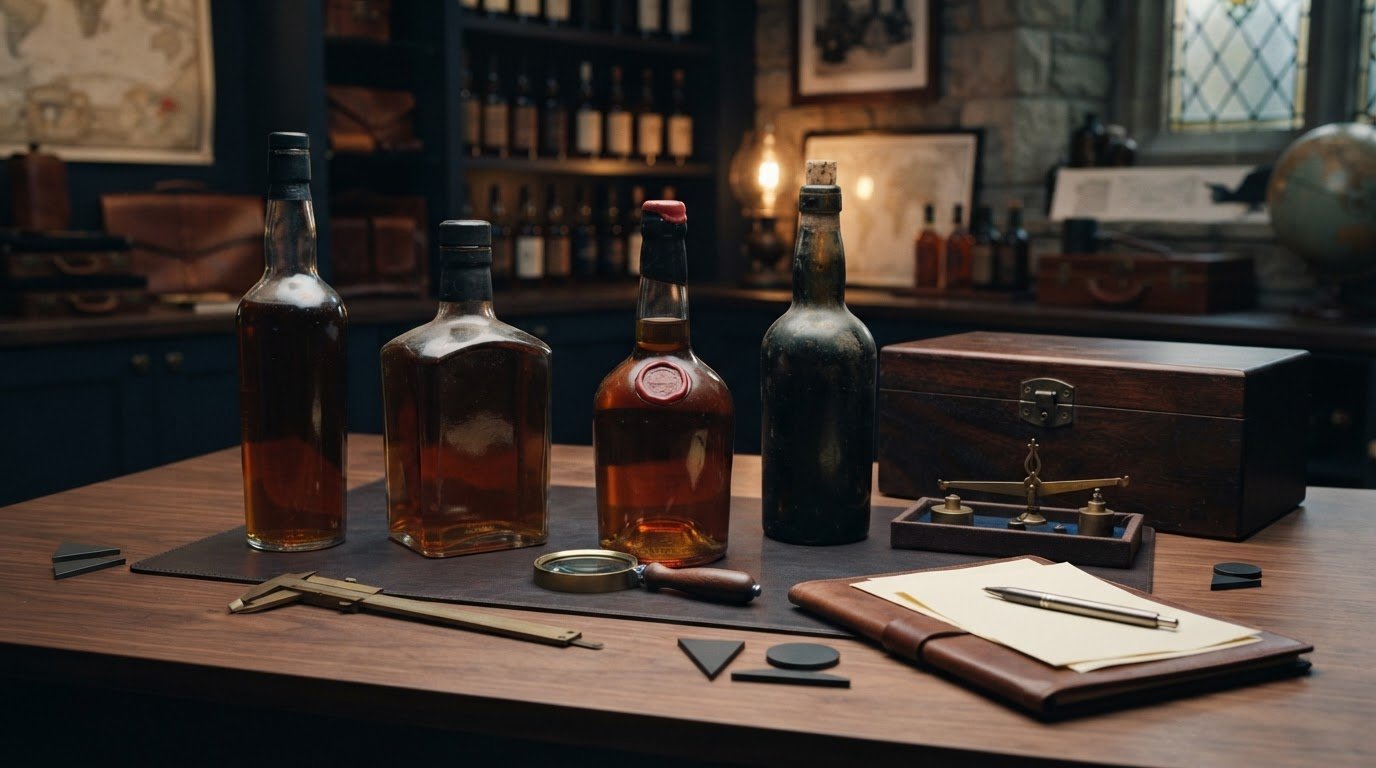
A single centimeter of evaporated spirit can strip 25% off a rare bottle’s market value before the auction hammer even falls. If you own collectible single malts, you already know how deceptive theoretical retail prices can be. Finding an ambitious merchant listing doesn’t mean cash in the bank, especially when market corrections and auction premiums separate listed figures from true secondary realization. Whether you’re cataloguing an inherited cellar or auditing a private reserve, this whisky collection valuation guide cuts through the noise to establish what your bottles are genuinely worth today.
You’ll learn the exact appraisal methodology experienced collectors and specialist merchants use to inspect physical condition, measure ullage accurately, and gauge real liquidity across different distillery tiers. We’ll walk you through an objective appraisal process that contrasts gross replacement costs against net realizable proceeds, giving you the clarity needed to insure, expand, or sell your rare expressions with complete confidence.
Key Takeaways
- Distinguish between retail replacement costs and actual secondary hammer prices to determine realistic net liquidation proceeds.
- Identify how physical variables like fill level, capsule integrity, and original packaging directly impact collector appeal and price realization.
- Follow our step-by-step whisky collection valuation guide to audit distillation years, bottling dates, and historical auction data systematically.
- Understand distillery tier dynamics and market liquidity to benchmark trophy bottles against accessible drinking expressions.
- Apply proper cellar storage standards and record-keeping protocols to safeguard bottle condition and support agreed-value insurance policies.
Understanding Whisky Valuation: Replacement Cost vs Secondary Market Value
Establishing bottle worth begins with understanding that value isn’t a fixed figure. The price printed on an original till receipt rarely dictates secondary collector demand years later. Market dynamics in 2026 reflect disciplined buying habits, where speculative premiums have cooled in favor of proven liquid quality. Accurate appraisals weigh four core variables: distillery prestige, age statement, physical preservation, and liquid rarity within established single malt Scotch whisky classifications. Any practical whisky collection valuation guide must separate what an expression costs to acquire from what it actually yields when liquidated.
The Three Tiers of Whisky Valuation
An objective appraisal categorizes worth into three distinct financial benchmarks:
- Retail Replacement Value: The gross cost required to purchase an identical bottle immediately from a specialist spirits merchant or premier saleroom, including applicable buyer premiums and delivery taxes. This figure forms the basis for specialized, agreed-value insurance schedules.
- Fair Secondary Market Value: The gross hammer price achieved in an open auction between willing buyers and sellers. This benchmark reflects actual competitive bidding on any given day.
- Net Liquidation Proceeds: The net cash you deposit after deducting saleroom commissions, listing fees, transport insurance, and merchant processing charges.
Why Retail List Prices Are Not Market Value
Browsing online inventory often provides a distorted view of your holdings. Unsold merchant listings frequently reflect aspirational margins rather than settled trades. A discontinued single malt may sit in an online showcase for years at an inflated figure without attracting a single motivated buyer.
Secondary liquidity depends entirely on genuine collector appetite. What a retailer hopes to achieve on the shelf means very little; what an active collector bids when the hammer falls establishes real-world worth. When utilizing a whisky collection valuation guide to benchmark your portfolio, verified secondary transactions must always take precedence over static asking prices.
Key Physical Factors That Determine a Bottle’s Value
Two identical bottles from the same distillation year can realize wildly different hammer prices based purely on physical condition. Novice collectors often assume that a famous name guarantees full market value. Specialist merchants and auctioneers know better. Preserving liquid levels, pristine closure seals, and complete original packaging dictates whether an expression realizes its full market potential. When evaluating historical expressions of rare scotch, condition grading forms the bedrock of every professional appraisal.
Assessing Fill Level and Ullage
Ullage refers to the headspace between the liquid and the closure. Because spirits must be stored upright to prevent high-proof alcohol from eroding the cork, slow evaporation naturally occurs over decades. This fill level provides vital evidence regarding closure integrity and air contact.
Industry standard appraisal tiers penalize evaporation heavily:
- Into Neck: Retains 100% of expected market valuation. The liquid sits firmly within the bottle neck, indicating an airtight seal.
- High Shoulder: Triggers an immediate discount to roughly 75% of peak value. Air has entered the chamber, though oxidation remains modest.
- Mid Shoulder: Drops market realization to approximately 60%. Collectors view this level as a drinking bottle rather than an investment-grade asset.
- Low Shoulder to High Body: Reduces secondary worth to 20% to 45%. Severe cork degradation has occurred, risking flattened aromas and off-notes.
Capsule, Seal, and Label Integrity
Closures require careful scrutiny under direct light. Vintage lead capsules are prone to fatigue and tearing, while contemporary wax seals frequently develop micro-fissures from environmental fluctuations. Any hairline fracture or signs of adhesive tampering can indicate refilling. Labels must also be inspected for cellar dampness, mold foxing, or ultraviolet bleaching. Valuers verify that batch codes, fill volumes, and vintage declarations adhere to legal standards like the Scotch Whisky Regulations 2009 to confirm genuine provenance.
Original Packaging and Documented Provenance
Packaging represents far more than cosmetic presentation. Missing a branded wooden case, an outer transit carton, or a hand-numbered certificate can penalize a bottle’s valuation by 15% to 30%. Serious salerooms require unbroken chains of ownership. Original retail invoices, historic merchant receipts, and documented cellar storage records reassure buyers, cementing top-tier secondary realization. If you are examining your own holdings or seeking museum-grade expressions with impeccable storage history, explore verified bottlings at Whisky Fix to benchmark industry standards.
Step-by-Step Methodology: How to Value Your Whisky Collection
Accurate appraisals require a methodical system rather than casual online searches. Automated database matches often overlook minor label variants, regional export proofs, or physical wear that alter market worth. Follow this three-step whisky collection valuation guide to establish an authentic baseline for every bottle in your cellar.
Step 1: Build a Detailed Bottle Inventory
Every reliable valuation begins with an exhaustive audit. Create a digital spreadsheet to log specific manufacturing details across every expression:
- Identity & Heritage: Record the distillery name, official age statement, vintage year, and exact bottling year.
- Technical Specifications: Document alcohol by volume (ABV), stated bottle volume (e.g., 70cl vs. 750ml), cask type, individual cask number, and specific bottle numbers from limited single-cask runs.
- Photographic Archive: Capture high-resolution photographs under neutral lighting. Frame the front and back labels, capsule closures, fill levels, base glass markings, and matching presentation cases.
Step 2: Cross-Reference Secondary Market Databases
Consult historical auction databases such as Whiskystats alongside recent results from major European salerooms. Generic search queries will misrepresent your bottle’s true worth. Instead, filter your search criteria rigorously:
- Match the exact ABV percentage; export releases bottled at 43% often command vastly different prices than domestic 40% expressions.
- Identify subtle label iterations, such as font alterations or royal warrant seals, which delineate valuable early batches from modern standard editions.
- Exclude artificial price spikes caused by rogue bidding duels or non-paying buyers, taking a rolling average of the last three to six clean sales instead.
Step 3: Calculate Net Realizable Market Value
Gross auction hammer figures represent the buyer’s clearing bid, not your personal payout. To calculate actual proceeds, deduct platform friction from the gross hammer estimate. Major auction houses impose seller commissions typically ranging between 2.5% and 10%, alongside listing fees, reserve charges, and optional loss-and-breakage assurance fees. Secure transport costs and courier insurance will further reduce your total realization.
In jurisdictions like the United Kingdom, HMRC exempts bottled spirits as non-wasting chattels for gross disposal amounts of £6,000 or less per item under section TCGA92/S262. Disposing of complementary sets or bottles valued above that threshold may incur taxes against individual allowances. Subtracting these operational expenses gives you a reliable net liquidation figure alongside a realistic reserve threshold.

Distillery Hierarchy and Category Dynamics in Modern Valuations
Every bottle’s liquidity traces back to its birthplace. While maturation style and cask type influence flavor profile, distillery pedigree drives secondary market resilience. The modern market operates on a distinct hourglass model: capital flows toward apex trophy assets or settles into high-turnover drinkers’ bottles, leaving mid-tier speculative releases vulnerable to corrections. Discerning where an expression sits across single malt scotch whisky classifications helps valuers distinguish genuine liquid gold from slow-moving shelf stock.
Blue-Chip Distilleries vs Emerging Producers
Certain Scottish icons command sustained global liquidity regardless of broader economic fluctuations. Distillers such as The Macallan, Springbank, Bowmore, and select vintage Ardbeg releases act as blue-chip equities in the secondary saleroom. Their liquid trade is supported by deep institutional and connoisseur interest, ensuring ready buyers at realistic market prices.
Beyond these stalwarts, secondary demand varies sharply by provenance. Reviewing traditional scotch whisky distilleries reveals regional variations: heavily peated Islay single malts and small-batch Campbeltown bottlings frequently outpace standard core expressions from prolific Speyside producers. Meanwhile, modern craft distillers face an uphill battle. Without decades of auction data or aged inventory to substantiate prestige, contemporary independent releases must rely strictly on small outturns and exceptional cask management to build secondary traction.
The Premium on Silent and Lost Distilleries
Bottles hailing from silent distilleries occupy a revered category in any whisky collection valuation guide. Facilities shuttered during the major industry rationalization of 1983, most notably Brora, Port Ellen, and St. Magdalene, produce a finite pool of available liquid that contracts every time a cork is pulled. That mathematical scarcity anchors high valuations.
Valuers must separate original, pre-closure bottlings from modern revival releases. While resurrected distilleries like Rosebank and Brora have fired up their stills once more, modern output carries entirely different market mechanics. Collector premiums remain concentrated on historic vintage stock distilled prior to closure, where irreplaceable yeast strains, floor maltings, and legacy worm tubs forged the original profile. If you want to benchmark museum-grade rarities against current global demand, browse authenticated rare single malts at Whisky Fix to inspect genuine collectible inventory.
Curating, Insuring, and Refining Your Whisky Holdings
Completing a thorough audit is only the midpoint of responsible cellar stewardship. The ultimate purpose of this whisky collection valuation guide is to help you protect, manage, and refine your portfolio over time. Turning appraisal figures into lasting security requires active risk management, strict conservation standards, and deliberate portfolio refinement.
Securing Specialized Insurance for Rare Spirits
Relying on standard household contents insurance presents serious financial vulnerabilities. Mainstream domestic policies frequently impose strict single-item limits of £1,000 to £2,500, often explicitly excluding spirit evaporation, cork failure, and transit breakage. If an unrecorded shelf fails, standard policies rarely pay full value.
Serious collectors secure specialized, agreed-value fine art and spirits riders. These underwriting contracts bypass theoretical depreciations by pre-agreeing on fixed compensation figures per bottle. To keep coverage valid, submit up-to-date photographic audits alongside itemized spreadsheets, scheduling full reappraisals every two to three years to align coverage with secondary index movements.
Storage Standards to Protect Future Valuation
Careless environmental conditions quietly destroy market worth long before you consign a bottle to auction. Protect your investment by following strict cellar controls:
- Vertical Placement: Always keep bottles upright. Unlike wine, high-strength spirit constantly degrades natural cork, leading to catastrophic rot and severe ullage over time.
- Temperature Stability: Maintain temperatures between 12°C and 18°C. Frequent thermal fluctuations expand the liquid volume, straining capsules and creating micro-leaks around the stopper.
- Light & Humidity Safeguards: Store bottles in dark spaces away from direct sunlight, which bleaches inks and ruins presentation cartons. Aim for relative humidity around 50% to 60% to stop corks drying out without encouraging label mildew.
Rebalancing Your Collection with Verified Specialists
Appraisal results often reveal deadweight in your holdings, such as speculative modern bottlings or redundant multiples that show little liquidity. Pruning these stagnant expressions frees up capital to acquire true cornerstone releases from iconic distilleries.
When refining a reserve, buying from reputable sources eliminates the counterfeit risks found in peer-to-peer markets. Independent specialists inspect every wax seal, print code, and label alignment before listing an item. Explore authenticated old and rare single malts at Whisky Fix today to secure verified expressions backed by careful provenance and reliable worldwide shipping.
Mastering Your Rare Whisky Portfolio
Accurate appraisal requires looking past theoretical retail listings to measure genuine secondary hammer prices. As outlined in this whisky collection valuation guide, determining true worth demands strict attention to physical preservation, ullage levels, and verifiable provenance. When you deduct auction fees and preserve your bottles in stable, dark conditions, your collection stands on solid financial footing.
Valuing rare spirits isn’t just about cataloguing past acquisitions; it’s about making deliberate choices for the future. Whether you plan to insure prized vintage releases, divest underperforming expressions, or reinvest capital into museum-grade bottlings, working alongside dedicated specialists ensures your holdings retain their pedigree.
Based in the historic distilling town of Oban, Scotland, Whisky Fix brings decades of hands-on expertise to spirits curation. Our specialists inspect and authenticate every bottling to ensure flawless condition, fill levels, and packaging integrity. Take the next step in refining your collection and discover rare single malt Scotch whiskies at Whisky Fix today, supported by seamless and reliable worldwide shipping straight to your door.
Frequently Asked Questions
How often should I revalue my private whisky collection?
Revaluing your private collection every two to three years is the optimal cadence for active collectors. Secondary spirits markets shift with economic cycles, consumer trends, and distillery release volumes. Scheduling a formal audit ensures insurance replacement figures remain accurate. Applying this whisky collection valuation guide periodically prevents being underinsured during market spikes or overpaying premiums on bottles that have experienced price adjustments.
Will opened or sampled whisky bottles hold any secondary market value?
Opened or sampled whisky bottles forfeit virtually all commercial investment value. Commercial auction houses and specialist retailers strictly refuse unsealed bottles due to food safety regulations and tampering risks. While rare decanters or historical packaging retain modest interest as decorative display items, the liquid itself cannot be verified or legally resold. Enjoy unsealed bottles with friends or utilize them during private tasting sessions instead.
Why do auction estimates differ from online retail list prices?
Auction estimates represent the expected hammer price between active bidders, whereas retail prices include merchant margins, overheads, and long-term storage costs. A retailer might list a rare bottling at a high figure to wait for an eager private buyer. In contrast, an auction clears within days. Valuers rely on hammer data because it proves what someone actually paid rather than an aspirational asking price.
How much value does a whisky bottle lose if the box is missing or damaged?
Missing or damaged packaging typically deducts between 15% and 30% from a bottle’s secondary value. For modern limited editions or single-cask releases, collectors expect pristine presentation boxes, numbered certificates, and outer transport sleeves. Missing containers immediately push a bottle into the drinking category rather than investment grade. Highly sought antique bottles from the early twentieth century suffer less, as surviving packaging is exceptionally rare.
What is bottle ullage and how does it impact valuation?
Bottle ullage refers to the empty headspace between the spirit and the closure caused by natural evaporation. Fill levels dropping below the neck signal compromised cork seals and potential oxidation. In our whisky collection valuation guide, a high-shoulder level reduces realizable value by 25%, while mid-to-low shoulder levels can wipe out 40% to 80% of hammer value, rendering the bottle risky for serious collectors.
Can I use standard home contents insurance to cover high-value whisky?
Standard home contents insurance rarely provides adequate protection for fine whisky collections. Most domestic policies cap payouts with strict single-item limits between £1,000 and £2,500, while excluding accidental bottle breakage, spirit leakage, and gradual ullage. High-value collections require dedicated agreed-value fine art or spirits insurance riders. These specialist policies guarantee fixed payouts based on itemized appraisal spreadsheets and high-resolution photographic evidence without arbitrary depreciation.
Do independent bottlings hold value as well as original distillery releases?
Independent bottlings generally trade at a discount compared to original distillery releases, though select single casks perform exceptionally well. Historic independent bottlers like Gordon & MacPhail, Cadenhead’s, and Samaroli command strong secondary appeal due to exceptional liquid quality and cask curation. However, casual collectors still favor official distillery bottlings for liquidity, making pedigree and vintage selection far more critical when evaluating independently bottled expressions.