

- October / 2 / 2026
Whisky Cask Investment Alternatives: 2026 Buyer’s Guide
What if the best alternative to whisky cask investment isn’t another investment at all? A cask offers a direct connection to whisky as it matures, but ownership can also involve unfamiliar decisions about management, storage and resale. If those responsibilities feel more complicated than compelling, consider other ways to engage with whisky.
The right choice depends on what you want: to own whisky, pursue a financial objective or simply enjoy exploring it. This guide compares bottle collecting, whisky experiences and other asset categories by purpose, complexity, control and risk. Past performance and projected returns are never a promise of future results.
You’ll also learn how owning bottles differs from owning a cask, and why tastings can reward curious drinkers who value discovery over asset management. Whether you’re drawn to rare expressions or would rather deepen your knowledge one dram at a time, use this guide to find an approach that fits your interests and appetite for complexity.
Key Takeaways
- An alternative to whisky cask investment could mean owning bottled whisky, enjoying tastings or exploring a different asset category. Start by identifying what you want from the choice.
- Bottles offer direct ownership of whisky, while casks involve a different form of ownership and management. Neither guarantees financial gain.
- Compare casks, bottles, gold, fine art and conventional financial assets by the control, expertise, storage and exit considerations each may involve.
- Use a five-step framework to clarify your goal, set boundaries, compare ownership, assess evidence and make a considered decision.
- If exploration matters more than managing an asset, whisky tastings offer an experience-led way to deepen your appreciation.
What does “alternative to whisky cask investment” actually mean?
An alternative to whisky cask investment could mean staying connected to whisky while changing how you engage with it, or choosing an entirely different asset category. The distinction matters: owning a cask means holding an interest in whisky maturing in wood, while buying a bottle gives you ownership of a finished, bottled whisky. Neither form of ownership guarantees financial gains.
Whisky may appeal for its provenance, distillery character and craft. A financial objective is different: it centres on potential returns and the risks of pursuing them. Collectors may value rarity or personal interest; drinkers may want a bottle to open and share; others may prefer guided tastings without owning whisky. Whisky collecting is sometimes grouped with alternative investments, but a category label doesn’t establish an asset’s value or suitability.
Start by asking what you want to replace: the whisky itself, the experience of ownership or the possibility of financial exposure. Your answer helps you decide whether to consider bottles, tastings or assets outside whisky. This guide provides general comparisons, not personal financial or tax advice.
What do people hope to replace when they avoid cask ownership?
Some people are drawn to whisky’s character and history; others focus on potential financial returns. You may also want to own something tangible, avoid the involvement of managing a cask or have more direct control over what you buy and keep. These aims can point in different directions. A bottle may suit someone who wants to choose and enjoy a particular expression, while a tasting may better serve someone whose priority is discovery. Neither guarantees an investment outcome.
Is collecting whisky bottles the same as investing in whisky?
No. Buying a bottle gives you ownership of that bottled whisky, not a claim on a cask or its maturing spirit. Bottle collecting can be driven by interest in a distillery, provenance, design or the pleasure of exploring different styles. A collector may also consider financial prospects, but that is a separate objective, not an automatic feature of collecting. Rarity or age alone doesn’t establish future value, buyer interest or resale demand. Treat these characteristics as details to research, not assurances.
Bottle collecting and whisky experiences: the closest whisky-focused alternatives
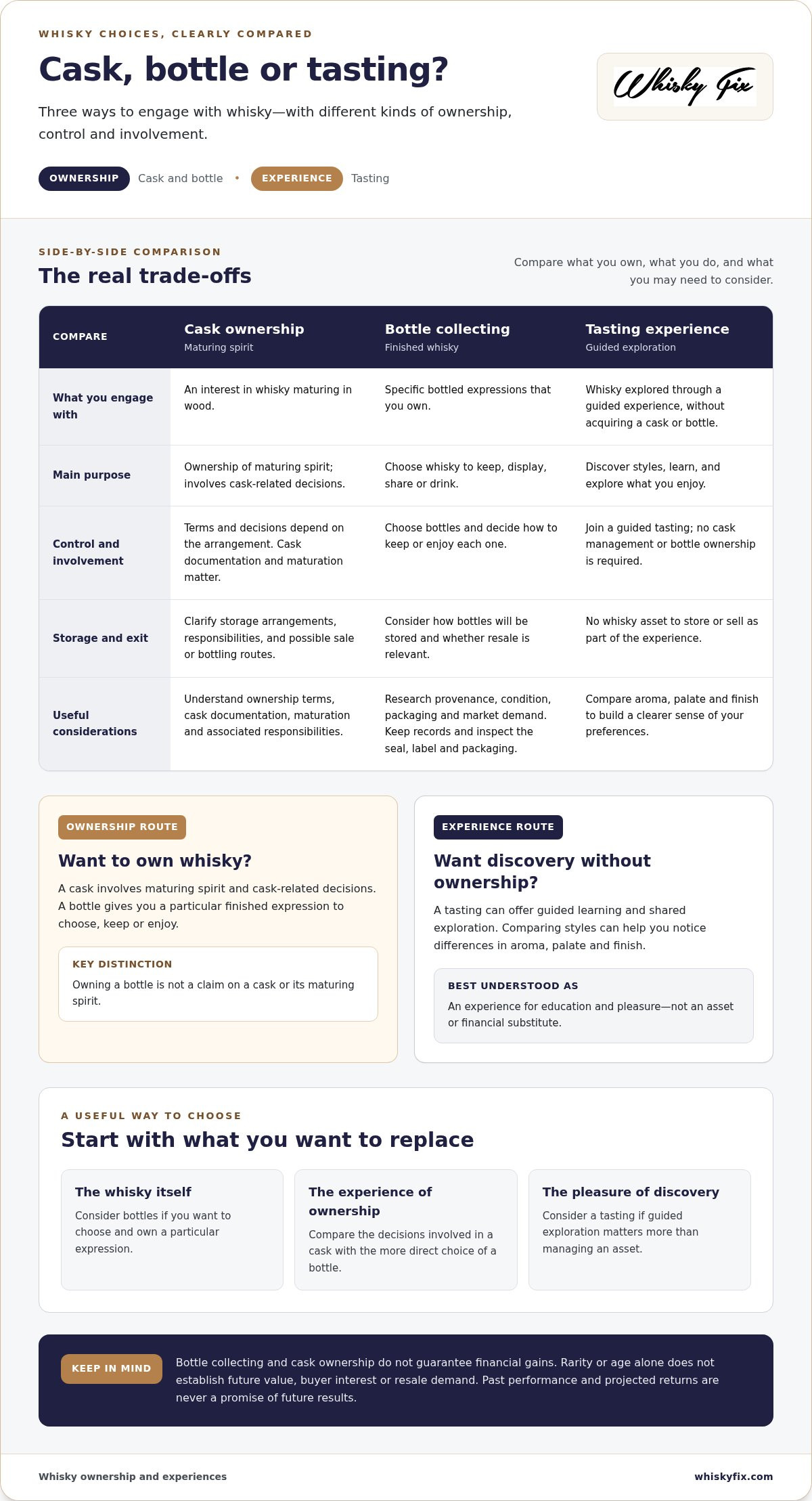
If you want to stay connected to whisky without taking on cask ownership, bottles and tastings offer two distinct paths. A bottle gives you a specific, finished expression to keep, display, share or drink. A tasting gives you a guided opportunity to explore whisky without acquiring an asset. Neither should be assumed to deliver financial returns.
| Option | Purpose | Control and involvement |
|---|---|---|
| Cask ownership | Own an interest in maturing spirit | Involves cask-related management and decisions |
| Bottle collecting | Own particular bottled expressions | Choose, store and decide whether to display, share or drink each bottle |
| Tasting experience | Explore and learn about whisky | Join a guided experience without owning a cask or bottle |
What can bottle collecting offer instead of a whisky cask?
A bottle is a defined expression of whisky, ready to enjoy or keep. You can select by distillery, style, age statement or personal interest, and build a collection at your own pace. That direct control can make bottle collecting a practical alternative to whisky cask investment if your priority is owning whisky rather than managing maturing spirit.
For collectors, provenance, condition, packaging and market demand are useful research considerations. Keep records of where a bottle came from, and inspect its seal, label and packaging. These details can inform your assessment, but they don’t guarantee authenticity, future value or resale interest. The Scotch Whisky Association offers background on Scotch whisky, its production and its protection.
When is a tasting experience a better fit than buying an asset?
Choose a tasting if discovery, guided learning or sharing an experience matters more to you than ownership. Comparing styles side by side can help you notice differences in aroma, palate and finish, and develop a clearer sense of what you enjoy before choosing bottles to collect. A tasting is for education and pleasure, not an asset or financial substitute.
If you’re exploring bottles, the rare Scotch collector’s guide offers a useful next read. For direct ownership centred on enjoyment, browse whisky bottles from Whisky Fix, a specialist retailer in Oban, Scotland.
Whisky casks, bottles and other assets: compare the real trade-offs
A useful comparison looks beyond the asset’s name. Consider what you own, which decisions you control, what knowledge and storage it may require, and how an eventual sale could work. An alternative to whisky cask investment might still involve a tangible collectible, such as a bottle, gold or fine art, or it might involve conventional financial assets. These are distinct categories, not interchangeable choices or recommendations.
| Asset category | Control and expertise | Storage and exit considerations |
|---|---|---|
| Whisky cask | Ownership terms and decisions depend on the arrangement; understanding cask documentation and maturation matters. | Clarify storage arrangements, associated responsibilities and possible routes to a sale or bottling. |
| Bottled whisky | You own a defined finished expression and can decide whether to keep, display or drink it. | Consider storage conditions, provenance, packaging and whether interested buyers exist. |
| Gold | Physical gold and financial products linked to gold involve different forms of ownership and expertise. | Holding arrangements and possible sale processes depend on the form chosen. |
| Fine art | Assessment can involve subject-specific knowledge and evidence about the work. | Consider appropriate care, documentation and how a sale would be arranged. |
| Conventional financial assets | Shares, bonds and funds have their own structures, terms and risks. | Access and transaction arrangements depend on the specific product and account. |
How do bottles differ from casks in ownership and involvement?
A bottle is a finished, identifiable item. A cask contains spirit that continues to mature and may involve additional ownership and management arrangements. That difference affects what you can control and what you need to understand, but it doesn’t mean one is always easier to sell. Before committing funds to either, examine the actual ownership terms, documentation, storage responsibilities and potential exit process. Provenance and condition can inform your assessment, while buyer demand remains uncertain.
How do non-whisky alternatives differ from collectible spirits?
Physical gold or fine art may involve holding and caring for a tangible object. Conventional financial assets are structured differently and may be accessed through financial products or accounts. The Guide to Alternative Investments from the DC Department of Insurance, Securities and Banking provides context on alternative-investment structures and risks. Access, regulation, valuation and holding arrangements vary by asset and jurisdiction. Financial products and tax treatment also differ across jurisdictions, so seek qualified financial guidance for individual portfolio or tax decisions.
Choosing Alternatives to Whisky Cask Investment
A clear decision starts with your purpose, not a return claim. The best alternative to whisky cask investment depends on whether you’re seeking financial exposure, collecting, drinking, learning or choosing a gift. Work through these five steps before committing funds.
- Define the goal. Name the outcome you want. Is it a financial objective, a bottle to enjoy, a collection built around provenance, a guided tasting or a thoughtful gift? Ask what would still make the purchase worthwhile if you never resell it.
- Set your boundaries. Decide what you can afford to lose, how long you’re prepared to hold an asset and how much time or effort you want to spend. Include practical limits, such as storage needs and the complexity you’re comfortable managing.
- Compare ownership. Choose between a physical bottle, a tasting experience or a separate asset category. Consider what you would own, what responsibilities come with it and how much control you’d have over its use or eventual sale.
- Research the evidence. Write down your criteria, then examine documentation, ownership terms and costs. Distinguish provenance records and current asking prices from completed sales. An asking price shows what someone hopes to receive, not necessarily what a buyer has paid.
- Decide without pressure. Compare the option against your original goal and boundaries. Treat projections as uncertain, and scrutinise guaranteed-return promises or urgency-led sales language rather than letting them rush your judgement.
Which questions should shape your decision?
Before choosing, ask yourself: Would I still value this if resale never happened? Do I want to own a bottle, attend a tasting or explore a different asset category? What evidence supports the claims being made, and what responsibilities will I take on? Write down your answers. Clear criteria make it easier to distinguish genuine interest from persuasive sales language and support independent research before any financial commitment.
How can you assess claims without mistaking them for guarantees?
Check what a document actually establishes. Provenance information may describe a bottle’s history, while a current asking price is not proof of a completed sale or a dependable future value. Be cautious of confident projections, promised returns and pressure to act immediately. For tax, legal or regulated-investment questions, consult an appropriately qualified professional in your jurisdiction.
If your priority is choosing bottled whisky to own and enjoy, explore Whisky Fix’s whisky selection.
Explore whisky without owning a cask: a considered next step
The right route depends on what you want whisky to bring to your life. If you enjoy discovering distilleries, styles and provenance, bottle collecting lets you choose a finished expression to keep, share or open. If you’re still developing your palate, a tasting offers guided exploration without the commitment of owning a whisky asset. If your main purpose is financial, consider broader asset categories separately, with qualified advice suited to your circumstances.
These paths serve different priorities. Bottles are for people who want direct ownership and the choice to enjoy what they buy. Tastings centre on learning and experience. Other financial assets have their own structures, risks and considerations. There’s no need to make whisky ownership carry an investment purpose if what draws you to it is the pleasure of exploring the spirit.
How can a specialist retailer support a bottle-led approach?
Whisky Fix is an independent specialist retailer based in Oban, Scotland. Its selection includes single malt Scotch, rare and old expressions, and international spirits. Browsing a specialist selection can help you explore bottles by style and interest, whether you’re choosing one to enjoy or beginning a collection. A bottle’s age or rarity alone doesn’t establish future value, so approach each choice as a matter of taste and informed interest, not a promised return.
When should readers choose a tasting over a purchase?
Choose a tasting if you’d rather learn before deciding what to buy. Guided exploration can help you compare regional styles, consider how production influences character and recognise the flavours you prefer. That knowledge can make later bottle choices more personal and considered, without requiring you to own a cask or build a collection.
For a foundation in the category, read the single malt Scotch whisky guide. Whisky Fix also hosts tasting events for those who want to explore whisky through a shared experience. If your priority is ownership and enjoyment, browsing bottles is a direct alternative to whisky cask investment that keeps the focus on the spirit itself.
Whether you’re looking for a bottle to enjoy, a rare expression to explore or a tasting experience, discover whisky at Whisky Fix.
Choose a Whisky Path That Fits Your Priorities
The best alternative to whisky cask investment depends on what you want from whisky. Bottles offer direct ownership of a finished expression, while tastings let you explore styles and deepen your knowledge without managing an asset. If your goal is financial exposure, compare options carefully and seek qualified advice for decisions that depend on your circumstances.
Let your interest guide the next step. Collect for provenance or personal enjoyment, choose a bottle you’d be pleased to open, or start with a tasting if you’re still discovering your preferences. Whisky Fix is an independent specialist retailer in Oban, Scotland, with a selection spanning single malt Scotch, rare and old expressions, and international spirits. Its tasting events offer another way to explore the category.
Explore Whisky Fix’s specialist whisky selection and find a bottle or tasting experience that suits your interests. There’s no need to rush; a thoughtful choice can make the enjoyment of whisky its own reward.
Frequently Asked Questions
What is the best alternative to whisky cask investment?
There’s no single best option; it depends on what you want from whisky. Bottle collecting may suit someone who wants to own particular expressions, while tastings are a better fit for guided exploration without acquiring an asset. If your goal is financial exposure, compare whisky-related and other asset categories by ownership, expertise, storage and exit considerations. Consider potential losses and seek qualified advice for individual financial or tax decisions.
Are whisky bottles a better alternative to cask investment?
Whisky bottles may be a better fit if you want to own a finished expression and choose whether to keep, display or drink it. A cask is maturing spirit, with different ownership arrangements and responsibilities. Neither option is inherently better, and bottles shouldn’t be treated as guaranteed investments. Consider your purpose, the bottle’s provenance and condition, storage needs, and the uncertainty of future demand before buying.
Can you invest in whisky without buying a cask?
You can buy bottled whisky without owning a cask, but that gives you ownership of the bottle, not a guaranteed investment outcome. Some buyers collect with financial prospects in mind, while others buy for provenance, personal interest or enjoyment. Other financial products may provide different kinds of exposure, but they have their own structures and risks. Research carefully, and seek qualified financial advice before making investment decisions.
Are rare whisky bottles guaranteed to increase in value?
No. Rarity and age don’t guarantee that a bottle will rise in value or attract buyers later. Demand can change, and factors such as provenance, condition and packaging may affect how a bottle is assessed. Asking prices also don’t prove that a sale has taken place at that level. Treat claims about future value as uncertain, and don’t buy a bottle on the assumption that appreciation is assured.
What are the risks of collecting whisky bottles?
Bottle collecting involves the possibility of financial loss as well as practical considerations. Condition can change through poor storage or handling, and provenance may require careful research. A rare or old bottle may not find a buyer at the price you expect, or when you want to sell. Demand can shift, too. Decide whether you’d still value a bottle if resale never happens, and keep collecting within your means.
How does whisky cask ownership differ from buying bottled whisky?
A cask contains spirit that continues to mature, while a bottle holds a finished whisky ready to keep, display, share or drink. Cask ownership involves its own documentation, terms and management considerations. With a bottle, you own a specific bottled expression, though provenance, condition and storage still matter. Before committing funds to either, understand exactly what you own, the responsibilities involved and how a potential sale could work.
Is a whisky tasting experience an alternative to investing in casks?
A tasting is an alternative way to engage with whisky, but it isn’t an investment or a financial substitute for cask ownership. It can suit people who prioritise enjoyment, guided learning and discovering different styles without buying an asset. Comparing aromas and flavours may also help you understand your preferences before choosing bottles to collect. Whisky Fix hosts tasting events for those looking to explore whisky through a shared experience.
Ready to explore whisky without taking on cask ownership? Browse Whisky Fix’s whisky selection or discover its tasting events.