
- September / 19 / 2026
Whiskies of the World: A Connoisseur’s Guide to Global Spirits in 2026
By 2026, the definition of a world-class dram has moved far beyond the borders of the Highlands. While Scotland remains the spiritual home of the industry, the most exciting innovations are now happening in unexpected corners of the globe. You’ve likely felt the pull of a Japanese Mizunara cask or a bold American rye, yet the sheer volume of whiskies of the world can feel like a labyrinth. It’s difficult to tell which bottles represent genuine heritage and which are simply clever marketing. We understand that finding authentic craft in a sea of mass-market brands is a challenge for any serious collector.
This guide will demystify the global landscape of fine spirits. You’ll learn to identify the hallmarks of quality across different regions, gain the confidence to source rare bottles from overseas, and discover how to curate a collection that spans continents. We’ll explore everything from the precision of Japanese blending to the rising stars of the craft movement. Whether you’re looking to host a global tasting or secure a rare international release, our expertise as curators in Oban provides the clarity you need to enjoy these spirits with confidence. We prioritize provenance and authenticity, ensuring your journey through global distillation is as rewarding as it is enlightening.
Key Takeaways
- Understand the transition from Scotch dominance to a multipolar market and why the definition of global spirits is expanding in 2026.
- Distinguish between the traditional resurgence of Irish Single Pot Still and the innovative fast-maturation techniques utilized by distillers in tropical climates.
- Learn to navigate the diverse category of whiskies of the world by identifying authentic craft signatures that separate world-class spirits from mass-market offerings.
- Explore the unique terroir of emerging regions, including high-altitude Indian malts and the wine-cask influences defining the Australian “New World” style.
- Gain practical knowledge on curating a balanced international bar and the importance of specialist sourcing when acquiring rare global expressions.
The Evolution of Global Spirits: Beyond the Borders of Scotland
The historical narrative of grain spirits has undergone a profound transformation. For much of the twentieth century, the industry remained anchored to the traditional powerhouses of Scotland and Ireland. However, we’ve witnessed a shift toward a multipolar environment where excellence is no longer geographically confined. This expansion isn’t merely about volume; it’s about the diversification of the global history and classification of whisky. Digital connectivity and social media have democratized this space, allowing enthusiasts to track rare releases in real-time. A collector in London or New York can now appreciate the nuances of a Nordic craft distillery or a South African malt with the same depth of information once reserved for local experts.
Defining the Global Whisky Landscape
The modern market distinguishes itself through a balance of reverence for the past and a drive for technical innovation. While traditional regions rely on centuries of established protocol, newer producers often experiment with non-traditional wood types and fermentation lengths. This creates a vibrant spectrum of whiskies of the world that caters to a more adventurous palate. We define Whiskies of the World as a category that respects regional laws while pushing flavor boundaries. This classification ensures that while a Japanese malt follows strict internal standards, it still offers a profile distinct from its Scottish ancestors.
The Influence of Terroir and Local Ingredients
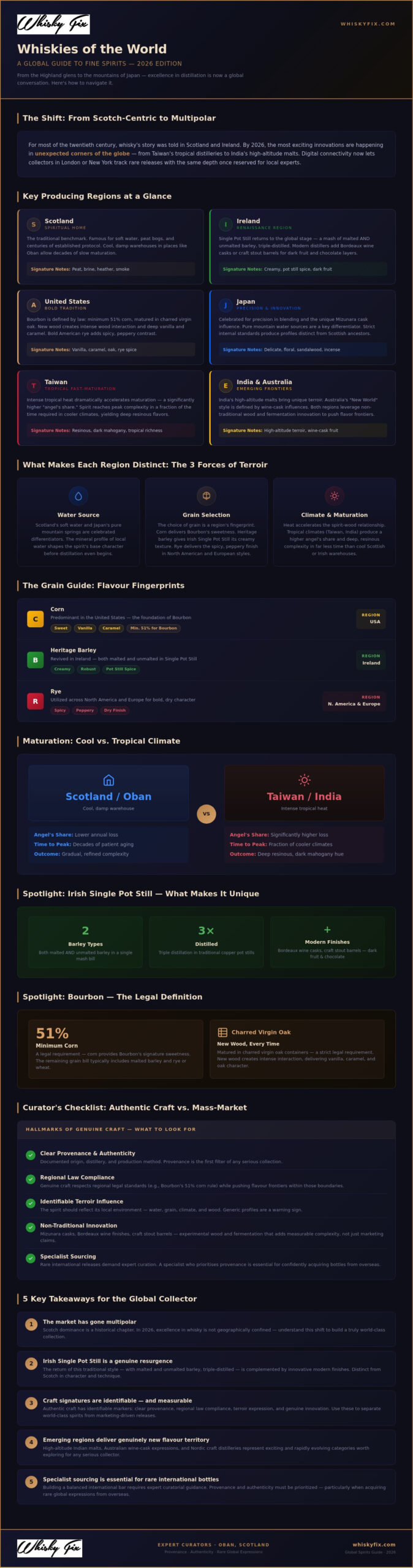
Terroir plays a decisive role in the final character of the spirit. In Scotland, the influence of soft water and peat bogs is legendary, but international distillers use their local environment to create something entirely new. Japanese producers often cite the purity of their mountain water sources as a key differentiator. The choice of grain is equally vital in defining these regional identities:
- Corn: Predominant in the United States, providing the signature sweetness found in Bourbon.
- Heritage Barley: Revived in Ireland to produce creamy, robust textures in Single Pot Still expressions.
- Rye: Utilized across North America and Europe for its spicy, peppery finish.
Climate also dictates the rhythm of maturation. In the intense heat of Taiwan or India, the “angel’s share” is significantly higher than in the cool, damp warehouses of Oban. This accelerated interaction between the spirit and the wood means these whiskies of the world often reach a peak complexity in a fraction of the time required in cooler climates. This rapid maturation creates deep, resinous flavors and a dark mahogany hue that’s impossible to replicate in Northern Europe without decades of aging.
The Pillars of Tradition: Ireland and the United States
Ireland and the United States represent the foundational pillars of international distilling outside of Scotland. While they share historical roots, their technical approaches to production create vastly different sensory experiences. These regions are essential for anyone building a comprehensive collection of whiskies of the world, as they offer profiles that contrast sharply with the peat and brine of the Hebrides. Understanding these differences is the first step toward becoming a true connoisseur. The wood defines the spirit, and for those who wish to celebrate its natural texture, WoodSnap provides a unique way to display distillery photography by printing directly onto sustainably sourced birch wood.
The Irish Whiskey Renaissance
The return of Single Pot Still whiskey to the global stage has revitalized interest in Irish heritage. This unique style uses a mash bill of both malted and unmalted barley, distilled in traditional copper pot stills. This specific method results in a creamy mouthfeel and a characteristic “pot still spice” that is distinct from the cleaner profiles found in The Connoisseur’s Guide to Single Malt Scotch Whisky. Modern Irish distillers are also pushing boundaries by experimenting with innovative finishes. Many producers now utilize Bordeaux wine casks or craft stout barrels to add layers of dark fruit and chocolate to the triple-distilled spirit, creating a more complex and modern flavor profile.
The Bold Spirit of America
Bourbon remains the cornerstone of American spirits, defined by its strict legal requirement of at least 51% corn and maturation in charred virgin oak containers. This reliance on new wood creates an intense interaction between spirit and timber. It delivers the robust vanilla, caramel, and cinnamon notes that enthusiasts prize. Rye whiskey, by contrast, requires at least 51% rye grain, producing a spicy, peppery profile that has seen a massive resurgence among cocktail historians and neat drinkers alike. While Bourbon dominates the conversation, the rise of American Single Malt has introduced a new layer of complexity. Comparing the rarity of allocated Bourbons to Rare Scotch: The Definitive Reference for Collectors reveals a different market dynamic. In the US, provenance and “bottled-in-bond” designations carry significant weight for those seeking the pinnacle of quality.
The primary difference in maturation between these regions lies in the cask selection. Scotch and Irish producers typically favor seasoned casks that once held Sherry or Bourbon. American distillers must utilize virgin oak. This choice accelerates the extraction of wood sugars and tannins, leading to a bolder, more immediate flavor profile. If you’re ready to explore these diverse traditions, our curated collection of whiskies of the world provides a perfect starting point for your next tasting. We focus on sourcing expressions that represent the absolute peak of these regional styles.
The Rise of the East: Japanese and Taiwanese Excellence
The rise of Asian spirits represents the most significant shift in the global market over the last two decades. While Scotland provided the foundational blueprint, distillers in Japan and Taiwan have refined the process into a distinct art form. These whiskies of the world are no longer mere alternatives; they’re often the first choice for serious collectors at international auctions. This success is rooted in a obsessive commitment to quality and a willingness to adapt traditional methods to local environments.
Japanese Whisky: Precision and Elegance
The influence of Suntory and Nikka cannot be overstated. Their approach to blending focuses on a clarity of flavor that mirrors the Japanese aesthetic. A defining characteristic of premium Japanese expressions is the use of Mizunara oak. This rare, porous wood requires decades to grow and is notoriously difficult to cooper; it imparts a singular aromatic profile of sandalwood, coconut, and temple incense. It’s this specific wood influence that creates the “incense” quality so prized by connoisseurs.
Authenticity has become a priority for the modern collector. To be labeled as “Japanese Whisky” under the strict 2024 JSLMA standards, the spirit must be fermented, distilled, and aged for at least three years within Japan using Japanese water. This regulation protects the integrity of the category. It ensures that bottles sold as whiskies of the world from this region represent true domestic craftsmanship rather than imported bulk spirits. This transparency has only increased the market value of verified bottles.
Taiwan and the Tropical Maturation Revolution
Taiwan’s Kavalan distillery achieved world-class status with remarkable speed, winning its first major international awards less than a decade after its 2005 founding. The secret lies in the intense tropical heat of Yilan County. While Scottish spirit rests in a cool, damp climate, Taiwanese barrels experience high temperatures that accelerate the interaction between wood and liquid. This isn’t a shortcut; it’s a scientific adaptation to local conditions that requires precise management of the warehouse environment.
This “fast maturation” shifts the flavor profile toward lush, tropical fruits. You’ll often find notes of mango, pineapple, and honeyed orchid in these single malts. The evaporation rate, or angel’s share, can reach 10% to 15% annually in Taiwan, compared to roughly 2% in Scotland. This creates a dense, concentrated spirit that feels far older than its chronological age. For the collector, these bottles offer a vibrant, fruit-forward contrast to the traditional European profile, proving that heat can be as effective a tool as time.
The New Frontier: Exploring Emerging Whisky Regions
The map of global distillation is expanding at an unprecedented rate. For the 2026 collector, the most significant growth is found in regions once considered outliers by traditionalists. These emerging whiskies of the world offer a combination of technical innovation and local terroir that challenges established conventions. While the historical powerhouses maintain their prestige, these new frontiers provide exceptional value and unique flavor profiles that are increasingly difficult to ignore. Investing in these regions now allows enthusiasts to secure future classics before global demand limits availability.
India: A Powerhouse of Flavor
India has successfully transitioned from a volume-based market to a producer of world-class single malts. Distilleries like Amrut and Paul John have demonstrated that high-altitude and tropical maturation can produce spirits of incredible depth in a fraction of the time required in Europe. The intense heat leads to a more aggressive extraction of wood tannins, resulting in a signature spice profile characterized by black pepper, cardamom, and toasted oak. This environment presents significant technical challenges, particularly regarding the high evaporation rate, yet it yields a richness and viscosity that is highly prized. For enthusiasts who appreciate the complexity of tropical aging, exploring our selection of Premium Rum Online offers a fascinating parallel in how climate shapes spirit development.
The Southern Hemisphere and Beyond
Australia’s “New World” style is defined by a focus on small-batch production and a symbiotic relationship with the local wine industry. Distillers here frequently utilize casks that previously held apera, the Australian term for Sherry-style fortified wine, or local port. This maturation choice imparts a dense, syrupy fruitiness to the malt that feels both robust and distinctly modern. It’s a departure from the lighter, floral notes often found in traditional mainland styles, offering a weightier palate that appeals to those who enjoy heavy cask influence.
Simultaneously, the Nordic region is establishing a reputation for precision and the use of indigenous materials. Swedish and Danish distilleries often experiment with local peat and ancient grains, sometimes incorporating juniper twigs during the kilning process. This results in clean, smoky profiles that are evocative of the Scandinavian landscape, providing a crisp alternative to the medicinal smoke of Islay. Identifying the next breakout region requires a focus on distilleries that prioritize transparency and local provenance. These regions represent a golden opportunity for collectors to diversify their cabinets with spirits that are as culturally significant as they are delicious. If you’re looking to expand your horizons, browse our latest collection of whiskies of the world to find your next favorite expression.
Curating Your World Collection with Whisky Fix
Building a diverse collection requires a strategic approach that moves beyond impulse purchases. To curate a balanced international bar, you should prioritize representative bottles from each major distilling tradition. A foundational collection might include a peated Islay malt, a high-rye Bourbon, a meticulous Japanese blend, and a vibrant “New World” expression from Australia or India. This variety ensures your palate remains sharp and your guests are always treated to a new sensory experience. For many enthusiasts, this journey of discovery extends to other craft spirits; for example, visiting the best mezcal bar San Francisco offers a similar opportunity to explore heritage and complex flavor profiles outside of the whisky category. As you progress, the focus shifts toward securing old and rare whiskies of the world that define the pinnacle of craftsmanship in these regions. We act as your trusted gatekeeper, sourcing these spirits with a focus on provenance and authenticity.
Acquiring rare bottles from across the globe presents unique logistical and authenticity challenges. Generic online marketplaces often lack the rigorous provenance checks required for high-value spirits. By choosing a specialist retailer based in Oban, the heart of Scottish distilling heritage, you gain access to a vetted selection of whiskies of the world. We prioritize direct relationships with producers and collectors to ensure every bottle in our inventory is genuine. Our established worldwide shipping infrastructure handles the complexities of international transit, ensuring your acquisitions arrive safely and securely. For those looking to bring spirits across the Atlantic, our guide on Importing Scotch Whisky to the USA provides essential insights into the 2026 regulatory landscape.
The Final Pour: Building Your Legacy
A legacy collection is built over time, starting with accessible core ranges before graduating to limited editions and single-cask releases. This methodical growth allows you to understand how different climates and grains influence the final spirit. Hosting tasting events is an excellent way to refine your international palate. It provides a structured environment to compare the subtle differences between, for example, a Taiwanese malt and a traditional Highland dram. These gatherings aren’t just social events; they’re educational workshops that deepen your appreciation for global craftsmanship. Sharing these discoveries with fellow enthusiasts transforms a solitary hobby into a collaborative journey. If you’re ready to take the next step in your connoisseurship, Explore our full Whiskies of the World collection today and discover the exceptional spirits we’ve sourced for your cabinet.
Embarking on Your Global Spirits Journey
The map of international distillation has never been more vibrant or technically sophisticated. By 2026, the global market has moved beyond the shadow of tradition to embrace a multipolar world where quality is defined by local terroir and innovative craftsmanship. You now have the tools to distinguish between authentic heritage and mass-market branding, whether you’re exploring the precision of Japanese blending or the spicy intensity of high-altitude Indian malts. Understanding these regional nuances is the key to building a collection that is both personally rewarding and culturally significant.
As a specialist retailer based in Oban, we take pride in acting as your trusted curator for this expanding category. Our expertly selected whiskies of the world represent the pinnacle of global excellence, sourced with a commitment to provenance that generic marketplaces simply can’t match. We offer worldwide shipping on all rare bottles, ensuring your next discovery arrives safely regardless of your location. It’s time to elevate your bar with spirits that tell a story of global innovation and heritage. Browse the full Whiskies of the World collection at Whisky Fix today and find an expression that truly speaks to your palate.
Frequently Asked Questions
What is the main difference between Scotch and other whiskies of the world?
The primary distinction lies in geography and the specific legal requirements governing production. Scotch must be produced in Scotland and aged for a minimum of three years in oak. Other whiskies of the world often follow different regional laws, such as the use of corn in American Bourbon or the triple distillation process favored in Ireland. These variations in grain choice and local climate create the vast spectrum of flavors found in our international collection.
Is Japanese whisky better than Scotch?
Quality is subjective, though Japanese distillers are renowned for their incredible precision and clarity of flavor. While Scotch offers a broader range of peated and medicinal profiles, Japanese expressions often focus on meticulous blending and the subtle influence of Mizunara oak. Both regions produce world-class spirits. Many collectors prize Japanese bottles for their elegance and often limited availability, making them a sophisticated alternative to traditional Highland or Islay malts.
Can I buy rare international whiskies online with worldwide shipping?
Yes, we offer secure worldwide shipping for our entire inventory of rare and international spirits. Based in the heart of Oban, we’ve developed a reliable infrastructure to ensure that every bottle is handled with professional care. We regularly ship to major markets, including the USA, providing collectors with access to exclusive releases that aren’t available locally. Our expertise in global logistics ensures your acquisition arrives in pristine condition, ready for your cabinet.
What makes American Bourbon different from other world whiskies?
Bourbon is defined by its strict legal requirement to use at least 51% corn in the mash bill and maturation in charred virgin oak containers. This differs from many whiskies of the world that utilize seasoned casks previously used for Sherry or Bourbon. The interaction with new wood creates an immediate, robust extraction of vanilla, caramel, and toasted oak. These regulations ensure a bold and consistent profile that remains unique to the American distilling tradition.
Why is Irish whiskey often described as smoother than Scotch?
The perceived smoothness of Irish whiskey usually results from the tradition of triple distillation and the use of unmalted barley. This process removes more heavy impurities than the double distillation typical in Scotland, creating a lighter and silkier mouthfeel. While many Scotch malts prioritize complex smoke or brine, Irish distillers often focus on a clean, honeyed character. This makes it an inviting choice for those who prefer a more delicate and spice-forward spirit.
Are whiskies from India or Taiwan worth collecting for investment?
Collectors are increasingly focusing on high-growth regions like India and Taiwan due to their exceptional auction performance and rapid maturation. Spirits from these regions have earned significant international acclaim, often outperforming traditional malts in blind tastings. While we focus on the joy of collecting rare bottles, the limited nature of these whiskies of the world makes them essential for a diverse portfolio. Their unique profiles and rising global demand contribute to their long-term collectability.
How should I store my international whisky collection to maintain its value?
Proper storage is essential for preserving the integrity and value of your spirits. You must store whisky bottles upright to prevent the high alcohol content from degrading the cork over time. Keep your collection in a cool, dark environment with a consistent temperature to protect the liquid and the label. Avoiding direct sunlight is vital, as UV rays can fade the packaging and alter the chemical balance of the whisky, potentially impacting its future resale value.
What are the best world whiskies for a beginner to try in 2026?
A beginner should start with accessible core expressions that represent the hallmarks of their respective regions. We recommend starting with a balanced Japanese blend for its elegance, followed by a traditional Irish Single Pot Still for its creamy texture. These provide a solid foundation before you explore more intense American ryes or smoky Nordic malts. Attending one of our tasting events is also an excellent way to sample several whiskies of the world under expert guidance.