
- October / 6 / 2026
What to Look for When Buying Rare Whisky: A 2026 Guide
What if the most compelling detail on a rare whisky bottle is the one you can verify, not the word “limited” on its label? A scarce release, an age statement or a storied distillery can all catch the eye. But when bottles have different histories and presentations, knowing what to look for when buying rare whisky means weighing the evidence behind the appeal.
This guide offers a practical way to assess provenance, condition, authenticity signals and price before committing to a bottle. You’ll learn which details to examine, from fill level and seal condition to release information and supporting records, and how to compare a bottle’s asking price with the evidence available. We’ll also look at why scarcity and age are not the same thing. Whisky Fix is an independent specialist retailer in Oban, Scotland, with a focus on rare and old expressions, making it a place to explore collectible whisky alongside current releases.
Key Takeaways
- When deciding what to look for when buying rare whisky, distinguish genuine scarcity from age, discontinued production or “limited edition” claims.
- Use bottle photographs and available records to examine provenance, identifying details and signs of authenticity.
- Compare fill level, label and closure condition, packaging and listing clarity rather than relying on presentation alone.
- Set your buying purpose first, then weigh each bottle’s evidence and condition against what matters most to you.
- A specialist retailer’s selection can help you explore old and rare expressions as you compare bottles.
What makes a whisky rare, and what should buyers assess first?
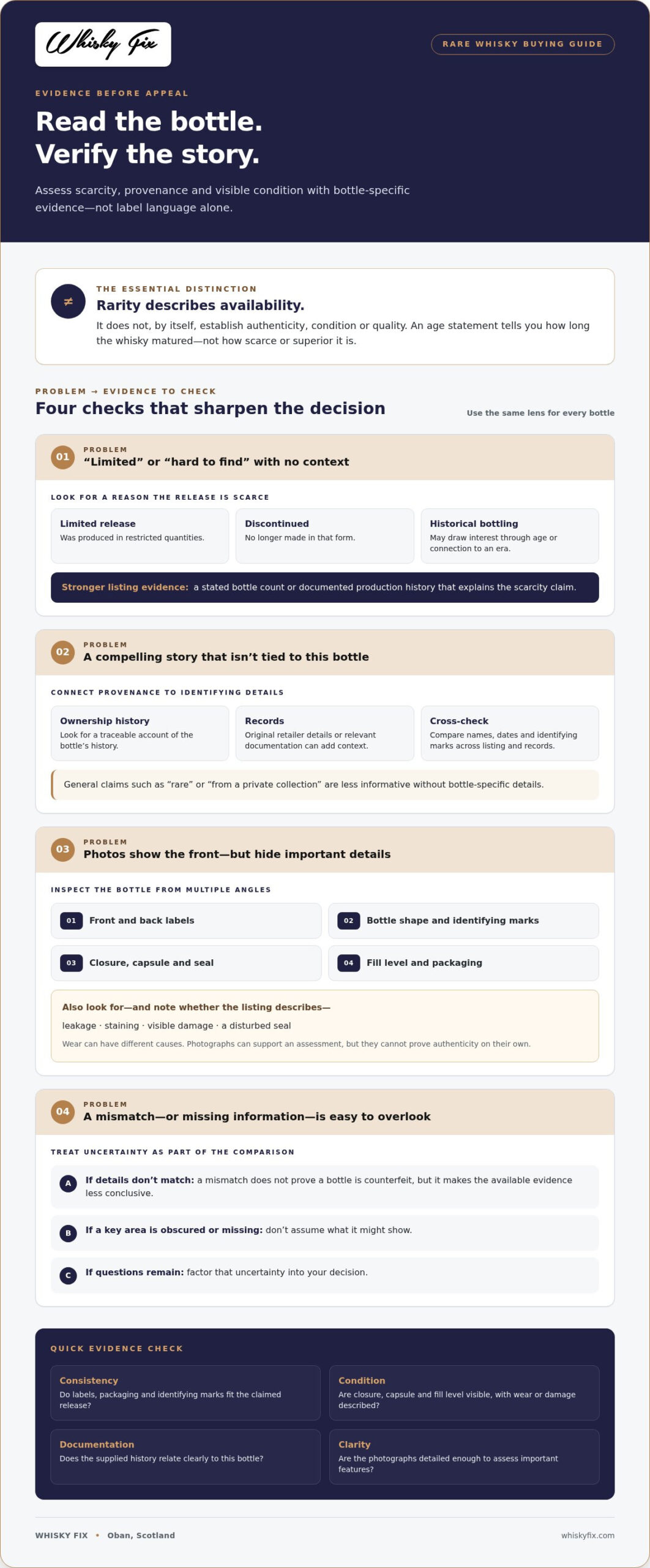
Rarity can come from a limited release, discontinued production, a historically significant bottling or a particular bottle’s unusual history. These factors help explain why a whisky may be scarce or sought after, but they don’t establish whether it is authentic, well preserved or right for your palate. Rarity describes availability; it does not, by itself, establish authenticity, condition or quality.
Before comparing bottles, decide what you want from the purchase. If you plan to drink it, consider your taste and how confident you are in the bottle’s condition. As a collector, you may give more weight to release history, provenance and presentation. For a gift, the whisky’s story and appearance may matter most. Some purchases serve more than one purpose, but setting your priorities makes trade-offs easier to assess.
What does rare whisky mean on a bottle listing?
A limited release was produced in restricted quantities. A discontinued expression is no longer made in that form, while a historical bottling may draw interest because of its age or connection to a particular era. A useful listing explains the reason for the claimed scarcity, for example, by providing a stated bottle count or documented production history. Phrases such as “hard to find” need context. An age statement tells you how long the whisky matured, not how scarce or superior it is. To explore the wider landscape, consult this comprehensive list of whisky brands.
Is an old bottle automatically a better buy?
No. Age, release history, condition and personal taste answer different questions. A long-matured whisky may interest a collector, but that alone doesn’t establish rarity or mean you’ll enjoy drinking it. A discontinued expression may appeal for its history, while a newer limited release may stand out for its production details. In either case, assess the bottle itself rather than relying on its age or label language. A broader guide to rare Scotch can help put individual bottles in the wider collector context.
For a practical first pass on what to look for when buying rare whisky, note what the listing supports and what matters for your intended use:
- Release: Does the listing explain the scarcity through limited production, discontinuation or historical significance?
- Age: Is there an age statement or vintage, and are you treating it as maturation information rather than proof of rarity?
- Purpose: Are you buying to drink, collect, give, or combine those aims?
These distinctions give you a sound basis for comparison. Next, examine the bottle’s documented history and the evidence available to support its authenticity.
How to assess rare whisky provenance and authenticity
Provenance is the documented ownership and handling history associated with a particular bottle. It can help explain where the whisky has been and whether its history is consistent with the release being offered. Provenance is strongest when a bottle’s identifying details align with its documented history. A rarity claim offers little context if the listing doesn’t connect it to supporting evidence.
Start with the listing and the bottle details, not the story around them. Review the available photographs and compare what you can see with the description. When considering what to look for when buying rare whisky, clear and consistent evidence matters more than confident wording. Photographs can support an assessment, but they can’t prove authenticity on their own.
Which bottle details should buyers compare?
Check the front and back labels, bottle shape, closure, capsule, fill level, packaging and any identifying marks. Consider whether these details appear consistent with the release described. Look for leakage, staining, visible damage or a disturbed seal, while keeping in mind that wear can have different causes. If a key area is obscured or missing from the images, don’t assume what it might show.
Compare the visible details with the listing’s claims. A mismatch between the stated bottling and the bottle doesn’t prove it is counterfeit, but it does mean the available evidence is less conclusive and should factor into your decision.
What provenance evidence adds useful context?
Useful supporting information may include a traceable ownership history, original retailer details or relevant documentation tied to the specific bottle. Compare names, dates and identifying marks across the listing and any records. General assurances that a whisky is “rare” or “from a private collection” are less informative without bottle-specific details. For background on collector terminology and historic bottlings, consult a guide to rare Scotch alongside the listing.
Use a simple evidence check:
- Consistency: Do the labels, packaging and identifying marks fit the claimed release?
- Condition: Are the closure, capsule and fill level visible, with wear or damage described?
- Documentation: Does the supplied history relate clearly to this bottle?
- Clarity: Are the photographs detailed enough to assess important features?
If images or records leave important questions unanswered, factor that uncertainty into your decision. Explore Whisky Fix’s rare and old whisky selection to compare expressions from an independent retailer based in Oban, Scotland.
How to compare rare whisky bottle condition, details and asking value
A useful comparison looks beyond the label and asking price. Record the same details for each bottle, then compare expressions with similar release histories and condition. Two bottles from the same distillery may not be meaningful comparators if their bottlings, packaging or preservation differ.
Use this framework to organise what to look for when buying rare whisky:
| Factor | What to compare | Why it matters |
|---|---|---|
| Provenance | Available ownership history and supporting records | Provides context for the bottle’s history and the claims made about it |
| Label and closure | Wear, staining, damage and visible seal condition | Can affect presentation and the buyer’s confidence in the bottle |
| Fill level | Visible level in the bottle, viewed alongside its age and condition | Offers a condition clue, but is not an authenticity verdict |
| Packaging | Presence and condition of any original box or other packaging | May matter more to a collector or gift buyer than to someone focused on drinking |
| Listing clarity | Completeness of the description and detail in the photographs | Helps you assess the bottle and identify unanswered questions |
How do fill level and packaging affect a rare bottle?
Fill level is one observable detail, not proof of authenticity or a complete measure of how a whisky has been stored. Consider it alongside the seal, bottle condition and available history. A worn label or damaged box may be a significant drawback for a collector seeking strong presentation, but less important to someone chiefly interested in drinking the whisky. Assess the whole bottle rather than letting one attractive feature dominate.
Does rarity make a whisky a sound investment?
Collectability and future financial performance are different considerations. Age, scarcity or past demand can explain interest in a bottle, but none guarantees what it may be worth later. Treat the asking price as the seller’s figure, not proof of market value. Where reliable sales evidence is available, compare similar bottles and account for differences in release details and condition. Avoid applying a simple price formula to dissimilar bottles.
Keep the decision grounded in your purpose, budget and confidence in the evidence. If you’re buying to drink, consider whether the bottle’s condition and appeal justify your choice. If presentation or collectability matters more, weigh those details against the rest of the listing. A measured comparison is more useful than assuming rarity alone makes one bottle the better buy.
A practical checklist for choosing between rare whisky bottles
A consistent process can turn an appealing listing into a considered decision. Use the same steps for each bottle and note any uncertainties. A “limited” label can create urgency, but it shouldn’t replace careful comparison.
- Define your purpose. Decide whether you’re buying to drink, collect, give as a gift, or for a combination of reasons. This sets your priorities.
- Compare the evidence. Check that the listing identifies the expression, release details and age statement where applicable. Compare the documentation and visible bottle details with the description.
- Inspect the condition. Review photographs of the labels, closure, fill level and packaging. Note damage, wear or unclear areas that could affect your confidence or the bottle’s appeal.
- Assess the seller and practical details. Look for clear descriptions and consistent information. If the bottle will cross a border, review delivery arrangements and the current import considerations for its destination.
- Decide without rushing. Weigh the evidence against your purpose and budget. If important questions remain, decide whether the uncertainty is acceptable before proceeding.
What should a rare whisky buyer verify before deciding?
Check that the listing names the expression and provides relevant bottle details, including an age statement where one applies. Make sure the photographs and supporting documentation tell a consistent story. Clear images and specific information make comparison easier. Gaps don’t automatically prove a problem, but they do leave more uncertainty to weigh. For international purchases, consider the destination’s delivery and import requirements before committing.
How can your buying purpose guide the choice?
If you’re buying to drink, compare the stated style and origin with flavours you enjoy, and give particular weight to your confidence in the bottle’s condition. For collecting, documentation, presentation and historical interest may matter more, but they don’t establish future resale value. For a gift, consider the recipient’s whisky preferences as well as the bottle’s story and presentation.
Trade-offs are normal. One bottle might have stronger provenance while another has more attractive labels and packaging. Decide which factors matter most for your purpose instead of letting one strength settle the comparison. That’s a practical way to apply what to look for when buying rare whisky to your shortlist.
Explore Whisky Fix’s rare and old whisky selection to compare expressions from a specialist retailer based in Oban, Scotland.
Where to buy rare whisky with confidence, and what to do next
A specialist retailer’s selection can make a varied field of rare and old expressions easier to explore. Clear descriptions, bottle imagery and available provenance details give you evidence to weigh as you make your decision. They don’t remove every uncertainty associated with historic bottles, so assess each expression on the information available.
What should a specialist rare whisky listing make clear?
Look for an identifiable expression, a useful description and images that show the bottle clearly. A listing is more helpful when it explains relevant details such as the age statement, release background and visible condition, rather than relying on scarcity language alone. Notes about label wear, packaging or other condition details help you compare options on a like-for-like basis. Even a detailed listing can’t establish every part of a bottle’s history, so consider the information in context.
As you browse, return to your checklist. Does the expression suit your purpose and taste? Do the images support the description? Are the available provenance details relevant to the specific bottle? These are practical ways to apply what to look for when buying rare whisky without letting presentation or a compelling story outweigh the evidence.
How to take the next step with Whisky Fix
Whisky Fix is an independent specialist retailer based in Oban, Scotland, sourcing rare and old expressions alongside current releases. Its selection gives you a place to explore bottles with a considered approach: read the listing, study the imagery and weigh the available details against what matters to you. Whisky Fix ships worldwide, with delivery and import considerations depending on the destination.
Take your time, compare the information available and choose a bottle that fits your interests, whether you’re building a collection, selecting a gift or hoping to enjoy a distinctive dram. When you’re ready, explore rare and old whisky at Whisky Fix.
Make your next rare whisky choice with confidence
The clearest way to assess a rare bottle is to look beyond scarcity claims. Consider why it’s rare, examine its provenance and condition, and compare the asking price with relevant evidence rather than treating age or collectability as a promise of future worth. Above all, let your purpose guide the decision, whether you’re choosing a whisky to enjoy, collect or give.
With a repeatable checklist, what to look for when buying rare whisky becomes easier to assess across different releases and bottle histories. Clear listing details support a more informed choice, while gaps in the evidence are a reason to pause and consider how much confidence you have in the bottle.
Whisky Fix is an independent specialist retailer based in Oban, Scotland, specialising in rare and old expressions alongside current releases, with worldwide shipping. Explore rare and old whisky at Whisky Fix and find a bottle whose story, condition and character suit you. A considered choice is a rewarding place to begin.
Frequently Asked Questions
What should I look for when buying rare whisky?
Start with the bottle’s identity, provenance and visible condition. Compare its labels, closure, fill level and packaging with the listing, and review clear photographs and any supporting history. Then decide whether it suits your purpose: drinking, collecting or gifting. When considering what to look for when buying rare whisky, treat age, scarcity and asking price as useful context, not proof of authenticity, quality or future financial performance.
How can I tell if a rare whisky bottle is authentic?
No single visual detail can establish authenticity on its own. Compare the bottle, labels, closure, packaging and identifying marks with reliable information about the claimed expression, and review any available provenance. An intact seal or attractive presentation isn’t proof by itself. Look for inconsistencies between the bottle and its description. If important details are unclear, pause and weigh that uncertainty rather than letting scarcity claims stand in for evidence.
Does an older whisky mean it is more valuable?
No. An age statement describes how long the whisky matured before bottling; it doesn’t establish rarity, condition, authenticity or market demand. A younger limited release may interest some collectors, while an older bottle may appeal for its history or style. Compare the specific expression, available documentation and condition, then consider your own purpose. Age alone isn’t a reliable measure of a bottle’s value or appeal.
What does provenance mean when buying rare whisky?
Provenance is the documented history associated with a particular bottle, including information about its ownership and handling where available. It adds context when the records align with the bottle’s identifying details and the listing description. Provenance isn’t a guarantee of authenticity or condition, so consider it alongside photographs and other evidence. A traceable history tied to the specific bottle is more useful than an unsupported claim that it’s rare.
Does bottle condition matter when buying rare whisky?
Yes. Review the visible fill level, label and capsule condition, closure, signs of leakage and any included packaging. These details can matter differently depending on whether you plan to drink, display or collect the bottle. Clear photographs help you compare condition, though they can’t reveal everything. Assess the whole bottle alongside its provenance and identity, rather than judging by presentation or one appealing detail alone.
Is rare whisky a good investment?
Rare whisky shouldn’t be treated as a guaranteed investment. Scarcity, age and past demand don’t promise future performance, and bottles can differ in condition, provenance and desirability. If you’re buying to collect, decide what makes the bottle meaningful to you and assess the evidence carefully. Keep financial expectations separate from the enjoyment of owning, gifting or eventually drinking a particular whisky.
Should I buy rare whisky from a specialist retailer?
A specialist retailer can help you explore a focused selection and compare rare and old expressions. Read the bottle details, review available photographs and provenance information, and consider whether the listing suits your purpose. Whisky Fix is an independent specialist retailer based in Oban, Scotland, sourcing rare and old expressions alongside current releases, with worldwide shipping. Specialist knowledge offers helpful context, but assess each bottle on its own evidence.
How should I store a rare whisky bottle after buying it?
Store the bottle upright in a stable, dry place away from direct sunlight and major temperature changes. Unlike wine, whisky bottles are generally kept upright because prolonged contact between high-strength spirit and the cork may affect it. Keep the closure secure and retain any original packaging and purchase documentation. Careful storage can help protect a bottle’s condition, but it can’t reverse existing damage or establish its provenance.