
- September / 24 / 2026
What Is Single Malt Whiskey? The Definitive Guide for 2026
Does a bottle labeled “single malt” come from an individual barrel, or does the term signal something entirely different? If you have ever stood before a shelf wondering what is single malt whiskey and whether it’s truly superior to a blend, you aren’t alone. Whisky terminology often feels like an exclusive dialect, leaving even passionate enthusiasts tangled in conflicting definitions, regional styles, and age statements.
The truth is that single malt defines distillery identity and provenance, not single-cask exclusivity or automatic prestige. In this definitive guide, you’ll discover the precise legal standards, production secrets, and regional characteristics that separate single malt from all other spirits. We’ll walk through the five essential stages of distillation from grain to glass, giving you the practical knowledge to choose and evaluate any bottle with absolute confidence.
Key Takeaways
- Clarify the legal standard behind what is single malt whiskey, discovering why the word “single” refers strictly to one distillery rather than a solitary barrel.
- Trace the five classic production stages from grain to glass, including the impact of traditional floor malting, peat smoke, and copper pot stills.
- Demystify the craftsmanship dividing single malts, blends, and bourbon across mash bills, distillation methods, and wood management.
- Master a four-pillar sensory framework using specialist glassware to unlock complex aromas, palate textures, and lingering finishes.
- Gain practical insight into curating a distinguished whisky shelf by navigating regional flavor profiles and independent bottler releases.
What Is Single Malt Whiskey? Legal Definition and Core Meaning
To understand what is single malt whiskey, one must start with a strict statutory baseline. Across traditional distilling regions, a single malt must be produced exclusively from 100% malted barley at a solitary distillery using batch distillation in copper pot stills, followed by aging in oak casks. Unlike industrial grain spirits distilled continuously in giant column stills, malt distillation preserves the rich cereal character, sulfur compounds, and heavy congeners intrinsic to barley.
The Crucial Word: Why ‘Single’ Means One Distillery
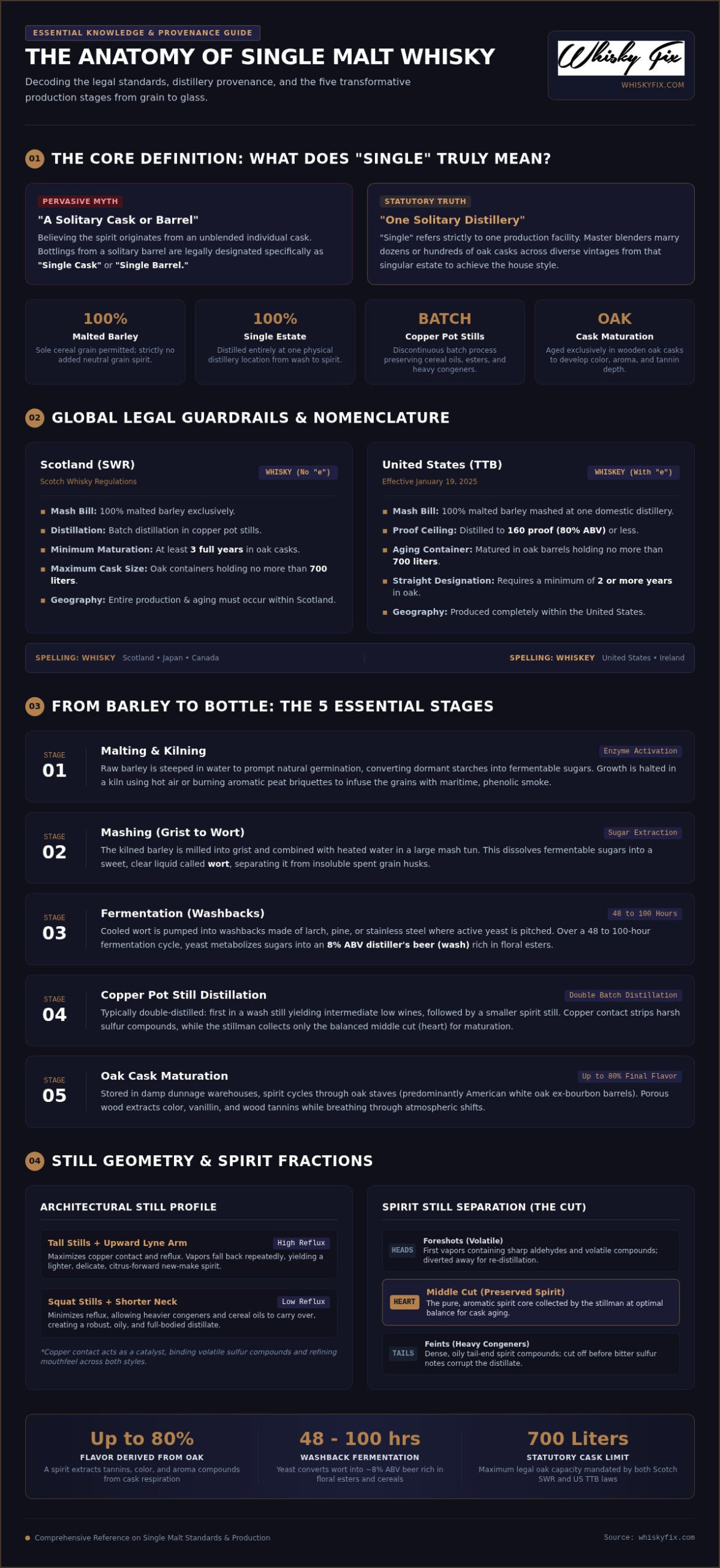
The most pervasive myth in spirits is that “single” signifies whisky from a solitary barrel. It does not. The term refers strictly to a single production facility. A standard commercial bottling represents a union of dozens, sometimes hundreds, of different oak casks filled across diverse vintages at that solitary site. Master blenders marry these barrels together in large vats to craft a harmonious, balanced distillery profile.
When an expression genuinely comes from an unblended, standalone barrel, producers label it specifically as a “single cask” or “single barrel.” Standard single malts celebrate the specific production footprint of one estate; its local water source, washback fermenters, and copper pot still shapes, rather than blending distinct spirits from multiple producers.
Whisky vs. Whiskey: Spelling Conventions and Geographic Rules
Spelling conventions reflect geographic heritage. Distillers in Scotland, Japan, and Canada produce single malt whisky without an “e,” whereas Irish and American producers craft “whiskey.” These linguistic differences accompany distinct legal guardrails:
- Scotch Whisky Regulations (SWR): Mandate batch distillation in copper pot stills, 100% malted barley, and a minimum of three years of maturation in oak casks with a maximum capacity of 700 liters entirely within Scotland.
- United States TTB Regulations: Effective January 19, 2025, American single malt whiskey must be distilled entirely at one domestic distillery from 100% malted barley, distilled to 160 proof (80% ABV) or less, and matured in oak barrels holding no more than 700 liters. Bottlings aged for two or more years earn the “Straight” designation.
While regional parameters establish local boundaries, the fundamental spirit remains pure across borders: one grain, one distillery, and disciplined oak maturation.
How Single Malt Whisky Is Made: From Barley to Bottle
Understanding what is single malt whiskey requires tracing how humble barley transforms into a spirit of remarkable depth. The journey hinges on five tightly choreographed stages: malting, mashing, fermentation, distillation, and maturation. Every production choice shapes the aromas and textures that eventually reach your glass.
Malting, Mashing, and Fermentation
The craft begins by steeping raw barley in water to encourage germination, unlocking natural enzymes that convert starch into fermentable sugars. Distillers then halt this growth by drying the grains in a kiln. Some facilities dry the malt over hot air, while others burn aromatic peat briquettes to infuse the barley with distinctive phenols, lending earthy, medicinal, and maritime smoke to the spirit.
Once dry, the malt is ground into grist and mixed with heated water inside a mash tun. This dissolves the sugars into a clear liquid called wort. Pumped into washbacks made of larch, pine, or stainless steel, the cooled wort meets active yeast. Over a 48 to 100-hour fermentation, the yeast converts sugars into an 8% ABV distiller’s beer rich in floral esters and cereal undertones.
Copper Pot Still Distillation
Distillation takes place in batch-operated copper pot stills. Most producers employ double distillation: first through a wash still to create intermediate low wines, followed by a second run through a smaller spirit still. Copper contact is vital during this phase because it binds with harsh sulfur compounds, refining the mouthfeel.
Tall stills with upward-sloping lyne arms encourage reflux, yielding light, citrus-forward new make. Squat stills produce robust, oily spirits. The stillman manages the run by dividing it into three fractions: volatile heads, heavy tails, and the balanced “middle cut” collected for aging. Individual architectural quirks across traditional Scotch whisky distilleries forge these unforgettable house profiles.
Oak Cask Maturation and Finishing
Porous oak barrels contribute up to 80% of a finished whisky’s flavor. During years of resting in damp dunnage warehouses, the spirit breathes through the wood staves, extracting color, tannins, and aromatic compounds:
- American White Oak (ex-bourbon): Imparts bright vanilla, toasted coconut, caramel, and orchard fruits.
- European Oak (ex-sherry): Contributes dark stewed fruits, clove, nutmeg, and rich cocoa notes.
- Cask Finishing: Involves re-racking mature spirit into secondary vessels like rum, port, or wine casks for several months to introduce tertiary layers.
Exploring these diverse wood finishes is simple when you source through dedicated merchants like Whisky Fix, whose selections showcase how warehouse microclimates and cask wood sculpt world-class drams.
Single Malt vs. Blended Whisky and Bourbon: Comparison Guide
Evaluating what is single malt whiskey becomes far simpler when placed alongside other major spirits categories. While single malt represents a focused snapshot of one distillery’s grain and still craft, blended whiskies and American bourbons follow distinct regulatory philosophies. Neither approach is intrinsically superior; they simply pursue different flavor architectures.
- Single Malt Scotch: 100% malted barley; copper pot stills; seasoned oak casks (often ex-bourbon or ex-sherry); aged minimum 3 years in Scotland.
- Blended Scotch: Blend of single malts and continuous column-distilled grain whisky; seasoned oak casks; aged minimum 3 years in Scotland.
- Blended Malt Scotch: 100% malted barley; copper pot stills; marriage of malts from two or more distilleries; aged minimum 3 years in Scotland.
- Kentucky Bourbon: Minimum 51% corn (plus rye, wheat, or malted barley); column or pot stills; brand new charred American oak containers; no minimum aging period (2 years for “Straight”).
Single Malt vs. Blended Scotch Whisky
A widespread assumption persists that single malts are inherently better than blends. Blended Scotch combines pot-distilled malt whiskies with lighter, wheat- or corn-based grain whiskies produced in continuous column stills. This combination allows blenders to achieve extraordinary consistency and silky drinkability across millions of cases.
Single malts champion idiosyncratic character and terroir, while premium blends display masterly harmonization across dozens of distillery components. Additionally, blended malts (formerly called vatted malts) combine single malts from separate producers without adding any industrial column grain whisky, providing a bridge between these philosophies. For an exhaustive exploration of these historic nuances, consult The Connoisseur’s Guide to Single Malt Scotch Whisky.
Single Malt vs. Bourbon and Rye Whiskeys
American whiskeys diverge radically in grain composition and maturation climate. Bourbon mandates a mash bill of at least 51% corn, while rye whiskey requires at least 51% rye grain. Both must age exclusively in brand-new charred oak barrels, resulting in rapid extraction of wood sugars, intense vanilla, baking spices, and assertive char.
Single malts rely on seasoned casks that have already surrendered their sharpest virgin oak tannins. Combined with Scotland’s cool, damp climate, single malts experience gentle oxidation and low evaporation over decades. American rickhouses undergo fierce summer heat, driving spirit deep into wood pores for rapid, bold flavor extraction.
How to Taste, Nose, and Evaluate Single Malt Whisky
Appreciating what is single malt whiskey extends beyond reading labels; it demands an active sensory method. Evaluating fine malt relies on a four-pillar ritual: visual assessment, nosing, palate exploration, and finish. By observing spirit clinging to the glass wall, you gauge viscosity and alcohol weight before taking a single sip.
Glassware, Nosing, and the Palate
Glassware selection directly dictates your tasting experience. Straight tumblers allow delicate aromatic compounds to dissipate into the room, while a tulip-shaped Glencairn or copita glass funnels volatile esters toward your olfactory receptors. When nosing, part your lips slightly while inhaling gently. This prevents high-proof ethanol fumes from numbing your palate.
Take a modest first sip to acclimatize your mouth. Roll the spirit across the tongue to register sweetness at the tip, bright acidity along the sides, and dry oak tannins toward the back. Adding two or three drops of room-temperature spring water breaks the spirit’s surface tension, taming alcohol heat and releasing subtle top notes of honey, citrus peel, or heather.
Deciphering Regional Flavors and Age Statements
Scotland’s geographic distilling regions provide a practical compass for identifying signature flavor families:
- Speyside: Celebrated for elegant profiles of crisp green apple, floral honey, vanilla, and dried sultanas.
- Islay: Renowned for intense peat smoke, medicinal iodine, brine, and bonfire embers.
- Highlands: Offers diverse profiles ranging from rich toffee and baking spice to heather smoke.
- Lowlands: Characterized by light, grassy, and delicate lemon grass nuances.
- Campbeltown and Coastal Regions: Distinctive maritime elements like sea salt, brine, and subtle oiliness, exemplified by historic coastal producers in distilling towns like Oban.
When assessing age statements on labels, remember the legal mandate: the displayed figure reflects the youngest liquid in the vatting. A twelve-year-old bottling may contain casks aged fifteen or twenty years, but it can never legally showcase anything beyond its youngest component.
Ready to sharpen your sensory palate? Explore authentic regional bottlings and attend specialist Tasting Events with Whisky Fix to experience Scotland’s finest distilleries firsthand.
Building a Single Malt Collection: Casks, Rarity, and Provenance
Curating a compelling shelf is where theoretical knowledge meets real-world discovery. Once you understand what is single malt whiskey and how individual distillers shape spirit character, building a personal library becomes an intentional pursuit. A well-rounded collection balances core regional flagships with unusual cask maturities, single barrel bottlings, and discontinued vintage releases.
Official Bottlings vs. Independent Bottlers
Official bottlings (OB) represent the flagship expressions released directly by the distillery. These offerings maintain the consistent house profile that consumers rely upon year after year. Conversely, independent bottlers (IB) acquire individual casks directly from distilling estates, maturing or bottling them under their own private labels.
Independent releases unlock expressions that distilleries rarely bottle themselves. These bottlers routinely present single malts at natural cask strength, skipping chill filtration and artificial coloring. For seasoned collectors, an independent release showcases how a single cask from a familiar distillery performs without corporate blending intervention, revealing unfiltered texture and atypical wood influences.
Sourcing Rare Releases with Global Delivery
Discontinued releases, silent distillery stock, and vintage single casks hold exceptional appeal for connoisseurs. Evaluating these bottles requires close scrutiny before acquisition:
- Provenance and Fill Level: Verify that the bottle has been kept in stable environments. Low neck fills or damaged foil seals often signal cork degradation or evaporation.
- Bottle Storage: Unlike wine, high-proof whisky must always be stored vertically. Direct contact with 40% to 60% ABV liquid rapidly degrades natural cork closures. Keep bottles away from direct sunlight and sharp temperature swings.
- Specialist Sourcing: Rely on established merchants located at the source. Securing authentic bottlings and vintage editions of rare Scotch through specialist retailers provides guaranteed provenance alongside worldwide shipping.
Focus your collection on personal palate preferences rather than chasing speculative market trends. Choosing bottles with verified provenance, transparent cask details, and regional character ensures your collection delivers genuine drinking pleasure for decades to come.
Mastering the Craft: Taking Your Next Sip with Confidence
Understanding what is single malt whiskey transforms every dram from a simple pour into an appreciation of craftsmanship, copper pot distillation, and oak maturation. With the myth of the “single barrel” cleared away, you can now evaluate regional profiles, decipher age statements, and appreciate the creative freedom of independent bottlers with genuine confidence.
Finding exceptional bottles begins with trusted provenance. Operating from the historic coastal town of Oban, Scotland, Whisky Fix curates an extensive inventory of rare single malts, classic expressions, and hard-to-find international releases. When you are ready to expand your shelf, explore our curated single malt collection at Whisky Fix and enjoy secure worldwide shipping direct from Scotland. Your journey into the nuances of fine malt is just beginning, and the finest discoveries lie ahead.
Frequently Asked Questions
Does single malt whiskey come from just one single barrel?
No, standard single malt whisky does not come from an individual barrel. Understanding what is single malt whiskey starts with dispelling this myth: the term refers strictly to a single distillery. Master blenders marry dozens or even hundreds of oak casks from that solitary site to craft a cohesive profile. Spirits drawn from a solitary barrel carry the label designation “single cask.”
Why is single malt whisky generally more expensive than blended scotch?
Single malt commands higher prices primarily because of raw ingredient costs and batch distillation limitations. Producing spirit from 100% malted barley using copper pot stills requires substantially more time, energy, and labor than continuous column distillation of industrial grains. Extended maturation in high-grade oak casks, alongside decades of storage losses to evaporation, adds to the production investment.
Is single malt Scotch better than bourbon or blended whiskey?
No, single malt is not objectively better than bourbon or blended Scotch. Quality depends on personal preference and production artistry. Single malts champion regional terroir and distillery character, while exceptional blends showcase masterly balance across multiple components. Bourbon offers robust caramel and vanilla derived from fresh charred oak. Each spirits style delivers a unique, compelling tasting experience.
What does the age statement on a bottle of single malt mean?
An age statement guarantees the exact minimum number of years the youngest whisky in the bottle rested in oak. If a bottle states twelve years, every drop inside matured for at least twelve years, though older barrels may be present. Aging halts the moment the spirit enters the glass bottle; liquid does not mature further on a shelf.
Can any country produce single malt whiskey or only Scotland?
Any country can produce single malt whiskey, provided distillers adhere to legal requirements governing grain and distillation. While Scotland established the historical blueprint, producers in Japan, Ireland, India, and America craft world-class expressions. What is single malt whiskey across global markets remains anchored to the same core principle: 100% malted barley distilled at one dedicated facility.
Should you add water or ice to a premium single malt?
Adding a few drops of room-temperature spring water is recommended, while ice should generally be avoided during serious evaluation. Water reduces alcohol heat, lowering surface tension to release delicate volatile esters on the nose and palate. Conversely, ice chills the spirit excessively, numbing your tongue and masking the complex aromatic compounds master distillers spent years developing.
How long does an opened bottle of single malt whisky stay good?
An opened bottle of single malt remains in prime condition for roughly one to two years if stored correctly. As air volume increases inside the bottle, oxidation gradually softens bright fruit and peat notes. Keep bottles stored upright in a cool, dark environment. If a bottle sits near empty, transferring liquid to a smaller vessel limits air contact.