
- October / 9 / 2026
Spotting a Counterfeit Whisky Bottle: A Practical Guide
A convincing label isn’t proof of a genuine whisky. Spotting a counterfeit whisky bottle takes more than checking one detail: sophisticated fakes can have convincing packaging, and genuine bottles may be refilled. Small differences can also reflect a change in bottling or era, so a quick comparison with an online image may mislead.
If you’re weighing a rare find or want confidence in a purchase, that uncertainty is understandable. The strongest assessment comes from a chain of evidence, not a single visual clue. This guide explains how to examine packaging and bottle details in context, weigh provenance and the seller’s account, and decide when inconsistencies are reason to pause.
You’ll find practical checks, an explanation of why no single warning sign proves a bottle is counterfeit, and sensible steps to take if something doesn’t add up. The aim isn’t to turn every buyer into an expert authenticator, but to help you make a more informed decision before committing to a bottle.
Key Takeaways
- Spotting a counterfeit whisky bottle means weighing several clues together; convincing packaging alone can’t establish authenticity.
- Compare the bottle, label, closure and base with references for the same release and era, rather than relying on isolated flaws.
- Assess provenance as a documented ownership history, and compare it with bottle codes, release details and the seller’s account.
- If evidence conflicts or answers are evasive, pause, record your concerns and reconsider before proceeding.
- Use the full evidence picture to guide your decision, then explore whisky with the perspective of an independent specialist retailer.
What does spotting a counterfeit whisky bottle really involve?
Spotting a counterfeit whisky bottle means assessing whether the bottle, packaging and contents are being represented accurately. A bottle may be misrepresented even if its glass and label are genuine, for example if the contents have been substituted. Conversely, unusual wear or an unfamiliar design detail doesn’t, by itself, make a bottle counterfeit.
Appearance is only one part of the picture. A convincing label or closure can be copied, while a genuine bottle may differ from another due to its bottling period or design revision. The useful question isn’t simply, “Does this look right?” It’s whether the physical details, release information and account of the bottle’s history make sense together.
Rare, old or sought-after whiskies deserve particular care because scarcity and appeal can make a purchase harder to assess casually. That’s a reason to take time, not to assume every unusual bottle is suspect. A warning sign is a reason to investigate further, not confirmation of fraud.
Why a whisky bottle can look convincing
Counterfeiters can imitate familiar label layouts, closures and presentation packaging, so a plausible first impression may not be enough. At the same time, genuine bottles can differ by bottling period, market or design revision. Labels may show age-related wear, and packaging may be absent or imperfect after years of storage. Treat minor flaws as a reason to compare, not as a verdict.
What counts as useful evidence?
Build your assessment from details you can observe and information you can compare. Examine the bottle, label and closure, then consider whether the release details and available records fit the seller’s account. Keep observations separate from conclusions: “the label is misaligned” is an observation; “the bottle is fake” requires broader support.
- Physical details: Record visible features such as label placement, closure condition and bottle shape.
- Release information: Compare the bottle with references for the same expression and period, not just a similar-looking release.
- History and context: Consider whether the documented ownership history and seller’s explanation fit the bottle and its claimed origin.
One inconsistency raises a question; corroborating evidence strengthens it. A worn label may be consistent with age. But if several details also conflict with reliable release references and the seller can’t explain the bottle’s history, the combined picture calls for greater caution. No single visual clue can establish authenticity on its own.
This measured approach helps you avoid both easy reassurance and premature suspicion. The aim is to judge how well the available evidence agrees, and to recognise when there isn’t enough information to proceed with confidence.
How to inspect a whisky bottle, label, closure and contents
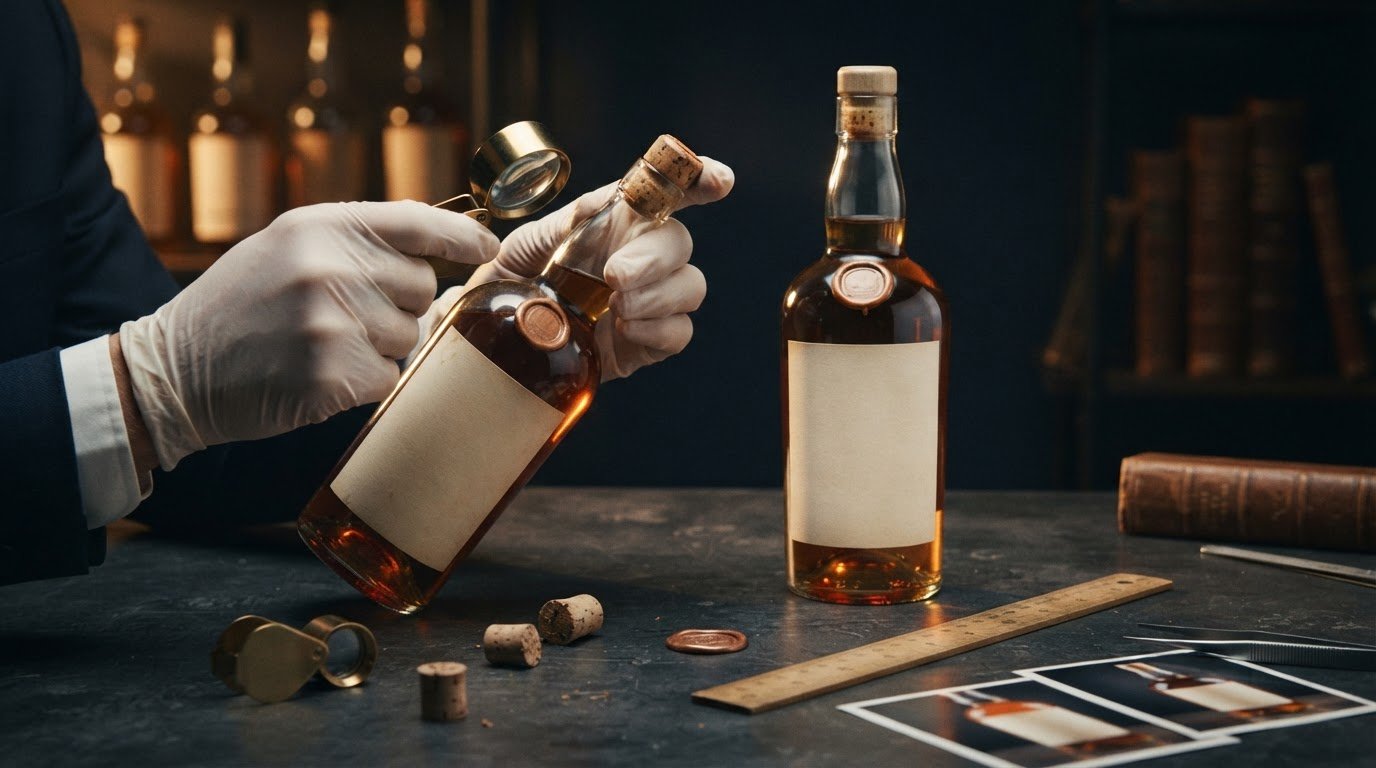
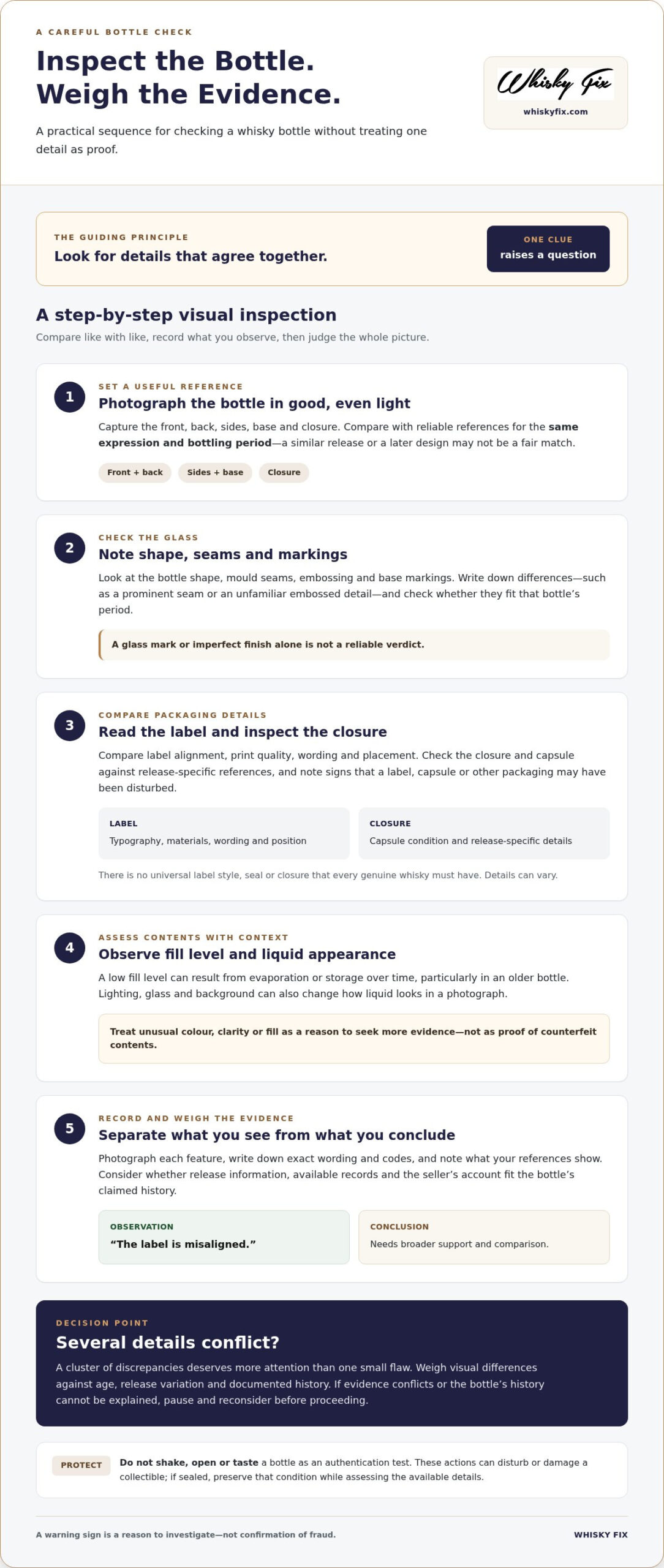
Begin with the bottle in good, even light. Take clear photographs of the front, back, sides, base and closure, then compare them with reliable images of the same release and bottling period. A similar expression or later design may be a poor reference because packaging can change across eras and markets. Look for several details that fit or conflict rather than expecting one flawless match.
What the glass, label and closure may reveal
Study the glass shape, mould seams, embossing and base markings. Record what you see, such as a seam that appears unusually prominent or an embossed detail that differs from a documented example. Then check whether that difference matters for the bottle’s period. A mark on the glass or an imperfect finish alone isn’t a reliable verdict.
Next, compare label alignment, print quality, wording and placement. Look for mismatched typography, inconsistent materials or signs that a label, capsule or other packaging has been disturbed. Check the closure and capsule against release-specific references too. There’s no universal rule that every genuine whisky must have one particular seal, label style or closure; these details can vary. Where possible, compare multiple sources instead of relying on a single photograph.
Why fill level and liquid appearance need context
Observe the fill level and liquid colour without opening the bottle. A low level can result from evaporation or storage over time, particularly in an older bottle, so consider it alongside age and condition. Lighting, glass and background can also affect how liquid appears in a photograph. Unusual colour or clarity is a reason to look for further evidence, not proof of counterfeit contents.
Don’t shake, open or taste a bottle as an authentication test. These actions can disturb or damage a collectible, and sensory impressions can’t reliably establish its history or contents. If the bottle is sealed, preserve that condition while you assess the available details.
Keep a simple record as you inspect: photograph each feature, write down the exact wording and codes, and note what your reference images show. Separate observations from interpretations. “The capsule edge is uneven” is observable; deciding what it means requires comparison with the same bottling and other evidence. A cluster of discrepancies deserves more attention than one small flaw, but weigh even several visual differences against the bottle’s age, release variation and documented history.
Whisky-related fraud can also involve claims beyond the bottle itself. A UK government report on a scam whisky investment firm illustrates why it’s wise to distinguish bottle inspection from assessing the wider offer. Visual checks are one part of an informed purchase. Whisky Fix’s whisky selection includes Scotch and spirits from around the world.
How provenance, bottle codes and seller details fit together
Provenance is the documented history of a bottle’s ownership and handling. It’s more than a persuasive account from a seller: useful support might include an old invoice, an auction catalogue entry or records linking previous owners to the bottle. Not every genuine bottle has a complete paper trail, especially after decades of private ownership. But unexplained gaps matter when the seller makes specific claims about origin or history.
How to assess provenance and supporting records
Look for a coherent timeline. Do the records identify the same whisky, bottle size, bottling details or other distinguishing features? Does the seller’s account explain changes of ownership or long periods without documentation? A catalogue description may support a bottle’s history, but it could refer to a similar bottle rather than the one offered. Treat gaps as reasons to pause and weigh, not automatic proof of counterfeiting.
What seller claims, photographs and codes can tell you
For an online listing, check whether the photographs show the actual bottle from clear, useful angles, including the label, closure and fill level. Stock images or cropped photographs limit what you can compare. Consider whether the seller’s description is specific and consistent with what’s visible, and whether answers address straightforward questions about the bottle’s history. Pressure to act quickly doesn’t strengthen the evidence.
Record serial numbers, batch markings and QR-code destinations where visible. Compare them with reliable release references, keeping in mind that codes can be copied, reused or vary by market and bottling. A QR code leading to a genuine-looking page doesn’t, by itself, establish that the bottle is genuine. A code supports identification only when the other bottle and provenance details agree.
Use each clue to test the others. If a seller describes a particular bottling, check whether its stated details fit the visible bottle and any records provided. If a code points to a different release, take note, but first consider whether the reference covers the same market and era. This is the practical discipline behind spotting a counterfeit whisky bottle: assess consistency across independent clues instead of giving one impressive detail decisive weight.
| Clue | What it may support | What it cannot prove |
|---|---|---|
| Invoice or ownership record | A plausible chain of ownership | That the document belongs to this exact bottle |
| Seller’s account | Context about where the bottle came from | That the account is accurate without corroboration |
| Serial number or QR code | Identification or a connection to release information | Authenticity of the bottle or its contents on its own |
| Listing photographs | Visible details to compare with references | Features that aren’t shown, or a complete ownership history |
No single record, code or seller statement settles the question. Give more weight to details that independently agree, and less to claims that can’t be checked against the bottle or supporting records. When the account, documentation and physical details point in different directions, slow down and clarify the discrepancies before deciding whether to proceed.
What to do when a whisky bottle raises red flags
A concern doesn’t require an instant verdict. Protect your decision, keep a clear record and avoid committing while important questions remain unanswered. Whether you’re viewing an online listing or have the bottle in hand, use a measured process rather than letting urgency or excitement decide for you.
A careful pre-purchase decision process
- Pause before paying. Don’t let a deadline or seller pressure rush your assessment. If the offer leaves you uncertain, take time to review it.
- Record what you’ve observed. Note specific details, such as a code that doesn’t match a release reference or a seller’s description that conflicts with the label. Keep observations separate from assumptions, hearsay or unsupported conclusions.
- Preserve the listing. Save the listing text, photographs, seller details and relevant messages while they’re available. Online content can change or disappear, and a dated record helps you review exactly what was represented.
- Compare and clarify. Check the bottle details against relevant release information and any records provided. If key views are missing, request clear photographs of the actual bottle and supporting documentation that relates to it.
- Decide whether to proceed. Consider how well the answers resolve each concern. Missing provenance isn’t automatic proof of a fake, but unexplained gaps, conflicting details or evasive replies are sound reasons to step back. If important inconsistencies remain unresolved to your satisfaction, don’t proceed.
One imperfect detail may have a straightforward explanation. The decision changes when several details disagree or the seller’s explanation can’t be reconciled with the available evidence. For spotting a counterfeit whisky bottle, the practical threshold isn’t absolute certainty; it’s having enough consistent information to make an informed purchase.
If a bottle is already in your possession
Keep the bottle, packaging and transaction records together. Avoid opening it, altering the seal, cleaning away marks or discarding protective materials. Photograph the bottle from several angles and record the details that prompted concern, along with the seller’s description, receipt and communications. A careful record preserves context if you need to raise the issue through the sales platform or payment provider.
If you’ve already consumed the whisky and feel unwell, seek appropriate medical help promptly. Don’t rely on appearance, smell or taste to determine whether the contents are safe. If nobody has consumed it, keep the bottle closed and set it aside while you consider the evidence and your next steps.
Whisky Fix is an independent specialist retailer based in Oban, Scotland, with a selection of Scotch and rare and old whisky. Its whisky selection provides one way to explore Scotch and other spirits.
Buy whisky with confidence: evidence first, specialist knowledge second
The most reliable approach is to assess the whole picture. A convincing label, readable code or compelling story may seem persuasive, but none should outweigh details that conflict elsewhere. Consider the bottle alongside its release information, condition and available history. If important questions remain unresolved, pausing is a sound decision, not a missed opportunity.
How specialist knowledge supports a more informed purchase
Understanding a distillery, bottling period and release context helps you make fair comparisons. A design change may explain a difference between two bottles, while a detail that doesn’t fit the claimed release may call for closer scrutiny. Background on Scotch whisky distilleries can help place a bottle within its wider history. Rare Scotch for collectors offers further context for exploring collectible releases.
Specialist retail knowledge can help readers understand whisky styles and release context. It isn’t the same as formal forensic authentication, and it shouldn’t be presented as a guarantee about a bottle’s contents or history. Keep those roles distinct as you weigh what you can observe against what you can document.
Confidence comes from consistent bottle details and a credible history together. That principle applies whether you’re considering a familiar release or a bottle whose age and rarity make comparison more complex. Specialist knowledge is most useful when it helps you ask better questions and interpret details in context, rather than replacing the evidence you need to make your own decision.
A measured next step for whisky enthusiasts
Before purchasing, revisit any unresolved concern. Does the seller’s account fit the bottle? Do the release details and available records support the description? If not, take time to reassess rather than relying on one reassuring feature. Spotting a counterfeit whisky bottle calls for several consistent clues, and sometimes the most informed choice is to walk away.
Whisky Fix is an independent specialist retailer based in Oban, Scotland, with a focus on Scotch, international spirits, and rare and old whisky. Its Scotch and rare whisky selection reflects that range.
Make your next whisky purchase a considered one
Before your next purchase, decide what information you need to feel comfortable moving forward. You might set a personal standard for clear bottle photographs, a coherent seller account and details that match the claimed release. Having that standard in mind can make it easier to pause when excitement, scarcity or urgency threatens to take over.
Good judgement doesn’t require you to identify every counterfeit. The aim of spotting a counterfeit whisky bottle is to make a decision that reflects the evidence available, including having the confidence to walk away when key questions remain. Let curiosity guide your search, but give each bottle the attention its history deserves.
When you’re ready to explore Scotch, rare and old whisky, and spirits from around the world, browse the Whisky Fix collection.
Frequently Asked Questions
Can a genuine whisky bottle contain counterfeit whisky?
Yes. A genuine bottle can be opened and refilled, or its contents otherwise tampered with, while the exterior remains plausible. Check whether the closure appears disturbed, but remember that a damaged seal can have other explanations, and an intact-looking one isn’t conclusive. Compare the bottle’s history and condition before deciding. Don’t taste it as a test. If the evidence conflicts, hold off drinking or buying and seek reliable, independent guidance.
Is a low fill level enough to prove a whisky bottle is counterfeit?
No. A low fill level can have explanations unrelated to fraud, including gradual evaporation over time. Consider the bottle’s age, storage conditions and closure, and compare it with a similar example from the same release if possible. For a listing, check whether the photograph shows the bottle upright and clearly; perspective can make the level look different. Treat the fill as one detail, not a stand-alone verdict.
Are older whisky bottles more likely to be counterfeit?
Age alone doesn’t show that a bottle is fake. Older packaging may look unfamiliar beside current designs, so spotting a counterfeit whisky bottle requires references relevant to the bottle’s claimed period. Check whether the details fit the seller’s specific account: a claimed bottling date, for instance, should make sense alongside the label and presentation. Wear may reflect age, but it can’t establish a bottle’s history either.
Can a QR code or serial number prove a whisky bottle is genuine?
No. A code can help identify a release or find related information, but it can’t establish that the bottle or liquid is genuine. If a QR code opens a webpage, check whether the information matches the claimed expression and bottling rather than assuming the link itself verifies the bottle. A number or digital label is useful as a cross-check, not a substitute for consistent physical details and credible records.
Can photographs alone authenticate a whisky bottle?
No. Photographs can support an initial review, but they can’t show every detail of the bottle or establish its ownership history. A close crop may hide the base, closure or label edges, while reflections and lighting can obscure condition. If important details aren’t visible, request clear views of the actual bottle from several angles. Even a complete set of convincing images should be treated as evidence to assess, not proof by itself.
What should I do if I have already tasted suspected counterfeit whisky?
Stop drinking it, and don’t serve it to anyone else. If you feel unwell, seek medical help promptly; for severe or rapidly worsening symptoms, contact emergency services. Keep the bottle and packaging closed and together if it’s safe to do so, and note when and where it was purchased. Don’t try to judge safety from taste, smell or appearance, and don’t induce vomiting unless a medical professional tells you to.
Explore Scotch, rare and old whisky, international spirits and whisky-inspired gifts at Whisky Fix.