
- September / 27 / 2026
Scottish Whiskey: A Guide to Scotch Whisky, Styles and Regions
Choosing Scottish whiskey is easier when you treat a region as a clue, not a promise of flavour. A familiar place name can help narrow your options, but it can’t tell you everything about what’s in the glass.
If you’ve wondered what makes Scottish whiskey Scotch, or how single malt differs from blended Scotch, you’re not alone. The labels can feel like a vocabulary test, and choosing by brand or region alone may leave you with a bottle that doesn’t match your taste.
This guide explains the essentials: what defines Scotch whisky, how its main categories and production choices shape character, and what regional descriptions can and can’t tell you. You’ll learn how to use clues such as smoke, fruit, sweetness and texture to narrow your options without treating a region as a guarantee. Whether you’re selecting a first bottle or planning a tasting, you’ll have a clearer basis for choosing. Whisky Fix, an independent specialist retailer based in Oban, Scotland, offers a Scottish perspective on a whisky tradition that reaches far beyond any one region.
Key Takeaways
- Learn what distinguishes Scottish whiskey from whisky made elsewhere, including why Scottish origin alone isn’t enough.
- Follow the key production stages and see how grain and production choices shape a whisky’s character.
- Understand what the five Scotch whisky categories describe, and why category names aren’t a ranking of quality.
- Use flavour preferences and regional cues to narrow your options, then check the details of the individual bottling.
- Apply a simple browsing checklist to compare expressions and explore Scotch through a specialist retailer based in Oban.
What Is Scottish Whiskey, and What Makes It Scotch Whisky?
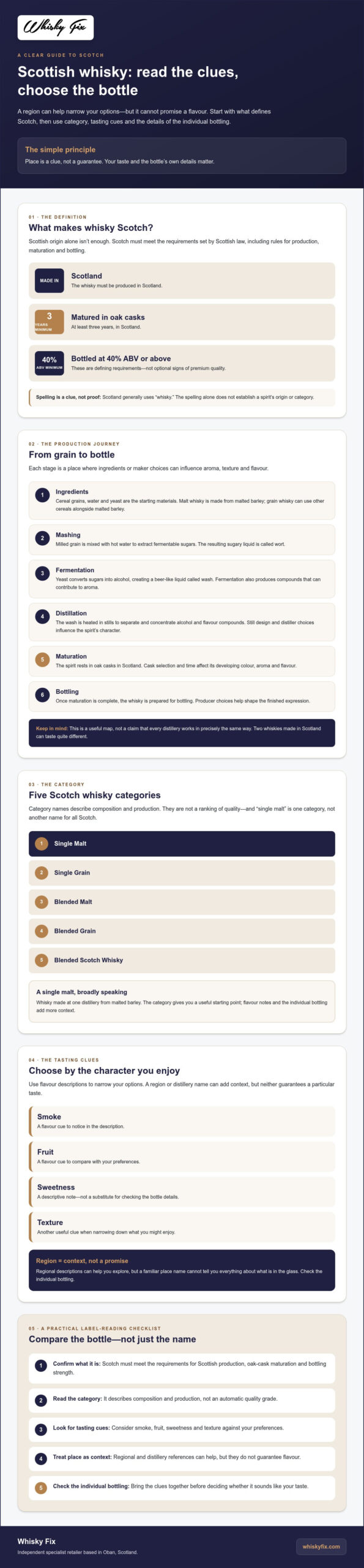
Scotch whisky is whisky made in Scotland that meets the requirements set by Scottish law. A spirit doesn’t qualify simply because it was distilled in Scotland: its production, maturation and bottling must also meet the rules. This distinguishes Scotch from whisky made elsewhere, even when bottles share familiar ingredients or production traditions.
The spelling can add to the confusion. Scotland generally uses whisky, while whiskey appears in the search phrase “Scottish whiskey” and in other traditions, including Irish and some American whiskey. Spelling is a useful clue, but it doesn’t establish a spirit’s origin or category. For more background on its history, production and classifications, see this overview of Scotch whisky.
What rules define Scotch whisky?
The relevant framework is the Scotch Whisky Regulations 2009. In plain terms, Scotch must be produced in Scotland, matured in oak casks for at least three years, and bottled at a minimum strength of 40% alcohol by volume (ABV). These are defining requirements, not optional markers of premium quality.
At a glance: Scotch whisky is produced in Scotland, matured in oak casks for a minimum of three years, and bottled at 40% ABV or above.
Those criteria are different from descriptive language on a label. Words suggesting smoke, fruit or sweetness communicate expected character; they don’t replace the legal requirements. Regional names and references to a distillery can add context, but they aren’t a shortcut for judging whether a particular flavour will suit you. Read those cues alongside the bottle’s category and other details.
Is Scottish whisky the same as single malt Scotch?
No. Scotch whisky includes five categories: Single Malt, Single Grain, Blended Malt, Blended Grain and Blended Scotch Whisky. “Single malt” is one category, not another name for all Scotch. Broadly, it refers to whisky made at one distillery from malted barley. The other category names describe different combinations of whisky, so the label tells you something about composition and production, not whether the bottle is automatically better.
If you’d like a closer look at this popular category, explore the single malt Scotch whisky guide. Identifying the category gives you a stronger starting point. Then consider the flavour notes and provenance. “Scottish” tells you where the whisky comes from, while its category and individual details help explain what you’re choosing.
How Scotch Whisky Is Made: From Grain and Fermentation to Maturation
The journey from cereal grain to bottled Scotch is a sequence of transformations. At each stage, the maker has choices that can influence aroma, texture and flavour, but no single ingredient or technique guarantees a particular taste. The Scotch Whisky Association offers further background on Scotch whisky and its production.
- 1. Ingredients: Cereal grains, water and yeast form the starting materials. Malt whisky is made from malted barley; grain whisky can use other cereals alongside malted barley.
- 2. Mashing: Milled grain is mixed with hot water to extract fermentable sugars. The resulting sugary liquid is called wort.
- 3. Fermentation: Yeast is added to the wort and converts sugars into alcohol, creating a beer like liquid known as wash. Fermentation also produces compounds that can contribute to the spirit’s aroma.
- 4. Distillation: The wash is heated in stills to separate and concentrate alcohol and flavour compounds. Still design and the distiller’s choices influence the character of the spirit.
- 5. Maturation: The spirit is filled into oak casks and left to mature in Scotland. Cask selection and time both affect the whisky’s developing character.
- 6. Bottling: Once maturation is complete, the whisky is prepared for bottling. The producer’s choices at this stage shape the finished expression presented to the drinker.
These steps are a useful map, not a claim that every distillery works in precisely the same way. Grain selection helps determine the Scotch category, while fermentation and distillation decisions can influence the spirit’s style. That’s why two whiskies made in Scotland may taste quite different, even before maturation adds another layer of variation.
Maturation is the period in which Scotch whisky rests in oak casks in Scotland for at least three years, developing colour, aroma and flavour through time and contact with the wood. The cask’s influence varies, and the final profile also depends on the spirit that went into it and the producer’s choices. An age statement refers to the youngest whisky in the bottle; it isn’t a measure of quality on its own. Longer maturation may suit one style, while a younger whisky may offer a character a drinker prefers.
For more context on how a distillery’s location connects with production, see this Scotch distilleries guide. To compare Scottish whiskey by style and bottling details, you can also browse Scotch whisky selections from Whisky Fix, an independent specialist retailer based in Oban, Scotland.
Scotch Whisky Categories and Regions: How to Read the Differences
A Scotch label gives you two useful kinds of information: its category describes how the whisky is made and composed, while its region identifies where it was produced. Neither is a quality ranking or a promise of a particular taste. The category definitions are set out in the Scotch Whisky Regulations 2009.
How do the five Scotch whisky categories differ?
Use the category as a starting point for understanding what’s in the bottle. “Single” refers to production at one distillery, not to a single cask or necessarily a single batch.
| Category | What the label means |
|---|---|
| Single Malt | Made at one distillery from water and malted barley, and distilled in pot stills. |
| Single Grain | Made at one distillery, using malted barley and potentially other whole cereals; it doesn’t meet the definition of single malt. |
| Blended Malt | A combination of single malt Scotch whiskies from two or more distilleries. |
| Blended Grain | A combination of single grain Scotch whiskies from two or more distilleries. |
| Blended Scotch | A combination of one or more single malts and one or more single grain whiskies. |
These terms describe production and composition, not a simple scale from ordinary to exceptional. A blend isn’t inherently inferior to a single malt, and a single malt isn’t automatically the better choice. When exploring Scottish whiskey, consider the category alongside the bottling’s flavour notes, age statement and cask information. Rarity is a separate consideration: it may affect how a bottle is sought after, but doesn’t by itself establish quality. For more on that distinction, see this rare Scotch collector guide.
Do Scotch whisky regions determine flavour?
The five recognised Scotch whisky regions are Speyside, Highlands, Lowlands, Islay and Campbeltown. They provide geographic context, but don’t prescribe a distillery’s recipe or the flavour of its whisky. Broad regional associations can help you decide what to explore, yet they’re best treated as tendencies rather than guarantees.
Distillery methods and cask choices also shape the spirit, so whiskies from the same region can differ markedly. Use region to narrow a search, not to predict the glass with certainty. Then check the individual bottling details and, when possible, compare expressions by tasting them together. This gives regional shorthand its proper role: a helpful first clue, not a verdict.
How to Choose and Taste Scottish Whiskey with Confidence
A good choice starts with your own preferences, not a supposed rule about what beginners should drink. Use category and region to narrow the field, then compare the individual bottling details. Think about three things: your tasting experience, flavours you tend to enjoy, and the occasion. If you’re new to Scotch, familiar notes such as fruit, sweetness or smoke can be a helpful starting point. For a gift or special occasion, consider what the recipient enjoys and the information provided on the label.
What should a beginner look for on a Scotch label?
Read the label as a set of clues, not a complete prediction of flavour. The category tells you how the whisky is made; a region gives geographic context. An age statement indicates the youngest whisky in the bottle, while the alcohol strength can help you compare bottlings. Look also for the producer or bottler and any stated cask details. Compare these details across bottles rather than relying on a familiar name alone.
Tasting notes are descriptive suggestions, not guaranteed experiences. Words such as “honey,” “citrus” or “smoke” may help you imagine a style, but your palate and the way you approach a whisky shape what you notice. Treat the notes as prompts, then decide whether the profile appeals to you.
How can you taste Scotch whisky without specialist equipment?
You don’t need specialist glassware or elaborate preparation. Choose a calm moment and a clean glass that lets you bring the whisky to your nose comfortably. Take your time and follow a simple sequence:
- Observe: Notice the colour, but don’t use it alone to judge age or quality.
- Nose: Bring the glass towards your nose gently and notice your first aromas. Pause, then smell again for anything you didn’t catch at first.
- Sip: Take a small sip and pay attention to the initial taste, texture and how the flavours develop.
- Add water, if you like: Try a small amount and smell or taste again. Water is optional and may change which aromas you perceive.
- Reflect: Consider the finish, the flavours that stayed with you, and whether you’d choose this style again.
Tasting notes are personal impressions, not universal descriptions of what everyone will experience.
Use that framework to compare expressions at your own pace, or explore Scotch whisky at Whisky Fix, an independent specialist retailer based in Oban, Scotland.
Where to Explore Scotch Whisky from a Specialist Retailer
Once you have a sense of the categories and flavour clues that interest you, a specialist retailer can make it easier to explore different expressions. Curation offers a route through the choices, not a guarantee that a particular whisky will suit your palate. Use the details provided for each bottling to decide whether it fits your preferences and occasion.
What can a specialist whisky retailer help you explore?
Whisky Fix is an independent specialist retailer based in Oban, Scotland. Its online range includes Scotch whisky, rare and old expressions, newer releases, international whiskies, Scottish gin, rum and whisky inspired gifts. This breadth can help you compare styles and consider options beyond a familiar brand or region. Specific bottles and expressions may vary, so check current listings for availability and bottling details.
Before browsing, keep a short checklist in mind:
- Category: Note whether you’re considering a single malt, a blend or another Scotch category.
- Flavour clues: Look for descriptions that appeal to you, while remembering that tasting notes are suggestions rather than promises.
- Bottling details: Compare the information shown, such as age statement, strength and cask details where provided.
- Occasion: Consider whether you’re choosing a whisky to explore yourself, share, give as a gift or enjoy at a tasting.
Those filters help turn a broad search for Scottish whiskey into a more focused comparison. They also leave room for discovery: a region or category can guide your search, but the individual expression deserves the final say.
What is a sensible next step after learning about Scotch?
If you’d like to learn by comparing whiskies in person, Whisky Fix also hosts tasting events. Event formats and details can change, so check the current information before making plans. A tasting can offer a practical way to notice differences between expressions and refine the flavour descriptions that matter most to you.
When you’re ready, explore Scotch whisky at Whisky Fix and use your checklist to compare the available expressions at your own pace. There’s no need to begin with the rarest or oldest bottle; start with the style and details that genuinely interest you.
Take Your Next Step into Scotch
Choosing Scottish whiskey becomes simpler when you treat category and region as starting points, then check the details of the individual bottling. Production, maturation and cask choices shape each expression, while tasting helps you discover which aromas and flavours you personally enjoy. No single regional profile or age statement guarantees the right bottle for every palate.
For a considered place to continue exploring, Whisky Fix is an independent specialist retailer based in Oban, Scotland. Its selection includes rare and old expressions alongside newer releases, with worldwide shipping offered. Browse at your own pace and use what you’ve learned to compare the available options.
Explore Scotch whisky at Whisky Fix and use your checklist to compare available expressions. Start with the style and bottling details that interest you.
Frequently Asked Questions
Is Scottish whiskey the same as Scotch whisky?
Usually, “Scottish whiskey” is an informal way of referring to Scotch whisky, though the customary Scottish spelling is “whisky.” Scotch must be produced in Scotland and meet the applicable production and maturation requirements; Scottish origin alone isn’t enough. The spelling “whiskey” is common in other traditions, including Irish whiskey and some American whiskey, so check the label and origin rather than relying on spelling alone.
What are the five regions of Scotch whisky?
The five recognised Scotch whisky regions are Speyside, Highlands, Lowlands, Islay and Campbeltown. A region tells you where a whisky was produced, offering useful geographic context as you browse. It isn’t a complete description of the spirit, however. Production choices and cask selection also influence character, and distilleries within the same region can produce whiskies with very different profiles. Treat regional descriptions as broad clues.
Is all Scotch whisky single malt?
No. Single malt is one of five Scotch whisky categories. The others are single grain, blended malt, blended grain and blended Scotch whisky. Single malt refers to whisky made at one distillery from water and malted barley, distilled in pot stills. The category names describe production and composition, not a ranking of quality. A blend isn’t automatically inferior, and a single malt isn’t necessarily the best match for every drinker.
How long does Scotch whisky have to mature?
Scotch whisky must mature in oak casks in Scotland for at least three years. A bottle’s age statement refers to the youngest whisky included in it, not the average age of its contents. More years in cask can influence flavour and character, but age alone doesn’t determine quality or whether you’ll enjoy a whisky. Consider the bottling details alongside your own preferences, rather than choosing by age statement alone.
Does Scotch whisky from each region taste different?
Regional profiles can suggest styles to explore, but they don’t guarantee a particular flavour. Whiskies from the same region may differ because distilleries make different production choices and use different casks. Use region as an initial filter, then read the individual bottling’s flavour notes and other details. If possible, taste more than one expression together. That helps reveal which characteristics you enjoy beyond regional shorthand.
How should a beginner taste Scotch whisky?
Start with a small pour in a clean glass and take your time. Observe the whisky, smell it gently, then take a small sip and notice its first impressions, texture and finish. Pause between sips and reflect on the flavours that stand out to you. You don’t need specialist equipment or expert vocabulary. Descriptive notes can prompt your attention, but your own impressions are the most useful guide.
Can you add water to Scotch whisky?
Yes, adding water is optional, and you can decide whether you prefer the whisky neat or with a little water. Start with a small amount, then smell and taste again to notice any changes in aroma or flavour. There’s no single correct approach. Try the whisky first without water so you have a point of comparison, then adjust gradually according to your own taste and the character you want to explore.