
- September / 7 / 2026
Rare Irish Whiskey: The 2026 Collector’s Guide to Liquid History
A bottle labeled “limited edition” is rarely as scarce as the marketing suggests. In a market where over 40 distilleries are now vying for your attention, true rarity is found in the intersection of historical significance and impeccable provenance. You’ve likely felt the anxiety of navigating a secondary market where counterfeit labels are becoming increasingly sophisticated. It’s difficult to distinguish between a genuine investment and a well-packaged trend, especially when international shipping for high-value spirits remains a logistical minefield. We understand these frustrations because we’ve spent years curating old and rare expressions from our historic hub in Oban.
This guide will show you how to master the art of identifying, sourcing, and preserving rare Irish whiskey with the confidence of a specialist curator. We’ll explore how the 2026 revisions to the Irish Whiskey Technical File, particularly the new grain allowances for Single Pot Still expressions, are shifting the collector’s landscape. You’ll learn a clear framework for evaluating liquid assets, from verifying the authenticity of a Midleton Very Rare 2026 Edition to securing specialized insurance for your collection. By the end of this guide, you’ll have a roadmap for building a portfolio that honors heritage while ensuring long-term value.
Key Takeaways
- Define true rarity beyond marketing labels by focusing on finite production counts and historical context that cannot be replicated.
- Identify the premium markers of rare Irish whiskey, such as liquid from silent distilleries and specialized cask-strength, non-chill filtered expressions.
- Navigate the secondary market safely by understanding the hidden costs of auctions and the provenance advantages of sourcing through a specialist retailer.
- Master the essential preservation techniques for high-value spirits, including precise temperature stability and the necessity of vertical storage to protect the cork.
- Learn how to leverage professional sourcing services to locate elusive “grail” bottles and ensure secure global delivery for your growing collection.
What Defines “Rare Irish Whiskey” in 2026?
True rarity in the spirits market is defined by a finite bottle count that can never be replicated. While many brands use the term “rare” as a marketing descriptor, a specialist curator views it through the lens of absolute scarcity. In 2026, we’re witnessing a peak for “liquid history” as the remaining stocks from the late 20th century rapidly deplete. This scarcity isn’t just a matter of age; it’s a reflection of the industry’s turbulent past and the limited quantity of maturing spirit that survived decades of consolidation.
The history of Irish whiskey illustrates a dramatic shift from the “Whiskey Loch” era, a period of oversupply and distillery closures, to the current high-demand collector market. Today, the value of rare Irish whiskey is driven by a convergence of historical provenance and sensory excellence. Collectors now prioritize expressions that capture a specific moment in time. The emotional value of owning a piece of distilling heritage often outweighs simple market speculation, making these bottles highly sought after for personal collections as much as for their potential appreciation.
Marketing Scarcity vs. True Scarcity
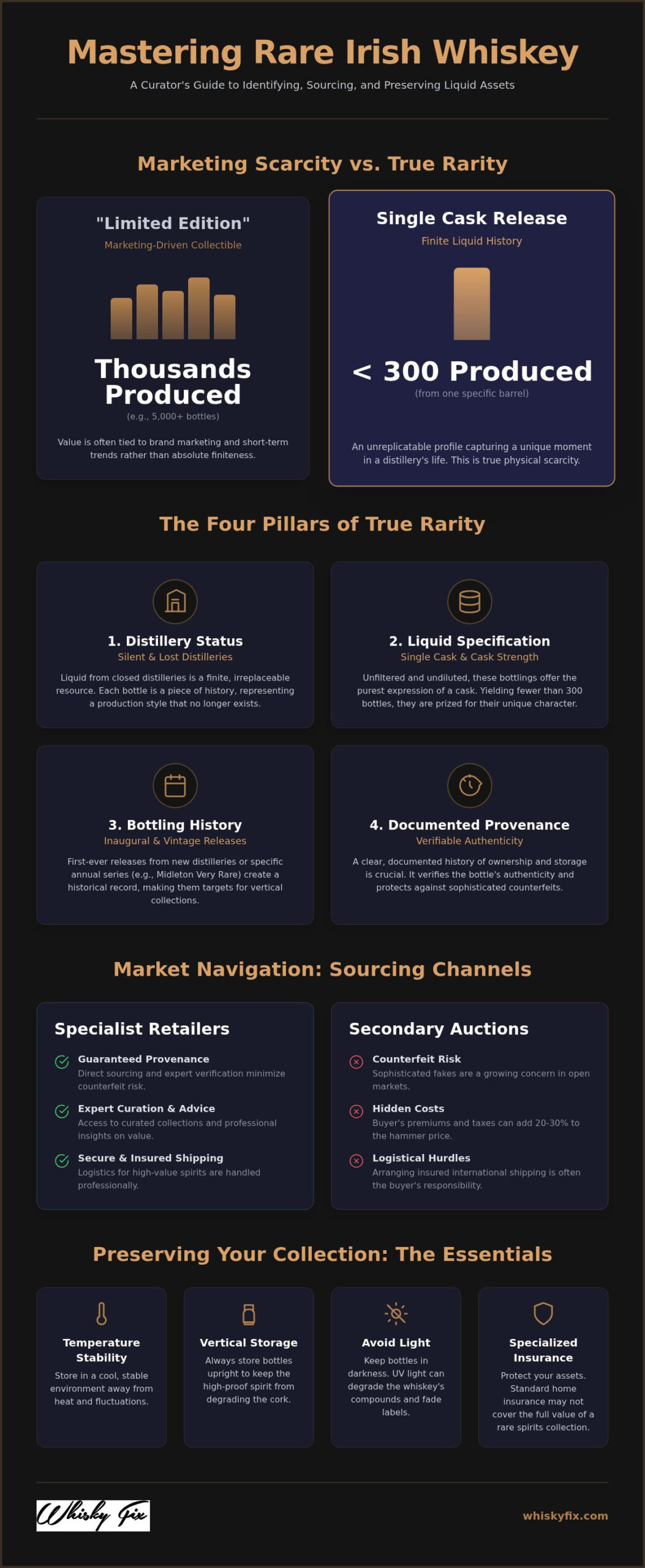
It’s vital to differentiate between marketing scarcity and true physical scarcity. Many “limited editions” are released in batches of several thousand bottles. While these are collectible, they don’t possess the same level of rarity as a single cask release where the total output is measured in the low hundreds. A numbered bottle is a helpful indicator of its place in a series, but its long-term value is ultimately tied to the quality and unique profile of the liquid inside. For modern collectors, inaugural releases from the new wave of Irish distilleries have become a significant focus. These bottles represent the start of a new chapter in the industry and are inherently limited because they can only be produced once.
The Role of Vintage and Cask Type
Specific years drive intense interest among enthusiasts. Annual releases, such as the Midleton Very Rare series, create a chronological record of a distillery’s evolution and are essential for those building vertical collections. Beyond the vintage, the choice of wood plays a critical role in defining rarity. Exotic cask finishes, including Sauternes or Japanese Mizunara oak, add layers of complexity that set these expressions apart from standard core ranges. In the 2026 market, a “unicorn bottle” is defined as a historically significant expression from a closed distillery or a one-off experimental cask that has achieved near-mythical status due to its total absence from the open market.
The Four Pillars of Irish Whiskey Rarity
Identifying an exceptional bottle requires looking beyond the age statement. While historical depletion defines the market broadly, the technical specifications of the liquid provide a deeper layer of exclusivity. We categorize these into four essential pillars: distillery status, liquid specification, bottling history, and documented provenance. Each pillar contributes to the “liquid history” that serious collectors seek to preserve.
The Allure of Silent and Lost Distilleries
Closed distilleries represent a finite resource. Once the last barrel is bottled, that specific distillery’s character is lost to history. These “silent” sites are the holy grail for collectors because the liquid is literally irreplaceable. While many enthusiasts are familiar with the heart of Scotland and its famous lost distilleries, the Irish landscape offers a similarly rich field for discovery. Bottles from these defunct operations command a premium because they represent a style of production that no longer exists in the modern era.
Cask Strength and Single Cask Bottlings
The pinnacle of rare Irish whiskey is the single cask release. Most standard bottlings are vatted from hundreds of casks to ensure a consistent flavor profile. In contrast, a single cask yields fewer than 300 bottles, each capturing the unadulterated profile of one specific barrel. Modern connoisseurs prize these for their natural color and high ABV, as they haven’t been diluted or chill-filtered. For those interested in how these standards compare to international benchmarks, the connoisseur’s guide to single malt Scotch whisky provides an excellent technical parallel for understanding liquid quality.
The physical bottle itself also dictates value. Discontinued bottle shapes and “old style” labels from the mid-20th century are highly prized, even when the liquid inside is relatively young. These aesthetics reflect a bygone era of branding and glass production. However, the most critical pillar remains documented provenance. A verifiable chain of custody ensures the bottle’s authenticity and storage history. This documentation is the only way to confirm that the spirit has been handled with the care a high-value asset deserves.
If you’re looking to expand your collection with bottles that meet these rigorous standards, our shop in Oban serves as a trusted anchor for sourcing authentic rare expressions with global reach.
Market Navigation: Specialist Retailers vs. Secondary Auctions
Acquiring a significant bottle often presents a choice between the high-stakes environment of a secondary auction and the curated security of a specialist retailer. While peer-to-peer marketplaces might offer a wider variety of listings at any given moment, they lack the oversight required to protect a serious investment. Navigating the market for rare Irish whiskey requires a clear understanding of the trade-offs between perceived variety and actual security. Auctions frequently obscure the final cost of acquisition through buyer’s premiums, which can add 15% to 25% to the hammer price, alongside mandatory insurance fees and high-risk shipping charges.
Purchasing through a specialist like Whisky Fix eliminates these variables. We provide transparent pricing and a guaranteed storage history that secondary platforms cannot replicate. Our role as a curator means every bottle is vetted for its physical integrity and authenticity before it ever reaches our shelves. This professional oversight ensures that the premium you pay reflects the true value of the liquid and its provenance, rather than a speculative bidding war.
The Growing Threat of Counterfeit Bottles
Counterfeiting has evolved into a sophisticated operation, moving far beyond crude label reproductions to high-precision replicas. Collectors must be vigilant for red flags such as tampered capsules, inconsistent fill levels, or suspicious adhesive residue around the neck. Specialists verify the authenticity of old and rare expressions by examining glass mould marks and printing techniques that are specific to certain eras. For international collectors, the logistical side of the purchase is just as critical as the authentication. Our guide on importing Scotch whisky to the USA provides essential guidance on navigating the 2026 shipping protocols for high-value glass bottles.
Why Provenance is the Ultimate Value Driver
Provenance is the documented chain of custody that tracks a bottle from the distillery to the current owner. It’s the most critical factor in determining the market value of rare Irish whiskey. A bottle that has been kept in a stable, temperature-controlled environment will always command a higher price than one with an unknown history. Buying from a physical shop in a historic hub like Oban adds a layer of trust; it provides a permanent point of contact and a reputation built on years of expertise. We advise all collectors to request high-resolution condition reports before a transaction. This documentation protects the asset’s value and is indispensable for insurance purposes.
The journey from our shop to your collection is handled with the same level of care. We utilize specialized, impact-resistant packaging designed specifically for high-value international transit. This ensures that delicate wax seals and historical labels remain undisturbed, preserving the bottle’s “liquid history” for the next generation of enthusiasts.
Preserving Your Collection: Storage and Insurance
Securing a significant bottle is only the first step in a collector’s journey. Protecting that asset from environmental degradation is a long-term commitment that requires technical precision. Unlike fine wine, which benefits from horizontal storage to keep the cork moist, rare Irish whiskey must always be kept in a vertical position. The high alcohol content in spirits is corrosive; if the liquid remains in constant contact with the cork, it will eventually dissolve the seal. This leads to evaporation and “cork rot,” a condition that can irreversibly taint the flavor profile and destroy the bottle’s market value.
Technical Storage Parameters for Spirits
Maintaining a stable environment is the most effective way to ensure the longevity of your collection. The ideal temperature range for storing high-value spirits is between 15°C and 18°C. While a slightly cooler room is acceptable, rapid fluctuations are dangerous. Temperature swings cause the air inside the bottle to expand and contract, which can compromise the integrity of the seal over time. Light exposure is another critical factor that collectors often overlook. UV light can degrade both the label and the liquid color in months, stripping away the aesthetic appeal and historical character that define premium expressions. A dark, climate-controlled space is not a luxury; it is a mandatory requirement for any serious gallery of spirits.
Insuring Liquid Assets in 2026
Standard home insurance policies are typically inadequate for high-value spirits. They often fail to account for the appreciation of “Old & Rare” items or the specific risks associated with glass breakage and transit. You should seek out specialist insurers who understand the nuances of the spirits market and offer coverage based on current market valuations rather than original purchase prices. To facilitate this, you must maintain a meticulous digital inventory. This record should include:
- High-resolution photographs of the labels, capsules, and fill levels.
- Original physical receipts from reputable specialist shops.
- Detailed condition reports for every bottle in the portfolio.
- Any Certificates of Authenticity provided at the time of purchase.
These documents are essential for maintaining resale value. A Certificate of Authenticity acts as a bridge of trust for future buyers, proving that the bottle has been vetted by an expert. For a deeper understanding of how these valuation and preservation principles apply across the industry, Rare Scotch: The Definitive Reference provides an excellent parallel for collectors managing diverse portfolios of liquid assets.
If you are ready to add a professionally vetted expression to your cellar, explore our current selection of Old & Rare bottlings, each sourced with impeccable provenance and handled with expert care.
Sourcing Rare Expressions with Whisky Fix
Whisky Fix stands as an independent specialist retailer dedicated to the procurement of the world’s most elusive spirits. From our base in Oban, a historic hub of distilling expertise, we act as a bridge between traditional craftsmanship and a global audience of collectors. While our roots are firmly planted in the Scottish Highlands, our curation of rare Irish whiskey is handled with the same level of professional rigor and technical scrutiny that we apply to our most prestigious Single Malt Scotch Whisky selections. We don’t merely stock bottles; we curate a revolving collection of liquid history that meets the highest standards of provenance and quality.
Many of the most significant bottles never reach a public shelf. For collectors seeking a specific “grail” bottle, we offer a bespoke sourcing service that leverages our extensive network within the industry. Whether you are searching for a specific vintage from a silent Irish distillery or a unique single cask release, our team acts as your dedicated curator. We handle the verification and acquisition process, ensuring that every bottle added to your portfolio is authentic and has been stored in optimal conditions. This service is designed for those who value long-term trust over short-term market trends.
From the Highlands to Your Door: Global Logistics
Moving high-value spirits across international borders requires more than just standard courier services. We’ve developed a specialized logistics framework designed specifically for the transport of rare glass. Every bottle is encased in impact-resistant, temperature-neutral packaging to protect against the rigors of transit. Our expertise extends to the complexities of 2026 international shipping protocols, where we manage all customs documentation and duty requirements on your behalf. This comprehensive approach includes transit insurance for every rare item, providing peace of mind that your investment is protected from the moment it leaves Oban until it arrives at your door.
Expert Consultation for Serious Collectors
Building a meaningful collection is a journey that benefits from professional guidance. We offer personalized consultations for enthusiasts looking to expand their portfolio or those just beginning to explore the “Old & Rare” market. Our team provides insights into market trends, technical specifications, and historical significance, helping you make informed decisions that align with your collecting goals. We encourage you to visit our shop in Oban for a face-to-face consultation, where you can experience our heritage and expertise first-hand. Alternatively, explore our “Old & Rare” section online to discover our latest curated finds and secure a piece of liquid history for your own collection.
Building a Legacy in Liquid History
Building a collection of rare Irish whiskey is a pursuit that balances aesthetic appreciation with disciplined technical management. The 2026 landscape is defined by a shift toward transparency and a deeper focus on technical specifications like cask strength and non-chill filtration. Success in this market depends on your ability to look past marketing scarcity and prioritize the verifiable provenance that only a specialist curator can provide. Proper preservation is equally vital; ensuring your bottles remain vertical and climate-controlled protects the structural integrity of your assets for decades.
Whether you’re seeking a specific inaugural release or a historical bottling from a silent distillery, having a trusted partner in the industry makes all the difference. At Whisky Fix, we leverage our independent status and decades of spirits expertise from our historic hub in Oban to source and authenticate the world’s most elusive expressions. We invite you to explore our curated selection of Rare Whiskeys at Whisky Fix. With our secure worldwide shipping and professional packaging, your next acquisition is handled with the same care you apply to your own collection. Start your journey with a partner who values heritage as much as you do.
Frequently Asked Questions
Is rare Irish whiskey a better investment than Scotch in 2026?
Neither category is universally superior; the choice depends on your specific collection goals. Scotch offers a well-established secondary market with decades of historical data, whereas Irish whiskey is currently in a high-growth premiumization phase. The 2026 global market valuation for Irish spirits reflects a compound annual growth rate of 7.5%. Many collectors find that diversifying across both categories provides the most stable long-term value for their liquid assets.
How can I verify if a rare Irish whiskey bottle is authentic?
Verification requires a thorough inspection of the bottle’s physical characteristics and its documentation. You should examine the capsule for signs of tampering, verify the fill level against historical standards, and check glass mould marks on the base. Specialist retailers like Whisky Fix provide a documented provenance chain and professional condition reports. These records are essential for verifying the integrity of rare Irish whiskey before you commit to a purchase.
What is a silent distillery and why does it matter for rarity?
A silent distillery is a production site that has ceased operations and no longer produces new spirit. This status is critical for rarity because the remaining inventory is finite and cannot be replaced. Once a bottle from a silent distillery is opened, the total world supply decreases forever. These “lost” expressions are the holy grail for collectors because they represent a closed chapter of distilling history that is fundamentally limited.
Does Irish whiskey age in the bottle after purchase?
No, whiskey does not age or improve once it is removed from the wooden cask and sealed in glass. The maturation process relies on the interaction between the spirit and the oak barrel; this stops completely upon bottling. A 12-year-old expression will remain a 12-year-old spirit regardless of how many decades it sits on your shelf. The value is driven by the quality of the initial maturation and the bottle’s preservation.
Can I ship high-value rare whiskey to the USA from Scotland?
Yes, you can ship high-value spirits globally through our specialized logistics framework. We handle the complexities of 2026 international shipping protocols, including customs documentation and duty requirements for the USA. Every bottle is encased in impact-resistant, temperature-neutral packaging designed for high-value glass. We include transit insurance for every rare bottling, ensuring your collection arrives safely from our shop in Oban to any global destination.
What are the most sought-after Irish whiskey brands for collectors?
Collectors focus on brands with significant historical provenance or unique technical specifications. Midleton Very Rare annual releases remain a cornerstone of the market, alongside the Teeling Vintage Reserve Collection and older Redbreast expressions. Inaugural releases from the new wave of Irish craft distilleries are also highly prized as they represent the start of a new legacy. Rarity is often driven by single cask yields rather than brand name alone.
Should I store my rare whiskey bottles lying down or standing up?
You must always store whiskey bottles in a vertical position. Unlike wine, the high alcohol content in rare Irish whiskey is corrosive and will degrade the cork if kept in constant contact. This leads to “cork rot” or a compromised seal, which causes evaporation and ruins the flavor profile. Keeping the bottle standing up ensures the liquid remains away from the cork, preserving the seal’s integrity for decades.
How do I track the market value of my whiskey collection?
Tracking value involves monitoring secondary auction results and specialist retail trends. You should maintain a digital inventory that includes high-resolution photos, original receipts, and detailed condition reports. Professional spirits databases provide historical data on hammer prices, but consulting with a specialist curator offers a more nuanced assessment. For “Old & Rare” items, value is heavily influenced by current global demand and the specific provenance of your individual bottles.