
- October / 1 / 2026
Rare Bourbon: The Ultimate Collector’s Guide to Sourcing and Investing in 2026
A rare bourbon isn’t automatically a valuable one, and a high price is no guarantee of authenticity. When allocated bottles sell for far more than their suggested retail price, collectors need to look beyond the label and the hype.
If you’ve struggled to find sought-after releases at a fair price, or found mash bills, age statements and provenance difficult to assess, you’re not alone. This guide explains how allocation, age and limited releases affect availability, and what to check when assessing a bottle’s history. It also shows how to distinguish genuine scarcity from inflated pricing, so you can make better-informed collecting decisions.
We’ll cover the details that make certain expressions sought after, practical checks that can help identify counterfeit risks, and considerations when sourcing across borders. Whisky Fix is an Oban-based specialist in Old & Rare Scotch, not a bourbon retailer. Its experience offers a global whisky perspective, while that distinction remains important. Whether you’re building a collection or assessing a bottle’s long-term appeal, start with evidence, provenance and a clear understanding of the market.
Key Takeaways
- Learn how allocation, age statements and limited-run releases shape the hierarchy of rare bourbon.
- Compare the appeal of iconic wheated bourbons and sought-after annual collections without assuming scarcity alone signals value.
- Use a focused collecting strategy and examine bottle details and provenance before purchasing through secondary markets.
- Understand how global demand broadens the search for elusive expressions, while checking shipping requirements for your destination.
- Discover how Whisky Fix’s Old & Rare expertise and Scottish roots offer a global perspective, while noting that the retailer specializes in Scotch rather than bourbon.
Understanding Rarity in Bourbon: Allocations, Age, and Artistry
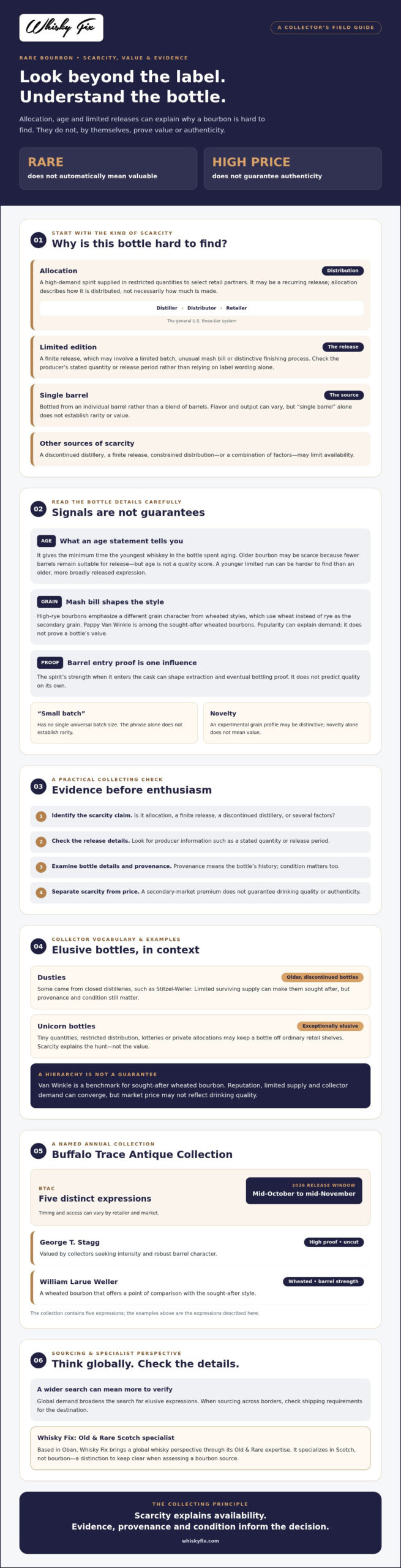
Bourbon’s rarity can reflect constrained distribution, a finite release, a discontinued distillery, or several factors together. Age and a hard-to-find label are only part of the picture. Bourbon is a distinctive product of the United States, but its collecting market extends well beyond its place of origin. Before judging a bottle, identify what kind of scarcity it represents and look for evidence that supports the claim.
Allocated vs. Limited Edition: Knowing the Difference
Allocation is the strategic distribution of high-demand spirits to select partners. An allocated bourbon may be a regular release made repeatedly, but supplied in restricted quantities to retailers. In the United States, the three-tier system generally moves spirits from distillers to distributors and then retailers. As a result, one shop may have access to a bottle that another retailer cannot order. Allocation describes how a bottle is distributed, not necessarily how much of it is made.
A limited edition is defined by the release itself, such as a finite batch, unusual mash bill or distinctive finishing process. A single-barrel bourbon is different again: it comes from an individual barrel rather than a blend of barrels. Its flavor and output can vary, but “single barrel” alone doesn’t mean a release is rare or valuable. Check the producer’s release details for a stated quantity or release period instead of relying on the label wording alone.
Age, Mash Bill, and the Character of Scarcity
An age statement tells you the minimum time the youngest whiskey in the bottle spent aging. Older bourbon may be scarce because fewer barrels remain suitable for release, but age is not a quality score. A younger limited run can be harder to find than an older expression released more broadly. “Small batch” also has no single universal batch size, so the phrase alone doesn’t establish rarity.
Mash bill offers another point of distinction. High-rye bourbons tend to emphasize a different grain character from wheated styles, which use wheat in place of rye as the secondary grain. The popularity of wheated bourbon, including Pappy Van Winkle, helps explain demand for that profile. In 2026, interest in wheated releases continues alongside a broader search for bottles that offer value without inflated secondary-market prices.
Barrel entry proof, the spirit’s strength when it enters the cask, influences how water and whiskey interact during maturation. It can shape extraction and eventual bottling proof, but it doesn’t predict quality on its own. Treat experimental grain profiles as one way producers create distinctive releases, then assess each bottle on its merits rather than assuming novelty means value.
Dusties and Unicorn Bottles
Collectors call older, discontinued bottles “dusties.” Some came from closed distilleries, such as Stitzel-Weller, and their limited surviving supply can make them especially sought after. A “unicorn” is an exceptionally elusive bottle. It may never reach an ordinary retail shelf because quantities are tiny, distribution is restricted, or access is managed through lotteries and private allocations. Scarcity explains the hunt, not the value. Provenance and condition still matter.
The Hierarchy of Rare Bourbon: Icons of the Bluegrass State
At the top of the rare bourbon hierarchy, reputation, limited supply and collector demand converge. Van Winkle remains a benchmark for wheated bourbon, whose mash bill uses wheat instead of rye as the secondary grain. Its standing reflects both a distinctive, sought-after style and the challenge of finding allocated releases. Scarcity can raise a bottle’s profile, but it doesn’t guarantee that its market price reflects its drinking quality.
Kentucky’s broader distilling heritage helps put these icons in context. The Kentucky Distillers’ Association provides an industry perspective on the state’s distillers and bourbon-making tradition. Use that context to look beyond one celebrated label and compare producers, styles and release histories.
The Buffalo Trace Antique Collection Breakdown
The Buffalo Trace Antique Collection, or BTAC, brings together five distinct expressions. Its 2026 release window is mid-October to mid-November, though release timing and access can vary by retailer and market.
- George T. Stagg: A high-proof, uncut expression valued by collectors who seek intensity and a robust barrel character.
- William Larue Weller: A wheated bourbon, bottled at barrel strength, that offers a point of comparison with the Van Winkle style.
- Eagle Rare 17-Year-Old: An aged bourbon whose extended maturation and limited annual release contribute to its appeal.
- Thomas H. Handy Sazerac Rye: A barrel-proof rye whiskey, bringing a grain profile distinct from the collection’s bourbons.
- E.H. Taylor Bottled-in-Bond: Added to the collection in 2025, it completes the five-bottle lineup described for 2026.
The collection draws interest because its bottles span different proofs, grains and maturation approaches. Annual releases keep them in collectors’ view, but availability and demand can shift secondary-market prices. Compare each bottle’s release details and condition, and don’t assume every bottle will appreciate.
Beyond the Big Names: Boutique and Vintage Bottles
Smaller distilleries can create future collectibles through distinctive recipes, limited production and careful maturation. Non-distiller producers such as Barrell Craft Spirits build releases by sourcing and blending whiskey, while Michter’s is a distiller in its own right, not an NDP. Retailer-selected single barrels can also be compelling, but each barrel is individual. Selection alone doesn’t establish rarity or quality.
Vintage bourbon from the 1970s or 1980s may attract interest because it reflects an earlier era of production. Yet age brings practical concerns: check seal integrity, fill level, storage history and documented provenance before buying. Similar care matters when collecting rare Scotch. For a comparison of how specialists present old and rare spirits, Whisky Fix’s Old & Rare Scotch selection offers a useful reference, though the retailer specializes in Scotch rather than bourbon.
The Global Hunt: Sourcing Elusive Expressions in 2026
Rare bourbon is no longer limited to the U.S. retail hunt. Collectors may encounter sought-after bottles through international auctions and specialist markets, where access can be broader but verification and delivery need extra care. A bottle appearing overseas isn’t automatically an export-only release. Confirm whether the producer made it for a particular market or whether it was resold across borders.
International availability can reflect different distribution channels, release allocations or collector resale. Specialists in old and rare spirits may draw on knowledge across markets to help identify bottles that aren’t visible in a collector’s local shops. Whisky Fix, based in Oban, Scotland, specializes in Old & Rare Scotch and international spirits. Its experience offers a perspective on global whisky sourcing, but it shouldn’t be mistaken for a retailer of bourbon.
International Sourcing: The Specialist Advantage
A knowledgeable specialist can help you ask better questions about a bottle’s origin, condition and documentation. A rare label alone is not proof of authenticity. Before pursuing an overseas bottle, establish who is selling it, where it has been stored and what records accompany it. For background on cross-border considerations, see Whisky Fix’s guide to importing Scotch whisky to the USA. That guide concerns Scotch, so check current rules for the specific spirit, route and destination before arranging a shipment.
Shipping high-value spirits internationally may involve destination-specific restrictions, taxes, carrier requirements and packaging considerations. Requirements can change, and rules for Scotch shouldn’t be assumed to apply to bourbon. Verify the current requirements with relevant authorities and the carrier before purchase, particularly if the bottle’s value or proof makes the shipment more complex.
Evaluating Provenance in a Global Market
Request clear photographs of the bottle, closure, label, fill level and any identifying codes. Ask for purchase records or auction documentation where available, then compare the details with reliable references for that specific release. Be cautious if a seller avoids basic questions, gives an inconsistent history, pressures you to act immediately, or can’t explain how the bottle came into their possession. An established retailer is not automatically risk-free, but transparent records and clear terms make it easier to assess a bottle than an undocumented private sale.
Chain of custody means documenting who has owned or handled a bottle and when. A credible record helps establish provenance and can strengthen confidence in a valuation. Keep invoices, correspondence and shipping documents together after purchase. For a broader perspective on specialist curation and worldwide shipping, explore Whisky Fix’s Old & Rare spirits selection, while confirming that any bottle you seek is within the retailer’s stated offerings.
Building a Portfolio: Provenance, Storage, and Valuation
A considered collection begins with a clear purpose, not a chase for every bottle described as rare. Decide whether you’re drawn to particular distilleries, age statements, mash bills or high-proof releases. Then record what you buy and why. A consistent record makes it easier to compare new finds with your interests instead of reacting to market excitement.
- Set your focus: Choose a collecting theme and record each bottle’s release details and purchase information.
- Inspect authenticity: Examine the seal, label, tax strip where applicable, and laser codes. Compare them with reliable references for that exact release. No single feature proves authenticity by itself.
- Store carefully: Keep bottles upright, away from direct sunlight and large temperature swings.
- Track evidence: Compare completed auction results and specialist retail listings. Note the date and bottle condition rather than relying on asking prices.
- Broaden thoughtfully: Exploring Whiskies of The World can add geographic and stylistic variety to a collection, though variety alone doesn’t protect against market losses.
The Science of Bourbon Storage
Unlike wine, spirits aren’t stored on their sides to keep the cork moist. Keep bourbon upright so prolonged contact with high-proof liquid doesn’t contribute to cork deterioration. Choose a stable, cool, dark location. Sunlight and heat can affect a bottle’s contents, while repeated temperature changes may stress the closure. Avoid displaying valuable bottles in bright windows or near heat sources.
Older corks may be fragile. Handle vintage and Old & Rare bottles gently, avoid unnecessary movement, and inspect the closure for leakage or crumbling. If a cork appears compromised, don’t force it. Seek guidance from a knowledgeable spirits professional before opening or recorking, as careless handling can damage the bottle and complicate its provenance.
Determining the Value of a Rare Bottle
MSRP is the manufacturer’s suggested retail price. Secondary-market value reflects what buyers have actually paid through channels such as auctions, and it can differ sharply from MSRP or current asking prices. Compare like with like: release, bottle condition, packaging, location and sale date all matter. A limited edition indicates a restricted release, not a promise of future appreciation. Demand can cool, and resale costs or bottle condition may affect what a seller ultimately receives.
For a useful cross-category comparison, read this connoisseur’s guide to single malt Scotch. Whisky Fix specializes in Old & Rare Scotch and other international spirits, not bourbon. To explore its confirmed range, browse Whisky Fix’s spirits selection.
Why Whisky Fix is the Connoisseur’s Choice for Rare Spirits
Whisky Fix brings a Scottish specialist’s perspective to collectors exploring fine spirits across borders. Based in Oban, the independent retailer focuses on single malt Scotch and Old & Rare expressions. That experience offers useful context for assessing age, origin, condition and provenance, considerations that also matter to collectors of rare bourbon.
There is an important distinction: Whisky Fix specializes in Scotch and international spirits, and doesn’t offer bourbon as a confirmed product. It shouldn’t be presented as a source for elusive American bottles or as a way to bypass U.S. allocation channels. Its relevance to a bourbon collector is the wider perspective: seeing how specialists describe, curate and present rare spirits can help inform your own sourcing decisions.
From Oban to the World: A Specialist’s Perspective
Experience with single malt Scotch develops an appreciation for how place, production, maturation and bottle history shape a spirit’s identity. Those principles can help collectors ask more precise questions across categories, without suggesting that Scotch and bourbon are made or regulated in the same way. Whisky Fix also hosts professional tasting events, offering opportunities to explore spirits through guided tasting. Check event details and the spirits featured directly.
For any high-value bottle, look for clear information about its identity, condition and history. A specialist retailer’s knowledge can help you understand what is being offered, but no description should replace your own checks of the bottle and its documentation. Provenance matters, and claims about authenticity should be supported rather than assumed.
Explore Old & Rare Spirits
Collectors interested in old and rare Scotch can browse Whisky Fix’s confirmed range and assess each expression on its own details. The retailer offers worldwide shipping for its products, but delivery options depend on the destination and applicable requirements. Check current shipping information before ordering, particularly for high-value or high-strength spirits.
If your focus is bourbon, continue to verify the seller, bottle condition, provenance and market evidence through sources that specifically handle bourbon. For a perspective rooted in Oban and specialist knowledge of Scotch, explore Whisky Fix’s Old & Rare spirits.
Collect with Care and Keep Exploring
A thoughtful rare bourbon collection starts with understanding why a bottle is scarce, then looking beyond the label to its provenance, condition and documented market history. Allocation, age and limited production can all shape availability, but none guarantees quality or future value. Careful storage and a clear collecting focus help protect both the bottle and the story behind it.
For bourbon, verify the seller and shipment requirements for your destination before buying. Whisky Fix is an independent specialist retailer based in Oban, Scotland, with expertise in single malt Scotch and a curated range of Old & Rare spirits. It offers worldwide shipping, subject to destination requirements, but does not specialize in bourbon.
Explore Whisky Fix’s confirmed Scotch offerings and discover another perspective on collecting: browse Whisky Fix’s Old & Rare collection. Keep asking careful questions, trust documented provenance over hype, and let curiosity guide your next find.
Frequently Asked Questions
What makes a bourbon considered “rare”?
A bourbon is considered rare when its availability is limited relative to collector demand. Scarcity can come from restricted allocation, a finite release, an individual barrel, long maturation, or a discontinued distillery. These are different forms of rarity, and none automatically means the whiskey is exceptional or valuable. Check the release details, production context, bottle condition and provenance rather than relying on words such as “limited” or “small batch” alone.
Is rare bourbon a good investment in 2026?
Rare bourbon can attract collectors, but it isn’t a dependable investment. In 2026, the secondary market has cooled from earlier peaks for many allocated bottles, even as highly sought-after releases continue to draw strong interest. Prices can fluctuate, and future demand is uncertain. Consider whether you value a bottle for its history and drinking experience, and research completed sales for comparable releases before making a purchase.
How can I tell if a bottle of rare bourbon is authentic?
No single detail proves a bottle is genuine, so assess the evidence together. Request clear images of the closure, label, fill level, tax strip where applicable and any laser codes. Compare them with reliable references for that specific release, and ask for purchase records or auction documentation. Be cautious if the seller’s story changes, key details are obscured, or they pressure you to buy before you can verify the bottle.
Why is Pappy Van Winkle so hard to find and expensive?
Pappy Van Winkle is difficult to find because demand for its wheated bourbon profile exceeds the supply available through regular retail channels. Allocation limits how many bottles reach individual retailers, and collectors compete for each release. That imbalance can push secondary-market prices well above suggested retail prices. Scarcity and reputation explain the premium, but they don’t guarantee that every asking price is fair or that a bottle will appreciate.
Does Whisky Fix ship rare bourbon to the USA and internationally?
No, Whisky Fix’s confirmed offerings don’t include bourbon. The independent retailer, based in Oban, Scotland, specializes in single malt Scotch, Old & Rare expressions and other listed spirits, and offers worldwide shipping for its products. Whether a particular spirit can be shipped to a destination depends on current requirements, so check the retailer’s shipping information and relevant rules before ordering. Don’t assume Scotch shipping information applies to bourbon.
How should I store my rare bourbon to preserve its value?
Store bourbon upright in a cool, stable, dark place. Unlike wine, it shouldn’t be kept on its side, since extended contact between high-proof spirit and cork may contribute to cork deterioration. Keep bottles away from direct sunlight, heat sources and temperature swings, which can affect condition over time. Handle older bottles gently, retain original packaging and purchase records, and periodically check for leakage or a falling fill level.
What is the Buffalo Trace Antique Collection?
The Buffalo Trace Antique Collection is an annual lineup of sought-after American whiskeys. The 2026 collection includes George T. Stagg, William Larue Weller, Thomas H. Handy Sazerac Rye, Eagle Rare 17-Year-Old and E.H. Taylor Bottled-in-Bond. The bottles vary in grain profile, proof and maturation, so the collection isn’t composed solely of bourbons. Its limited annual releases and collector demand contribute to difficult availability and changing secondary-market prices.
What is the difference between bourbon and Scotch rarity?
Bourbon and Scotch rarity reflect different production traditions and collecting histories. Rare bourbon scarcity is often associated with allocations, limited releases, single barrels or bottles from discontinued distilleries. Rare Scotch may be prized for a particular distillery, vintage, age statement, single cask or discontinued bottling. Both markets rely on condition, provenance and demand, but a label’s age or scarcity alone doesn’t establish quality or future value.