

- October / 23 / 2026
Most sought-after whisky bottles 2026: what makes them collectible
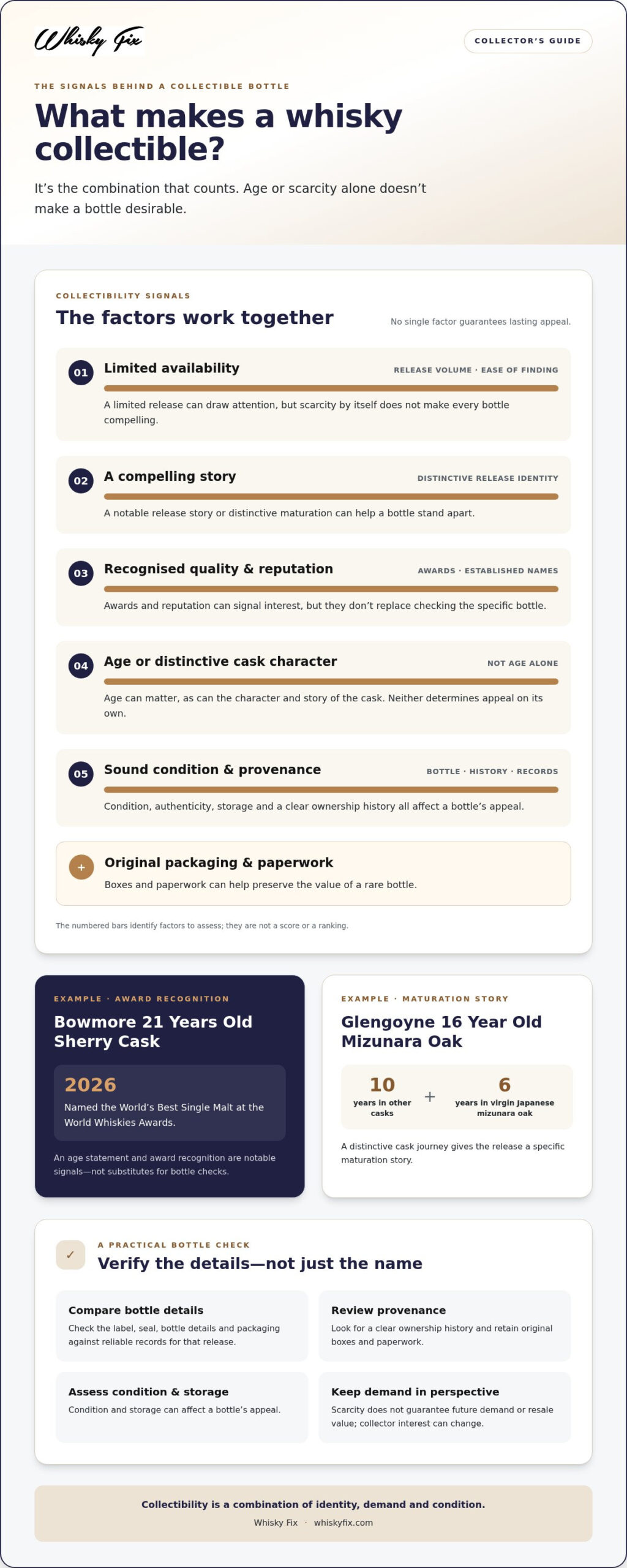
Rarity alone doesn’t make a whisky collectible. The strongest candidates combine limited availability with a compelling story, recognised quality, age or distinctive cask character, and sound condition; original boxes and paperwork can help preserve a rare bottle’s value. For collectors considering the most sought-after whisky bottles 2026 has to offer, Bowmore 21 Years Old Sherry Cask stands out after being named the World’s Best Single Malt at the 2026 World Whiskies Awards.
It’s understandable to assume that older always means more desirable. In practice, demand also depends on how many bottles were released, a whisky’s reputation, and how readily collectors can find it. Scarcity can attract attention, but it doesn’t make every limited release equally compelling.
This guide explains the qualities that can make a bottle collectible, how availability shapes interest, and which established names and releases may draw attention in 2026. You’ll also find practical ways to assess a bottle’s condition and provenance, so you can distinguish a release with lasting appeal from one whose attraction rests mainly on limited supply.
Key Takeaways
- Assess collectibility through a combination of reputation, distinctiveness, and release availability rather than age alone.
- Explore how the 54 single-cask expressions in Hanyu Ichiro’s Malt Card Series illustrate the appeal of a defined, finite collection.
- Consider how limited supply and discontinued releases can shape collector interest, while remembering scarcity alone doesn’t determine desirability.
- Compare Macallan vintage and age-stated releases by their release history and collector appeal, not just the age on the label.
- Use interest in Hibiki 21-Year and 30-Year expressions as a guide to bottles that may attract attention in 2026, not as a guarantee of future demand.
1. What makes a whiskey bottle collectible?
A collectible bottle combines a distinctive identity with demand, scarcity, and strong condition. Age matters, but it doesn’t determine appeal alone. Bowmore 21 Years Old Sherry Cask, named the World’s Best Single Malt at the 2026 World Whiskies Awards, has both an age statement and award recognition. Original packaging and paperwork can help preserve a rare bottle’s value.
Special-occasion Scotch often draws interest through age, cask influence, or a notable release story. Older whiskies can be compelling gifts, while sherry casks may bring flavours associated with dried fruit and sweetness. Glengoyne 16 Year Old Mizunara Oak offers a distinctive maturation story: it spent six years in virgin Japanese mizunara oak after its first decade in other casks. A gift or collection choice should still suit the recipient’s taste, not just its rarity.
There isn’t one universal list of single malt Scotch bestsellers. Sales rankings change, while established names such as Lagavulin and Macallan attract attention for different reasons. Beginners might start with a clearly defined age-stated Scotch and compare its flavour with another style. Lagavulin 8 Year Old, bottled at 48% ABV, offers an example of a named Islay single malt to explore.
For value-minded choices, compare character and bottling details rather than assuming that a lower-priced bottle is automatically better value. Deanston 12 Year Old is bottled at 46.3% ABV, while Compass Box Orchard House is bottled at 46% ABV. These examples offer starting points for comparing Scotch styles without treating cost as a measure of quality.
Which American whiskey and bourbon bottles are most sought-after in 2026? Names attracting collector interest include Pappy Van Winkle expressions and Buffalo Trace Antique Collection releases, including Eagle Rare 17-Year and Sazerac 18-Year Rye. William LaRue Weller is an annual limited release in that collection.
How much do sought-after whisky bottles cost in the U.S. in 2026? On the market, bourbon whiskey bottles typically range between 177 and 455 USD, with a median about 215. That aggregate range describes bourbon offers, not every sought-after whisky.
Which rare bottles have the highest auction prices or investment returns? There is no universal leader among these examples. Collector interest in names such as Pappy Van Winkle depends on the specific release, condition, provenance, and demand.
How can buyers verify authenticity and provenance? Compare the label, seal, bottle details, and packaging with reliable records for that release. Preserve original boxes and paperwork, and look for a clear ownership history.
What risks should collectors consider before investing? Scarcity does not guarantee future demand or resale value. Condition, authenticity, storage, and changing collector interest can all affect a bottle’s appeal.
2. Karuizawa and Hanyu Ichiro’s Malt Card Series
Karuizawa and Hanyu Ichiro’s Malt Card Series represent two distinct routes into Japanese whisky collecting. With a named distillery, cask details, and individual bottling identity, a single-cask expression offers a clear focus for comparison. The Hanyu Card Series consists of 54 single-cask expressions, making the complete series a defined collection rather than an open-ended search. Collectors can compare each bottle’s release details and condition, then decide whether they value one expression or the series as a whole.
That structure helps explain why the Hanyu series attracts attention among Japanese whisky enthusiasts. Each expression has its own cask identity, while the series ties the bottles together. Collectors can document the expressions they own and note gaps without assuming that every bottle has equal demand. Apply the same disciplined approach to Karuizawa: assess the specific bottle, its provenance, and its condition rather than treating a distillery name as proof of value.
Awards offer another way to identify releases attracting notice, though a medal alone doesn’t establish collectibility. In 2026, Ichiro’s Malt & Grain Blended Japanese Whisky was named the World’s Best Blended Limited Release. Kwun Cheung Mongolian Oak Aged received the World’s Best Blended Malt title. These distinctions make the bottles relevant examples for readers comparing premium blended expressions with single malts.
The World’s Best Single Malt title is a separate category from blended whisky awards. Bowmore 21 Years Old Sherry Cask received that title at the 2026 World Whiskies Awards. Its recognition can help collectors identify a notable release, but it shouldn’t replace checks of the bottle’s provenance, presentation, and condition.
What are the most sought-after Japanese and Irish whisky bottles in 2026? Japanese examples include the 54-expression Hanyu Card Series and Ichiro’s Malt & Grain Blended Japanese Whisky, a 2026 award winner. Irish award examples include Red Spot, named the World’s Best Pot Still whisky, and Fercullen 15 Year Old, named the World’s Best Grain whisky. These awards identify notable bottles, not a definitive ranking of demand.
Keep categories precise while comparing styles. Red Spot is recognised as pot still whiskey, while Fercullen 15 Year Old is recognised as grain whisky; neither award identifies an Irish single malt. If you’re comparing international releases with Scotch, explore whiskies from around the world by style and origin, then record the bottling details that distinguish each expression.
3. Bottle availability
Availability affects collector interest because a bottle’s supply determines how easily enthusiasts can acquire it. In March, the U.S. received 150 bottles of Glengoyne Oak Masters Mizunara Scotch. That limited allocation makes the release harder to find in that market than a broadly distributed bottling. It doesn’t establish future value, but it gives collectors a concrete supply detail to consider alongside age, cask history, and condition.
Annual releases create a different pattern. Michter’s 25-Year Bourbon is described as one of the rarest annual American releases in production. William LaRue Weller is also an annual limited release in the Buffalo Trace Antique Collection. With a recurring release, availability may change from one release to another. Record the exact expression and release details rather than treating a familiar name as a single, unchanged bottle.
Discontinuation can make an existing bottle more difficult to replace. Hibiki 17-Year was discontinued, so its remaining supply differs from that of an active release. That fact can influence attention, but scarcity alone does not explain a bottle’s appeal. Collectors also consider condition, provenance, reputation, and whether the whisky suits their own collection.
Limited annual releases can attract continuing demand. Yamazaki 18-Year is identified as a limited annual release that can carry secondary-market value when sealed and in good condition. Yamazaki 25-Year is also identified as a limited annual release that trades at a meaningful secondary-market premium. The specific expression and bottle condition therefore matter; the distillery name alone cannot describe every release’s availability.
For American whiskey, distinguish a limited release from a single-barrel bottling. A single barrel comes from one cask, while “straight” describes a whiskey category, not the number of bottles released. Neither term alone proves that a bottle is exclusive or scarce. Read the label and release information together, then compare the stated batch or cask identity with the bottle.
Use a simple record to assess supply without confusing rarity with desirability. Note the expression, release type, market or region, packaging, and whether it is discontinued or recurring. Add the bottle’s seal and condition, since Yamazaki 18-Year’s stated secondary-market appeal specifically depends on being sealed and in good condition. If flavour matters more than scarcity, compare tasting descriptions, such as vanilla notes or a lingering finish, with your preferences.
These distinctions help explain why the most sought-after whisky bottles 2026 may be limited, discontinued, or regionally allocated. A small shipment such as Glengoyne’s U.S. allocation is a useful availability signal, while annual releases like William LaRue Weller follow a different supply pattern. Compare like with like, and treat each release as its own bottle, not simply a famous name.
4. Macallan vintage and age-stated releases
Macallan offers collectors two useful label clues: vintage year and age statement. A vintage identifies the year associated with the whisky, while an age statement gives the minimum age of the whisky in the bottle. These details help distinguish releases, but don’t make every bottle equally collectible. Compare the exact expression, packaging, and condition before adding a Macallan to a collection.
Pre-2000 Macallan Fine & Rare vintages attract collector attention. Their appeal rests partly on the combination of a named vintage and a release from an earlier period. The vintage is only one part of the bottle’s identity, however. Record the full label wording and examine whether the box and paperwork match the release. This creates a clearer reference point when comparing bottles from different years.
Age-stated releases also have distinct collecting histories. Pre-2018 Macallan 18-Year annual releases are identified as collector bottles. Macallan 25-Year and 30-Year Sherry Oak releases are also regarded as collector bottles when they’re in good condition with original packaging. For either age statement, assess the bottle and its presentation together. An impressive age on the label cannot replace sound condition or clear provenance.
Compare expressions by their maturation identity rather than treating every Macallan as interchangeable. Macallan 12 Year Old Sherry Oak and Macallan 18 Year Old Double Cask are separate named releases. The Macallan 12 Year Old 110 Proof offers another distinct bottling, at 55% alcohol by volume. A collector’s notes can capture each release’s name, age statement, bottling details, and packaging, helping prevent confusion between expressions.
Use a practical comparison method. First, transcribe the exact expression and age statement. Next, note any vintage, bottling strength, and packaging. Then compare those details with the bottle’s condition and documentation. For example, a pre-2000 Fine & Rare vintage should be assessed as that specific vintage, not merely as “old Macallan.” This careful description preserves useful context for future reference.
The word “character” can describe a whisky’s sensory profile, but it doesn’t establish rarity or future demand. A sherry-cask release may appeal to someone seeking that maturation style, while another collector may prioritise a vintage or age statement. Keep tasting preferences separate from scarcity when considering a release. Macallan’s varied age-stated and vintage bottlings show why precise identification matters.
These distinctions help readers evaluate Macallan among the most sought-after whisky bottles 2026 may bring into focus. Treat each release as an individual bottle, and assess its label, packaging, condition, and provenance together. That approach makes comparisons more meaningful than relying on the Macallan name or age alone.
5. Predicted popular whiskies for 2026
Interest in 2026 releases can be assessed through three signals: awards, a distinctive production story, and limited availability. None gives a complete forecast alone. For example, an award highlights judged quality, while an unusual cask or an age statement gives collectors a specific feature to follow. Compare these signals rather than treating any single one as a ranking.
What are the most sought-after Scotch whisky bottles in 2026? Among Scotch examples, Lagavulin 11 Year Old Sweet Peat offers a distinctive profile, with 35 ppm peat and 86 proof. Glenallachie 1990 is another bottle to watch, a 35-year-old cask-strength Speyside whisky with an extended cask-finishing story.
Lagavulin Sweet Peat gives collectors concrete bottling details to record. Its 35 ppm peat level and 86 proof help distinguish it from other releases bearing the distillery name. Compare those specifications with your palate preferences, then note the exact expression and bottling details. This makes the bottle easier to identify and compare within a collection.
Glenallachie 1990 may appeal to collectors drawn to mature spirit and complex maturation. It spent about three decades in ex-bourbon barrels, followed by finishing in four cask types for three to six years. That sequence gives the release a specific story beyond its age statement. For a collector, the original cask details provide a useful basis for comparing its character with other Speyside whiskies.
Awards offer another signal of attention. At the 2026 World Whiskies Awards, Ballantine’s 23 Years Old was named the World’s Best Blended whisky. The title distinguishes a particular category and release; it doesn’t make the bottle a single malt or establish its future demand. Keep the award, whisky style, and release identity separate in your notes.
Collectors can make a practical shortlist by recording each candidate’s distillery, expression, age statement, cask story, and award recognition. Then compare those details with availability and condition. A distinctive barrel finish may matter to one palate, while another collector may prefer an original release with a recognised award. These criteria help turn broad interest in 2026 bottles into specific comparisons.
For a Scotch-focused shortlist, compare releases by their stated style and maturation, not by reputation alone. Record what distinguishes Lagavulin Sweet Peat from Glenallachie 1990, then decide which characteristics suit your collection. You can explore Scotch whisky releases while comparing expressions with those criteria.
Whisky Fix: Single Malt Scotch Whisky
Whisky Fix offers a natural next step for readers ready to explore the styles and release details discussed here. Its Single Malt Scotch Whisky selection lets enthusiasts browse Scotch expressions, while Old & Rare offers another route for those drawn to older, harder-to-find bottles. Use the criteria in this guide to focus your search: compare the distillery, age statement, cask character, condition, and provenance rather than relying on reputation alone. Whisky Fix also offers worldwide shipping for online purchases. Whether you’re refining a collection or choosing a bottle for a special occasion, explore the selection at your own pace. Visit whiskyfix.com to browse Whisky Fix’s whisky offerings.
Build a Collection Around Your Own Taste
The most sought-after whisky bottles 2026 may attract attention, but a collection becomes more rewarding when each bottle has a reason to belong. Choose a direction that reflects your palate, whether that means exploring a distillery, following a cask style, or seeking an older expression for a special occasion. Let rarity inform your decision, not make it for you.
For your next step, Whisky Fix offers Single Malt Scotch Whisky and Old & Rare bottles for collectors exploring Scotch, alongside Scottish Gin for a different tasting occasion. If you’re weighing expressions or looking for a bottle that suits your interests, contact Whisky Fix to discuss whisky. Take your time, follow your curiosity, and let each addition bring something distinctive to your collection.
Frequently Asked Questions
What makes a whiskey bottle collectible?
A whiskey bottle becomes collectible when its identity and story matter to enthusiasts beyond its contents. A discontinued expression, distinctive maturation, recognised award, or place in a defined series can give collectors a reason to seek it. The purpose of collecting also matters: someone building a regional tasting set may value a bottle differently from someone focused on award-winning releases. Decide what makes a bottle meaningful to your collection before pursuing it.
Which whisky bottles are most sought-after in 2026?
The most sought-after whisky bottles 2026 include Hibiki 21-Year and 30-Year expressions, which are attracting strong interest. Collectors following award recognition may also consider 2026 winners such as Ballantine’s 23 Years Old, named the World’s Best Blended whisky. These examples represent different styles and reasons for attention. Compare each release’s category and story with your collecting interests rather than treating any list as a definitive ranking.
What makes a whisky bottle highly collectible or in demand?
Demand tends to build when a release combines a recognisable identity with qualities collectors value, such as a distinctive cask story or limited availability. A bottle’s appeal can also depend on its condition and interest in its distillery or style. After purchase, store whisky upright in a cool, dark place, since heat and sunlight can affect the spirit and its label.
Where can U.S. buyers find sought-after whisky bottles at retail or auction?
U.S. buyers can browse online retail selections, including Whisky Fix’s Single Malt Scotch Whisky and Old & Rare offerings, with worldwide shipping. Auction listings are another way to locate older or less commonly seen releases. Compare the exact expression, lot description, bottle condition, and provenance before deciding. Retail suits buyers seeking an online purchase; auctions can help collectors search for specific bottles that may be harder to find through retail.
Which rare whisky bottles have the highest auction prices or investment returns?
There is no universal leader. Collector interest in bottles such as Pappy Van Winkle depends on the specific release, condition, provenance, and demand.