
- September / 16 / 2026
Lost Distilleries of Scotland: The Definitive Guide to Ghost Whiskies
Every time a cork is pulled from a bottle of Brora or Port Ellen, the world’s supply of that specific liquid shrinks forever. These are the ghost spirits of the lost distilleries of Scotland whisky collectors pursue with such intensity. They represent a vanished era of craftsmanship, captured in glass before the “Whisky Loch” of the 1980s forced many legendary sites to fall silent. These bottles are more than just spirits; they are finite time capsules of a production style that no longer exists.
You likely recognise the prestige of owning such a relic, but identifying which “silent” names hold genuine value can be a daunting task. The distinction between a closed, mothballed, or recently revived distillery like Rosebank is often blurred by complex terminology. We’ll clarify these definitions and show you how to identify the blue-chip names that define the category. This guide provides the historical context and technical expertise you need to source these rare expressions safely in 2026. We will explore the legendary names, examine the impact of recent global trade shifts, and explain how modern authentication ensures the absolute provenance of your collection.
Key Takeaways
- Understand the critical technical differences between “silent,” “mothballed,” and the lost distilleries of Scotland whisky to accurately assess rarity and market value.
- Explore the historical impact of the 1980s overproduction era and how corporate consolidation permanently extinguished some of the world’s most unique stills.
- Familiarise yourself with the legendary profiles of ghost icons such as Port Ellen and Brora to understand why they remain the gold standard for enthusiasts.
- Learn to navigate the 2026 secondary market by distinguishing between the value of official distillery releases and prestigious independent bottlings.
- Discover how to safely source authenticated “Old & Rare” bottles from specialist curators who provide secure global shipping for international collections.
What is a Lost Distillery? Defining Scotland’s Ghost Whiskies
A lost distillery is a site that has permanently ceased production, typically resulting in the removal of its copper stills or the complete demolition of its structures. These locations are the sources of what enthusiasts call “ghost whiskies,” spirits that represent a finite, non-renewable resource. Unlike active distilleries that can alter their output to meet market trends, the flavour profile of a lost distillery is frozen in time. Once the last cask is emptied, that liquid history vanishes. This scarcity creates an emotional and historical weight, turning each bottle into a tangible piece of heritage that can never be replicated by modern means.
To understand the lost distilleries of Scotland whisky market, you must first master the industry’s specific vocabulary. While these terms are often used interchangeably in casual conversation, the technical distinctions are vital for serious collectors. You can find a comprehensive list of closed distilleries that illustrates just how many of these icons have disappeared since the 19th century, each leaving behind a dwindling legacy of maturing stock.
The Terminology of Rarity
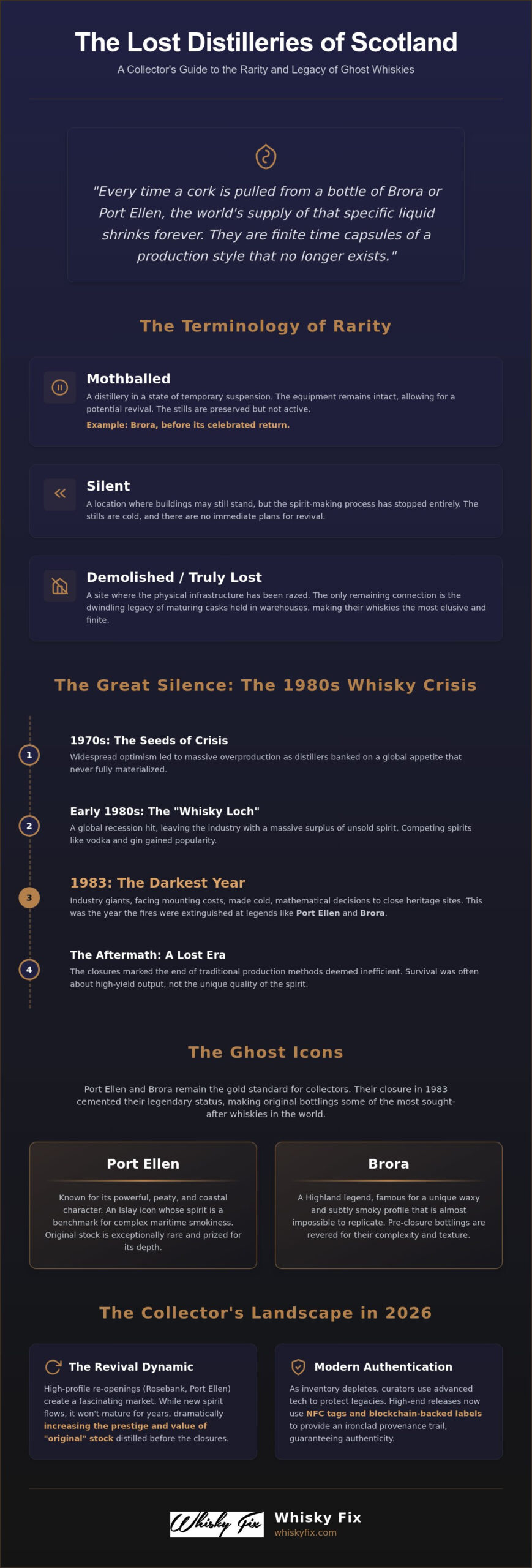
The status of a non-operational distillery usually falls into one of three categories. A “mothballed” site is one that has been placed into a state of temporary suspension. The equipment remains intact, allowing for a potential revival, as seen with the celebrated return of Brora. A “silent” distillery refers to a location where the buildings still stand, but the spirit-making process has stopped entirely and the stills are cold. Finally, a “demolished” distillery is a site where the physical infrastructure has been razed. In these cases, the only remaining connection to the distillery is the remaining casks held in bonded warehouses, making them the most elusive expressions of the lost distilleries of Scotland whisky category.
Why 2026 is a Turning Point for Ghost Whiskies
As we move through 2026, the landscape for these rare spirits is shifting rapidly. The high-profile re-openings of legendary names like Rosebank and Port Ellen have created a fascinating market dynamic. While new spirit is flowing once again, it won’t reach maturity for many years. This often increases the prestige of the “original” stock distilled before the gates closed decades ago. Simultaneously, the mathematical reality of inventory depletion is setting in. With fewer casks remaining, curators now use advanced technology to protect these legacies. Many high-end “Old & Rare” releases now utilise NFC tags and blockchain-backed labels to provide an ironclad provenance trail, ensuring that the bottle you acquire is an authentic relic of Scotland’s distilling past.
The Great Silence: Why Scotland’s Distilleries Fell Silent
The disappearance of these sites wasn’t a gradual decline but a sudden, traumatic fracture in the industry. During the 1970s, optimism led to massive overproduction, as distillers banked on a global appetite that never materialised. When the global recession hit, the industry was left with a surplus so vast it became known as the “Whisky Loch.” Many famous lost distilleries were once the primary employers in their rural communities, and the lost distilleries of Scotland whisky collectors now treasure were often the victims of this economic collapse. Beyond the financial loss, the closures meant the end of traditional production methods that corporate owners deemed too inefficient for the modern age.
The 1983 Crisis: The Year the Stills Went Cold
1983 stands as the darkest year in Scottish distilling history. It was the year that industry giants, faced with mounting costs and a “Whisky Loch” that peaked in the mid-1980s, decided to extinguish the fires at Port Ellen and Brora. This era saw a significant shift in consumer behaviour; the rise of vodka and gin meant that brown spirits were viewed as antiquated by a new generation. The “Whisky Loch” refers to the massive surplus of unsold spirit that accumulated during the 1980s economic crash, forcing an industry-wide contraction. Corporate owners had to choose which sites to sacrifice to save the wider business. It was a cold, mathematical process that prioritised high-yield sites over heritage.
The Survival of the Fittest vs. The Luck of the Draw
Deciding which stills survived was rarely about the quality of the spirit. Often, “workhorse” distilleries stayed open because they were efficient or produced a neutral flavour profile that was easy to use in mass-market blends. Legendary names in the lost distilleries of Scotland whisky category were often closed precisely because they were too unique or too expensive to run. Sites with traditional floor maltings or inefficient, direct-fired stills were the first to be cut. Ironically, the very characteristics that made these distilleries “inefficient” in 1983 are what make their remaining bottles so prized by modern connoisseurs. If you are looking to secure a piece of this history, you can explore our curated collection of Old & Rare expressions to find these elusive spirits. The move from volume-based blending to the appreciation of single malts eventually saved the industry, but it came too late for these ghost icons.
The Ghost Icons: Legendary Lost Names Every Collector Should Know
The 1983 crisis didn’t just close doors; it inadvertently created a pantheon of spirits that define the lost distilleries of Scotland whisky market today. While dozens of sites were shuttered, a handful of names have achieved a cult-like status among global collectors. These “Ghost Icons” are prized not only for their rarity but for specific flavour profiles that modern production methods struggle to replicate. Owning a bottle from these stills is a way to experience a specific moment in Scottish heritage that’s gone forever.
The Big Three of the Silent Era
Port Ellen remains the ultimate Islay ghost. Its character is defined by an industrial, smoky character that balances heavy peat with a distinct, oily metallic note. Unlike modern Islay whiskies, Port Ellen’s smoke feels integrated into the very texture of the spirit, a result of traditional floor maltings and the specific Islay peat used at the time. Similarly, Brora represents a Highland legend. Known for its “farmy” and waxy profile, Brora’s most famous releases come from a period in the 1970s when an “accidental” peating created a masterpiece. This resulted in a “Highland Peat” style that’s unparalleled in its oily complexity.
Completing the trio is Rosebank, the “King of the Lowlands.” Located in Falkirk, it utilised a combination of triple distillation and traditional worm tubs. This yielded a spirit that was remarkably floral and delicate, yet possessed a weight and depth that defined the pinnacle of Lowland whisky before its closure in 1993. These three names are the cornerstones of any serious collection, representing the height of their respective regional styles.
Under-the-Radar Ghost Distilleries
Beyond the household names, several hidden treasures offer exceptional value for the discerning palate. St. Magdalene, also known as Linlithgow, is a refined Lowland treasure with a sophisticated, grassy character that is increasingly difficult to source. In Speyside, Convalmore remains a “distillery’s distillery.” Its spirit was rarely released as an official bottling during its lifetime, but rare independent releases often showcase its crisp, fruity, and malt-forward profile. These independent bottlings are often the only way to experience this lost distilleries of Scotland whisky treasure.
Littlemill, which claimed to be the oldest distillery in Scotland, is another fascinating study. Its unique fruit-forward profile and history make it a target for those seeking a more exotic ghost spirit. Finally, Lochside offers a rare glimpse into a site that produced both grain and malt whisky, creating a legacy of rare single grains and malts that are highly sought after. Each of these names serves as a reminder of the diversity that was lost during the industry’s contraction, providing a broader perspective on the vanished landscapes of Scottish distilling.
Sourcing Rarity: A Collector’s Strategy for 2026
Acquiring lost distilleries of Scotland whisky in 2026 requires more than a high budget; it demands a disciplined strategy. Your first step is to define your objective. Are you seeking a bottle for a landmark tasting, or are you building a collection of “Old & Rare” spirits to preserve? This distinction dictates whether you should focus on pristine official bottlings or the often more character-driven expressions from independent bottlers. Given the finite nature of these spirits, every purchase should be viewed through the lens of provenance and authenticity.
Official vs. Independent Bottlings
Official bottlings, such as Diageo’s “Special Releases” for Port Ellen and Brora, often command the highest premiums due to their direct connection to the distillery owners. These releases are considered the definitive expressions of a ghost distillery’s house style. Conversely, independent bottlers like Gordon & MacPhail or Signatory Vintage often hold the most unique expressions. These houses frequently acquired casks decades ago, allowing them to release whiskies at unconventional ages or with unique wood finishes that the original distilleries never explored. For a deeper understanding of these nuances, consult our guide on Rare Scotch: The Definitive Reference for Collectors.
Authentication and Provenance in 2026
The secondary market for lost distilleries of Scotland whisky has become increasingly sophisticated. In 2026, buyers must scrutinise physical details with professional precision. High fill levels are essential. A “low shoulder” fill suggests oxygen ingress, which can degrade the spirit’s flavour and compromise its value. You should also examine the cork condition and tax stamps for any signs of tampering or seepage. While many high-end bottles now feature digital tracking via NFC or blockchain, these tools are secondary to the reputation of your source. Anonymous auctions often lack the rigorous vetting processes required for ghost whiskies. Choosing an established specialist based in the heart of the industry, such as Oban, ensures that every bottle has been physically inspected and its history verified by experts.
The safest path for any modern collector is to build a relationship with a trusted curator. A specialist retailer provides a level of accountability and expertise that transactional platforms cannot match. If you are ready to secure your next ghost expression, you can browse our curated selection of Old & Rare whiskies today. We offer the security of expert sourcing combined with worldwide shipping for international collectors.
The Connoisseur’s Choice: Finding Lost Whiskies at Whisky Fix
A collection of ghost spirits is more than a display of rare glass; it’s a preserved record of Scotland’s distilling evolution. At Whisky Fix, we specialise in identifying and securing the elusive “Old & Rare” expressions that define the lost distilleries of Scotland whisky market. Our role is that of a trusted curator, bridging the gap between the traditional craft of the past and the sophisticated requirements of the modern global collector. Based in Oban, a town deeply rooted in the historic heart of the industry, we bring a level of professional authority and personal passion to every bottle we source.
Curating Your Private Collection
Building a portfolio of ghost whiskies requires a nuanced understanding of distillery character and bottling history. We provide personalised advice to help you navigate this complex landscape, ensuring that your selections reflect both your palate and your collecting goals. Whether you’re seeking the heavy industrial peat of Islay or the delicate, floral notes of a lost Lowland still, our expertise ensures you acquire bottles with impeccable provenance. For those looking to deepen their knowledge of the broader industry, we recommend exploring our A Comprehensive Guide to Scotch Whisky Distilleries. Our physical shop in Oban serves as a hub for this discovery, where enthusiasts can engage with our specialists and view some of the world’s most sought-after releases in person.
Worldwide Access to Liquid Gold
The pursuit of liquid history shouldn’t be limited by geography. We’ve developed a robust logistical network to facilitate seamless worldwide shipping, ensuring that the lost distilleries of Scotland whisky enthusiasts covet are accessible to the global community. We understand the anxiety associated with transporting rare bottles, particularly to destinations like the USA where regulations and distance present unique challenges. Every shipment is handled with extreme care, using specialised packaging designed to protect fragile wax seals, aged corks, and original labels from the rigours of transit.
By choosing a specialist partner, you ensure that your investment is protected from the moment it leaves our hands until it reaches your bar. We handle the complexities of international delivery so you can focus on the appreciation of the spirit itself. If you’re ready to secure a finite piece of Scottish heritage, we invite you to Explore our collection of Old & Rare whiskies today. Experience the quiet pride of owning a spirit that can never be made again.
Preserving the Legacy of Ghost Spirits
The landscape of Scottish distilling is defined as much by its silent stills as its active ones. By understanding the economic shifts of the 1980s and the technical nuances of ghost sites, you’re better equipped to navigate this prestigious market. These bottles represent a non-renewable resource that captures a specific moment in time. Whether you’re drawn to the industrial smoke of Islay or the floral elegance of the Lowlands, acquiring lost distilleries of Scotland whisky is an act of historical preservation.
Sourcing these relics safely requires a specialist who understands the gravity of provenance. From our historic base in Oban, we provide the expertise needed to authenticate and acquire elusive expressions. We invite you to secure your piece of liquid history at Whisky Fix, where our expertly curated Old & Rare collection is backed by secure worldwide shipping. It’s a privilege to help you find a bottle that truly resonates with your collection. Start your journey into Scotland’s vanished past today.
Frequently Asked Questions
What is the most expensive lost distillery whisky?
Port Ellen and Brora consistently command the highest prices at auction, often exceeding tens of thousands of pounds for rare, well-aged expressions. While individual bottle records vary, a 50-year-old Bowmore reached over $32,000 in early 2026. The value of lost distilleries of Scotland whisky is driven by finite supply and the prestige of the brand. Rare official bottlings from the 1970s are currently among the most sought-after relics in the global secondary market.
Can a lost distillery ever be re-opened?
Yes, a lost distillery can be revived if the brand rights and physical site are acquired by investors. As of 2026, legendary names like Rosebank, Brora, and Port Ellen have successfully returned to production. While the new spirit is technically the same distillery name, collectors often distinguish between the “original” ghost stock and the new spirit. The revival of these sites often increases interest in the remaining original casks distilled before the initial closure.
Why did so many Scottish distilleries close in 1983?
The mass closures of 1983 were the result of a perfect economic storm involving global recession and a massive surplus known as the “Whisky Loch.” During the 1970s, many producers overestimated future demand, leading to a glut of maturing stock. When consumer tastes shifted toward white spirits like gin and vodka, corporate owners were forced to consolidate. They chose to extinguish the stills at legendary but inefficient sites to ensure the survival of higher-volume distilleries.
Are independent bottlings of lost distilleries as good as official ones?
Independent bottlings are often considered superior by connoisseurs who seek unique flavour profiles outside the standard distillery character. Houses like Gordon & MacPhail or Signatory Vintage acquired casks decades ago, allowing them to release lost distilleries of Scotland whisky at varying strengths and ages. While official releases carry the prestige of the brand owner, independent versions provide a broader perspective on the spirit’s evolution. Both are essential for a comprehensive understanding of a silent distillery’s legacy.
How can I tell if a bottle from a silent distillery is authentic?
Authenticity is verified through a combination of physical inspection and documented provenance. You should examine the fill level, cork integrity, and the accuracy of the tax stamps or labels. In 2026, many high-end releases utilise digital tracking, such as NFC tags or blockchain labels, to provide an ironclad history. However, the most reliable method is to purchase from a specialist retailer who physically vets every bottle and stands behind the provenance of their Old & Rare collection.
What is the “Whisky Loch” and how does it affect prices today?
The “Whisky Loch” refers to the massive oversupply of unsold Scotch whisky that accumulated during the late 1970s and early 1980s. This surplus directly caused the permanent closure of many historic distilleries. Today, the “Loch” has long since dried up, leaving behind a very limited number of maturing casks. This historical scarcity is the primary driver of the high prices seen in 2026, as the remaining liquid from that era becomes increasingly rare.
Is Port Ellen whisky still being released in 2026?
Yes, Port Ellen continues to see limited releases in 2026, though original stock from the pre-1983 era is exceptionally scarce. While the distillery has recently returned to production, it will be years before the new spirit reaches the maturity levels collectors expect. Most current releases are highly sought-after official bottlings or rare independent expressions sourced from the final remaining casks. These releases represent the last opportunities to acquire the original industrial, peated character of this Islay icon.
Where can I buy rare lost distillery whisky with worldwide shipping?
You can acquire these elusive spirits through specialist retailers like Whisky Fix. Based in the historic distilling heart of Oban, we curate an extensive selection of Old & Rare expressions from Scotland’s most famous silent stills. We facilitate secure worldwide shipping to ensure global collectors have access to these liquid time capsules. Our expertise in sourcing and authenticating rare bottles ensures that your acquisition is both genuine and safely delivered, regardless of your location in the world.