
- November / 5 / 2026
How to Tell If a Whisky Bottle Has Been Opened by Its Seal
A disturbed seal, damaged cork, or unexpectedly low liquid level can indicate that a whisky bottle has been opened. Knowing how to tell if a whisky bottle has been opened also means checking for changes in aroma, flavour, and colour. Together, these clues can help distinguish a bottle that has simply been opened from whisky whose character may have changed through air exposure or poor storage.
It’s natural to want reassurance before pouring a bottle, especially when its history is uncertain. A change in smell, taste, or appearance won’t reveal exactly when the bottle was opened, so weigh the signs together rather than relying on one clue. Check the seal and cork, consider the liquid level, and assess any changes in aroma, flavour, or colour. Air exposure can gradually alter whisky, so these checks help you judge whether it still seems to retain its intended character.
Key Takeaways
- Look for tampering or damage across the seal and cork, rather than treating one detail as proof on its own.
- Use the liquid level as context: more empty space in the bottle can mean more air exposure and faster flavour changes.
- Compare the whisky’s aroma, taste, and colour with what you’d expect; a flat or unusual profile may signal lost character.
- Pay close attention to mould or a crumbling cork, which can be a reason to discard the whisky.
Changes in whisky smell, taste, colour, and liquid level
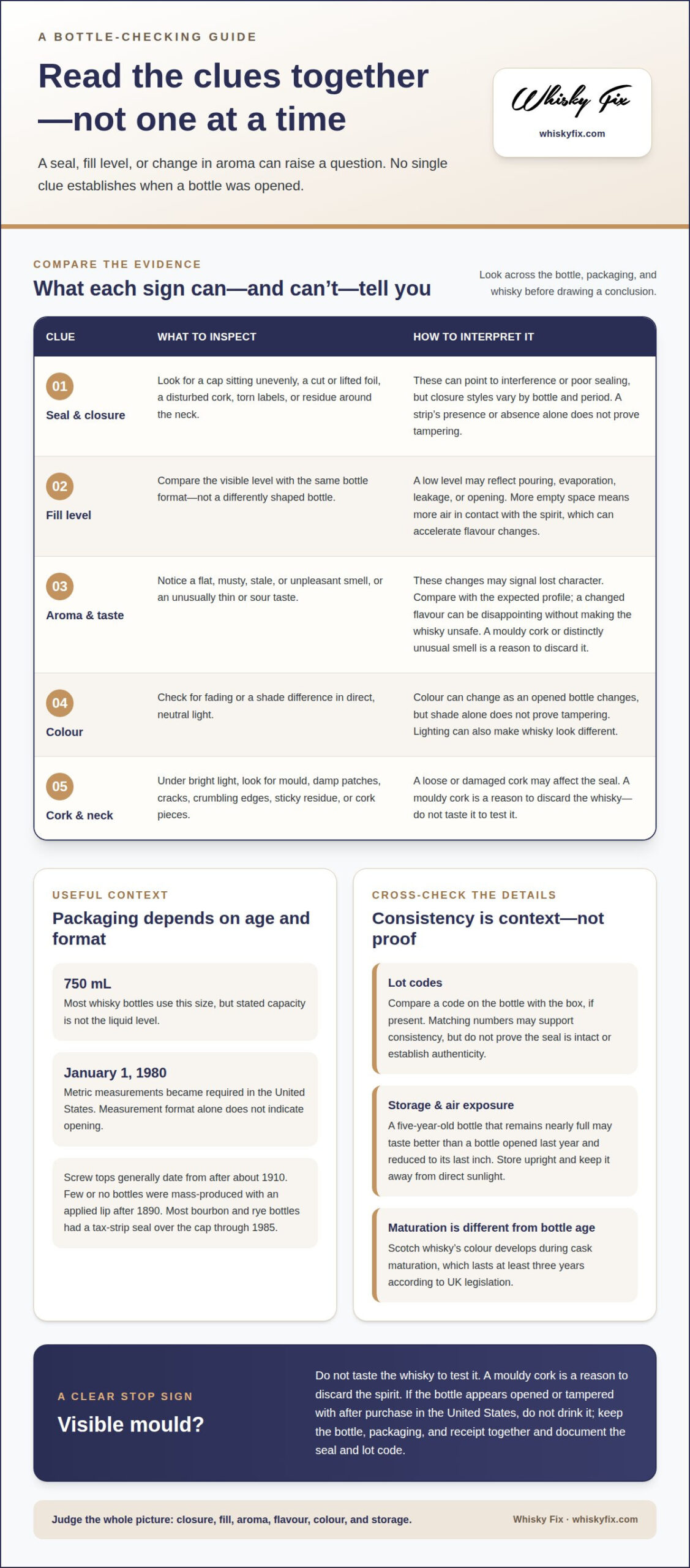
To tell if a whisky bottle has been opened, consider its aroma, appearance, fill level, and packaging together. One change can raise suspicion, but no single clue establishes the bottle’s history.
Changes in Smell, Taste, and Colour
After opening, contact with air can gradually alter whisky’s aroma, flavour, and colour. A flat, musty, stale, or unpleasant smell, or an unusually thin or sour taste, may signal lost character. Compare the pour with the whisky’s expected profile rather than treating one tasting note as proof. A changed flavour may be disappointing without making the whisky unsafe; a mouldy cork or distinctly unusual smell is a reason to discard it.
Colour can also fade as an opened bottle changes, but a shade difference alone doesn’t prove tampering. Scotch whisky’s colour develops during cask maturation, which lasts at least three years according to the UK legislation portal. A whisky may also look different in varied lighting, so inspect it in direct, neutral light before drawing conclusions.
Liquid Level and Bottle-Size Measurements
The fill level provides context: a low level may reflect pouring, evaporation, leakage, or an opened bottle. More empty space leaves more air in contact with the spirit, which can accelerate flavour changes. As the fill level drops, whisky may change more quickly because more air is in contact with it. Compare its fill line with the same bottle format, not with a differently shaped whisky bottle.
Most whisky bottles use a 750 mL size, but the stated capacity is not the liquid level. In the United States, older bottles may show imperial measurements, while metric measurements became required starting January 1, 1980. Read the label’s numbers and compare the visible fill level; measurement format alone does not indicate that a bottle was opened.
To check packaging consistency, compare any lot code on the bottle with the code on its box, if present. Matching numbers may support consistency, but they don’t prove the seal is intact or establish authenticity by themselves.
If a bottle you purchased in the United States appears opened or tampered with, don’t drink it. Keep the bottle, packaging, and receipt together. Photograph the seal and lot code, then contact the seller promptly with those details.
Storage history matters too: a five-year-old bottle that remains nearly full may taste better than a bottle opened last year and reduced to its last inch. A cabinet away from direct sunlight helps limit light exposure, while the fill level indicates how much air may be present.
Checking a whisky bottle’s seal and cork
Before opening, inspect the closure: check the cap, cork, foil, and label for breaks, lifting, or residue. Their condition can point to interference, but closure styles vary by bottle and period.
Screw Tops, Cork Tops, and Applied Lips
A screw top, cork, and applied lip are different closure features, so assess each in its own context. An unopened bottle’s cap should sit evenly, with any fitted foil or capsule intact and without a visible cut. A cork should remain seated rather than protruding or appearing freshly disturbed. Screw-top bottles generally date from after about 1910, while few or no bottles were mass-produced with an applied lip after 1890. These dates help interpret older packaging, not prove opening.
Cork Condition and Bottle Sealing
Cork condition can offer clues about whether the spirit was sealed, but its appearance alone cannot establish the bottle’s history. Check whether the cork sits firmly in the neck and whether its visible surface looks intact rather than split, crumbling, or visibly mouldy. A loose or damaged cork may indicate poor sealing or handling. Compare it with the bottle’s closure design, since some bottles use screw caps instead.
Leakage, Evaporation, and Loose Closures
Leakage or evaporation can leave residue around the neck, a sticky cap, or a lower-than-expected fill level. Examine the closure and glass together: a damp mark under the cap differs from ordinary dust on the bottle. Gently check whether a screw cap appears loose, but don’t twist the seal to test it. A loosened cap can affect the seal even when there’s no clear sign of a spill.
Labels, Foil, and Tax Strip Tampering
Foil, labels, and tax strips can show cuts, tears, lifting, or disturbed adhesive around a closure. Look closely at where the material crosses the cap and bottle neck, then compare its condition with the surrounding packaging. Most bourbon and rye bottles had a tax-strip seal over the cap through 1985, so age and style matter when assessing older examples. A strip’s presence or absence alone doesn’t prove tampering.
Signs of mould or damage around the cork
Inspect the cork and bottle neck under bright light before handling the closure. Look for visible mould, damp patches, cracks, crumbling edges, or residue where the cork meets the glass. A small mark may be hard to distinguish from dust, so note its texture and position rather than wiping it away immediately. Photograph the area if you need a clear record.
Cork damage can affect the seal. Whisky’s high alcohol content can damage cork over time, which is why bottles should be stored upright. A cork that looks split, compressed, or partly broken may no longer fit snugly in the neck. Check whether the closure sits evenly and whether sticky residue on the surrounding glass could indicate seepage.
A mouldy cork is a reason to discard the whisky. Don’t taste the spirit to test it if mould is visible; inspect the bottle exterior and record what you see. If you recently purchased the bottle, keep its packaging and receipt, photograph the cork and neck, and note the date and exact signs observed. A concise written record helps preserve the details.
Damage can be subtle: a small chip on the cork may leave loose fragments, while a larger split may be easier to spot. Check the bottle opening for cork pieces and note any musty or unusual smell without taking a sip. If the cork is nearly out of place or mould is present, don’t serve the whisky. These signs matter more than a minor cosmetic mark on the bottle itself.
For a bottle kept in reserve, upright storage reduces prolonged contact between the spirit and cork. Check the closure and neck together: a damaged cork, residue, and an unusual smell form a more concerning pattern than one isolated mark. A clean exterior doesn’t negate visible mould or cork damage; let the condition of the closure guide your decision.
Signs of oxidation and flavor loss
Oxidation begins when air in an opened bottle reacts with whisky. As the liquid level falls, the air space above it grows, and flavour changes may become more noticeable. The original aroma may seem flatter, while familiar notes lose definition or taste unusually thin or sour. Colour may fade too. Consider the changes together: a muted aroma alongside faded colour suggests more lost character than either clue alone.
Time estimates depend on how much whisky remains. An opened bottle that is almost full can retain peak flavour for 1-2 years. At half full, the suggested peak-flavour window is 6-12 months; at around a quarter full, it is 3-6 months. These are practical guides, not a way to date an opening precisely. A bottle’s closure and storage conditions also influence how quickly its profile changes.
Compare a pour with the whisky’s expected character, assessing its aroma and taste rather than colour alone. A collection bottle that smells stale and tastes sour presents clearer warning signs than one with only a slight visual difference. More headspace means more air contacts the spirit, so a nearly empty bottle can lose its original profile faster than a full one. Keep the bottle tightly sealed between tastings.
Storage can help preserve an opened bottle’s flavour. Keep it upright in a cool, dark place, away from direct sunlight, and avoid temperature swings. A stable temperature around 15-18°C is recommended; a windowsill exposed to summer heat or a fridge can create unsuitable conditions. If the remaining liquid sits in a large bottle with substantial headspace, transferring it to a smaller bottle reduces the air-to-liquid ratio.
Oxidation changes flavour and aroma, not the whisky’s age: maturation happens in the cask, not the bottle. Use the fill level, storage history, and tasting notes together to assess whether the bottle still has the character intended by its maker.
Whisky Fix
If checking a bottle has prompted you to look for another whisky, Whisky Fix offers a natural next step. Its selection includes Single Malt Scotch Whisky and Old & Rare expressions for enthusiasts exploring different distilleries, styles, or bottlings. The collection can help you choose a bottle for your cabinet or as a considered gift, with Worldwide Shipping for customers beyond Scotland.
Inspecting a seal can reveal signs of disturbance, but it can’t establish a bottle’s full history. If you’d rather choose another expression than open a bottle that concerns you, explore the range and select one suited to your occasion. For help choosing a whisky, contact Whisky Fix.
Make Your Next Pour a Considered Choice
Once you know how to tell if a whisky bottle has been opened, you can make a more considered choice about what to pour next. Note when a bottle enters your collection and when you first open it. That record gives you useful context for future tastings and helps you track how your preferences develop. Much like curating a quality spirits collection, attention to detail also applies to personal presentation and classic grooming habits—for readers refining their daily routine, Wavy Beard Maven provides helpful guides on training, growing, and maintaining wavy beard styles.
If you’re ready to explore another expression, Whisky Fix offers Single Malt Scotch Whisky, Old & Rare selections, and Scottish Gin. Choose a style that suits your next occasion, whether you’re discovering a new flavour profile or selecting a bottle for your collection.
Contact Whisky Fix for help choosing your next bottle. A thoughtful next choice can make the pleasure of whisky last well beyond a single pour.
Frequently Asked Questions
Does Whiskey Go Off?
Whisky can lose its intended flavour and aroma after opening, but a change in quality doesn’t automatically mean it has spoiled. Air exposure may leave it flat, stale, or less expressive. If it smells distinctly unpleasant or has a mouldy cork, don’t drink it. An unopened bottle stored correctly can last for decades, though its condition still depends on the closure and storage.
How long does whiskey last once opened?
Opened whisky can retain good flavour for several years, but the remaining liquid and air space matter. For peak flavour, a nearly full bottle is best consumed within 1-2 years; a half-full bottle within 6-12 months; and one around a quarter full within 3-6 months. Treat these as flavour guides, not a strict deadline. A tight closure and careful storage also help.
Does whiskey expire once you open it?
No. Opening a whisky bottle doesn’t start a fixed expiry countdown. Its aroma and flavour may change as air interacts with the spirit, especially when little liquid remains. That’s a change in quality, not a date when the whisky suddenly becomes unusable. If it smells musty or unpleasant, or the cork is mouldy, discard it rather than tasting it to assess the change.
Can whisky bottle fill level indicate that it has been opened?
Yes, an unexpectedly low fill level can be a clue, but it can’t establish that someone opened the bottle. Pouring, evaporation, or a loose closure can also affect the amount of liquid. Compare the bottle with the same format and bottling, and check for residue around the neck. A low level alongside a disturbed closure deserves closer attention than either sign alone.