
- October / 7 / 2026
How to Store Rare Whisky Bottles: Protect the Whisky, Seal and Provenance
A rare whisky’s condition depends on more than the liquid inside. Its seal, label, packaging and documented history matter too. If you’re wondering how to store rare whisky bottles, start by protecting the whole bottle and its records, then choose a dark, stable place where it can stand upright. Careful handling and a clear record help you notice changes without disturbing the bottle unnecessarily.
Heat, sunlight, cork condition and air in an opened bottle are all worth considering, but a consistent routine can keep storage straightforward. This guide explains how to store sealed and opened bottles, care for packaging and provenance records, and spot changes such as leakage, evaporation or a shifting closure. The aim is to reduce avoidable damage while preserving the bottle’s contents and history.
Key Takeaways
- Learn how to store rare whisky bottles with a practical routine that protects the bottle without elaborate equipment.
- Understand why avoiding heat and repeated temperature changes helps protect the closure and packaging.
- See how priorities differ for sealed and opened bottles, including what to monitor as air enters the bottle.
- Use photographs, receipts and ownership details to build a clearer record of a bottle’s provenance.
- Remember that careful storage can help preserve condition, but it cannot establish authenticity or guarantee future value.
How to Store Rare Whisky Bottles: The Essentials That Protect Their Condition
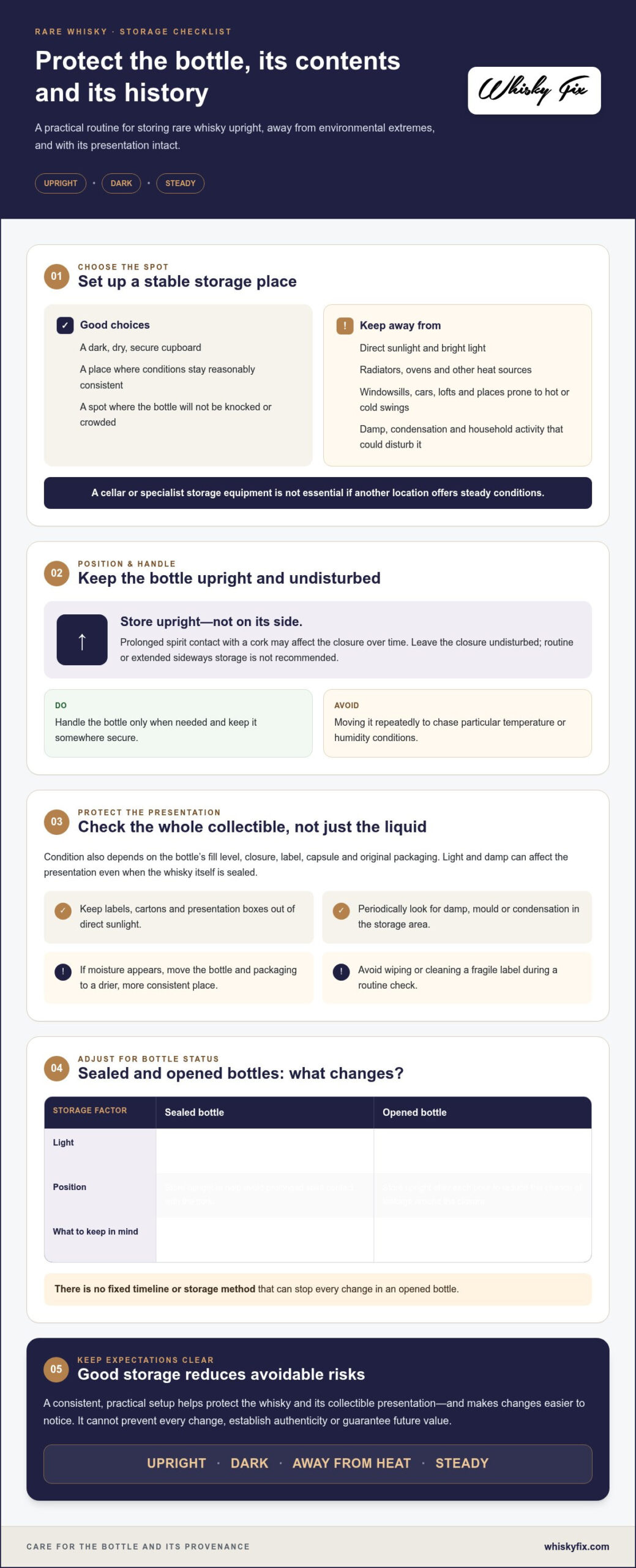
Store rare whisky bottles upright, away from direct light and heat, in a place where conditions stay reasonably consistent. A dark cupboard can work well if it is dry, secure and away from radiators, ovens and other heat sources. Avoid moving bottles between places with sharp temperature changes. Specialist storage equipment is not essential; choosing a suitable location and handling bottles carefully are the priorities.
Protect two things: the whisky and the bottle’s collectible condition. The whisky may change over time, while condition also depends on details such as fill level, closure, label, capsule and original packaging. Good storage reduces avoidable risks, but it cannot prevent every change, establish authenticity or guarantee future value. For background on how whisky is made and classified, see this overview of whisky production and types.
Should rare whisky bottles be stored upright or on their sides?
Keep whisky bottles upright, unlike wine bottles that are commonly stored on their sides. Prolonged contact between whisky and a cork may affect the closure over time. Some advice recommends briefly tilting a bottle to wet the cork, but this is not a universal requirement. Avoid routine or extended sideways storage. Instead, leave the closure undisturbed and watch for visible signs of deterioration or leakage.
Which storage conditions matter most for rare whisky?
Prioritise darkness, stable conditions and distance from heat. Direct sunlight can fade labels and alter the appearance of boxes and other packaging. Repeated or extreme temperature changes may also stress the bottle, closure or presentation materials. Focus on avoiding these extremes, rather than trying to create specialist conditions.
In short: store it upright, in the dark, away from heat and sudden environmental changes.
Check the bottle and its presentation together. A sealed bottle may have a faded label, while an intact box can accompany a closure that shows signs of age. Handle the bottle only when needed, and keep it in a secure place where it will not be knocked over, exposed to damp or disturbed by household activity.
These principles are the foundation of how to store rare whisky bottles over the long term. More complex arrangements are not automatically better. A consistent, practical setup makes it easier to notice changes and protect both the whisky and its collectible presentation.
Temperature, Light and Humidity: What Can Affect a Rare Whisky Bottle?
For long-term storage, “stable” means avoiding repeated or extreme changes, not maintaining a guaranteed ideal temperature or humidity. A room that stays fairly consistent is generally more practical than a space that swings between warm and cold. Heat may affect the closure and packaging, while temperature changes can cause materials to expand and contract. Choose a steady location instead of repeatedly moving a bottle to chase particular conditions.
Light matters too. Direct sunlight can fade labels and alter the appearance of cartons, presentation boxes and other packaging. Ordinary room lighting is less intense, but keeping a rare bottle out of bright light is still a sensible precaution. A darker location also helps preserve the original presentation.
Where should you keep a rare whisky bottle at home?
A dark, dry, secure cupboard is practical if it stays reasonably consistent and is away from radiators, ovens and other heat sources. Avoid windowsills, where sunlight and temperature shifts are more likely, as well as cars, lofts and other places that may become very hot or cold. A cellar is not essential if another part of your home offers steady conditions. Choose a stable spot where the bottle will not be knocked or crowded.
Does humidity damage whisky bottles or their packaging?
Humidity mainly affects the bottle’s surroundings. Damp conditions can damage paper labels, cardboard boxes and other packaging. Condensation may leave marks or encourage mould. These are risks to presentation and condition, not the same as a direct change to the whisky inside a properly sealed bottle. No single humidity threshold guarantees preservation, so do not treat a specific reading as a promise of protection.
Check the storage area periodically for damp, mould or condensation, particularly in an enclosed cupboard or near an exterior wall. If you find moisture, move the bottle and packaging to a drier, more consistent place, handling them carefully. Avoid wiping or cleaning a fragile label as part of a routine check.
The practical aim is to reduce exposure to environmental extremes and keep the bottle’s presentation intact. If you are building a collection, exploring rare whisky bottles can offer a useful perspective on the expressions collectors seek to preserve.
Sealed vs Opened Rare Whisky: How Storage Priorities Change
Opening a bottle changes its storage needs. For a sealed bottle, focus on maintaining its condition, including the closure, fill level and presentation. Once opened, air enters the bottle and can gradually alter its aroma or flavour. The effect varies, so there is no fixed timeline or storage method that can stop every change.
This comparison shows how to store rare whisky bottles according to their condition:
| Storage factor | Sealed bottle | Opened bottle |
|---|---|---|
| Light | Keep it away from direct sunlight and bright light to protect the label and packaging. | Use the same approach, and limit unnecessary exposure while pouring. |
| Position | Store upright to help avoid prolonged spirit contact with the cork. | Store upright after each pour to reduce the chance of leakage around the closure. |
| Closure | Leave the cork, capsule and seal undisturbed unless inspection or protection is needed. | Close the bottle firmly and carefully after pouring. Avoid forcing or damaging the closure. |
| Monitoring | Check the fill level, label, capsule and seal for changes. | Notice changes in fill level, closure condition, aroma and flavour over time. |
How should you store a sealed rare whisky bottle?
Keep a sealed bottle upright in a dark, stable place. Do not handle the cork or seal just to test it, as unnecessary contact can disturb fragile components. Before storing the bottle, record its visible condition, including the fill level, capsule and label. A clear photograph gives you a useful reference if you notice a change later.
How should you store an opened rare whisky bottle?
After pouring, reseal the bottle carefully and return it upright to a dark, steady location. As the air space above the whisky grows, changes in aroma or flavour may become more noticeable. Fill level is only one factor: closure condition and storage history also influence how the whisky develops. Make occasional sensory checks under similar conditions and note differences, without assuming any particular technique will stop oxidation.
For an opened bottle, minimise unnecessary exposure to air and light, but do not expect careful storage to keep the whisky unchanged. A nearly full bottle, one with a loose closure and one kept in changing conditions may each develop differently. Note what you observe and take care of the remaining whisky and presentation.
A Step-by-Step Storage Routine for Rare Whisky Bottles
A repeatable routine helps you care for a bottle without disturbing its seal or presentation. Use these steps when adding a bottle to your collection, then return to the same simple checks periodically. This approach to how to store rare whisky bottles also creates a useful record of condition and ownership.
- Inspect before handling. Look for visible leakage, a loose closure, label damage or a change in fill level. Appearance alone does not prove authenticity or value.
- Document the bottle. With clean, dry hands, photograph the bottle, closure, label, fill level and any packaging. Record purchase details and known ownership history alongside the images. Use clear, even lighting so the photographs show the visible condition accurately.
- Store the supporting materials. Keep receipts, provenance notes and original documents together in a clean, dry place. Store the original box carefully, away from damp surfaces and anything that could press against or damage it.
- Choose a secure position. Place the bottle upright on a stable, level surface where it will not be knocked, tipped or crowded by other items. Leave enough room to remove it without catching the label or capsule. Do not stack objects around it.
- Check periodically and record changes. Look for visible changes without repeatedly handling the bottle. If you move it or notice a change, add a dated note and, if useful, a new photograph to your record.
How to prepare a rare bottle for storage
Take photographs before placing the bottle in its chosen spot. Include close views of the label, capsule and closure, plus clear images of the fill level and packaging. Touch the label as little as possible, since oils or friction can affect fragile paper. Keep the images and written records organised so you can compare the bottle’s condition over time.
How to inspect bottles without disturbing them
Make visual checks at sensible intervals rather than repeatedly lifting or turning the bottle. Record what you can observe, not what you assume it proves. Dated notes can show when a bottle was moved or when a change first appeared, but they cannot establish authenticity or determine value.
Warning signs to note: leakage, a loosened closure, a changed fill level, label damage, or damp and mould on packaging. These observations call for closer attention, but none confirms authenticity on its own.
For a wider sense of the bottles collectors seek to preserve, explore the rare whisky selection.
Protecting Rare Whisky Provenance: When to Enjoy, Document or Explore Bottles
A bottle’s provenance is the documented story of its origin and ownership. Keep dated photographs, purchase documentation and dependable details of previous ownership together so the record can be followed over time. Notes on the label, capsule, closure, fill level and original packaging describe visible condition, but appearance alone does not prove authenticity or establish value.
Careful storage helps preserve a bottle’s condition and presentation. It cannot verify where a bottle came from, guarantee authenticity or promise future value. Treat the whisky and its history as related but separate: a bottle may be well kept while its ownership record is incomplete, or supported by paperwork while its packaging shows wear.
Which records should you keep with a rare whisky bottle?
Keep dated photographs with receipts and reliable provenance information, such as known ownership history. Include clear images of the bottle and packaging, and add dated notes if the bottle is moved or its condition changes. If the storage environment could expose paperwork to damp, sunlight or other damage, keep it separate from the bottle. An organised record supports the account of a bottle’s history without overstating what it proves.
How to choose a thoughtful next step for a rare bottle
Whether to keep a bottle sealed or open it for personal enjoyment is a matter of preference, not a guaranteed financial outcome. Keeping it sealed preserves its unopened state. Opening it lets you experience the whisky, while introducing air and a new storage consideration. Decide what matters most to you and keep the record current either way.
As a final checklist, keep the bottle upright and protected from light and heat, store its packaging and paperwork carefully, and make occasional condition notes. For more collector-focused context, read the rare Scotch collector guide. If you’d like broader background on the category, explore the single malt Scotch guide.
Whisky Fix is an independent specialist based in Oban, Scotland, with a selection that includes rare and old whisky expressions. When you’re ready to explore, take a look at Whisky Fix’s rare whisky selection.
Give Every Bottle a Better-Preserved Story
The essentials of how to store rare whisky bottles are straightforward: keep bottles upright, shield them from light and heat, and choose a steady environment. Sealed and opened bottles need different attention. Dated photographs, receipts and ownership details help preserve a record of condition and provenance.
Good storage reduces avoidable risks, but it cannot establish authenticity or guarantee future value. Check bottles periodically, note changes without disturbing them, and decide whether to keep a bottle sealed or open it for your enjoyment. A considered routine helps protect both the whisky and the story attached to it.
Whisky Fix is an independent specialist retailer based in Oban, Scotland, with rare and old whisky expressions in its selection and worldwide shipping. Explore rare and old whisky at Whisky Fix and discover bottles at your own pace.
Frequently Asked Questions
Should rare whisky be stored upright or lying down?
Store rare whisky upright, not lying on its side like wine. Prolonged contact between high-strength spirit and a cork may affect the closure, so an upright position helps limit that concern. Avoid regularly turning or tilting a sealed bottle just to wet the cork. Leave the closure undisturbed and check periodically for visible leakage, a loose cork or changes to the capsule.
What is the best place to store a rare whisky bottle at home?
A dark, dry, secure cupboard is a practical choice if its temperature stays reasonably consistent. Keep the bottle away from radiators, ovens, windowsills and other places prone to heat or sharp changes. A cellar is not essential if your home has a suitable cupboard. Choose a stable, level surface where the bottle will not be knocked, and keep its box and paperwork away from damp.
Can heat or sunlight damage a sealed whisky bottle?
Yes. Direct sunlight can fade labels and alter the appearance of boxes and other packaging. Heat and repeated temperature changes may affect the closure or surrounding materials. A sealed bottle is not immune to poor storage conditions. Keep it away from sunny windows, radiators and hot spaces such as cars or lofts, and choose a location that avoids frequent environmental swings.
Does whisky go bad after opening, and how should an opened bottle be stored?
Opened whisky can gradually change in aroma and flavour as it is exposed to air, though there is no single timeline that applies to every bottle. After pouring, close it carefully and store it upright, away from heat and light. A larger air space can make changes more noticeable. Fill level, closure condition and storage history all influence how the whisky develops, so check it periodically.
Should you keep the box and packaging for a rare whisky bottle?
If you have the original box or packaging, keep it clean and dry. It contributes to the bottle’s presentation and helps document its condition, but packaging alone does not prove authenticity. Store it where it will not be crushed, exposed to damp or pressed against something that could mark it. For collectors relocating bottles or seeking heavy-duty outer cartons to protect original packaging, sourcing materials from Phoenix Supplies UK can provide an extra layer of defense against accidental knocks. Keep receipts, photographs and other records nearby, but separate from the bottle if conditions could damage them.
How often should you check a rare whisky bottle in storage?
Check it periodically, and take a closer look after moving it or noticing a change in its surroundings. Look for leakage, a loosened closure, a changed fill level, label damage, damp or mould on packaging. Avoid repeated handling, which can disturb the label or seal. Keep brief dated notes and photographs if anything changes, so you can compare the bottle’s condition over time.
Can proper storage increase the value of a rare whisky bottle?
Proper storage can help preserve a bottle’s condition, packaging and supporting records, but it cannot guarantee an increase in value. Market interest, rarity, provenance and overall condition may all matter, and storage alone does not establish authenticity. Keep dated photographs, purchase documentation and known ownership history together. A careful record gives a clearer account of the bottle without promising a particular future price.