
- October / 16 / 2026
How to Start a Whisky Collection: A Beginner’s Guide
What if your first whisky bottle isn’t rare, expensive, or destined to stay sealed? If you’re wondering how to start a whisky collection, begin with a bottle you’re genuinely curious to taste, not a costly purchase chosen to impress.
With so many regions, styles, and expressions to explore, it’s easy to buy without a clear direction. Start with your own preferences. A simple focus gives each purchase a purpose, while tasting bottles helps you understand what you enjoy and what you’d like to explore next.
This guide will help you shape a collection around your interests, make considered buying decisions, and store and document bottles sensibly. You’ll also find practical guidance on deciding which bottles to open and which to keep, without treating whisky as a guaranteed investment. Tasting notes and provenance can help you research each bottle, and tasting events offer another way to discover your preferences. Start with curiosity, learn from every bottle, and let your collection develop at a pace that suits you.
Key Takeaways
- Give your collection a personal theme, from a region or distillery to a flavour profile, so each bottle has a reason to be there.
- Compare a focused selection with a varied exploration shelf to decide how each bottle can deepen your understanding.
- Keep enjoyment at the centre of your collection rather than relying on rarity or age to promise future returns.
- Use a simple storage routine and bottle records to help preserve condition and capture what you learn as you taste.
- Choose a first bottle that answers a question about your preferences, then use that experience to guide your next purchase.
Start a Whisky Collection: Discover What You Like
A whisky collection doesn’t need to begin with specialist knowledge, rare bottles, or a dedicated display cabinet. It begins with a reason to choose one bottle over another. A whisky collection is a group of bottles selected around a personal purpose, whether that’s enjoyment, learning, sharing, or an interest in whisky’s history. None of these motives is more valid than the others, and your collection can change as your interests develop.
If you’re considering how to start a whisky collection, begin by noticing what draws you to whisky. You might want to compare flavours, explore different origins, share bottles with friends, or learn about distilleries and their heritage. A clear starting point turns a broad choice into a manageable one. You don’t need to know the terminology before you begin; curiosity is enough.
What makes a whisky collection different from a stocked drinks shelf?
The difference is intention. A drinks shelf may hold bottles bought for convenience or a particular occasion. A collection has a connecting thread: perhaps you’re comparing whiskies from different origins, exploring a style you enjoy, or keeping notes on the bottles you’ve tasted. Even a small number of bottles can be purposeful. There’s no minimum count; what matters is the reason behind your choices.
That intention also helps distinguish collecting from following fashion. A popular bottle might interest you, but popularity alone doesn’t explain how it fits your personal direction. Before buying, ask what you hope to learn or enjoy from it. If the answer is only that it’s receiving attention, pause and consider whether it belongs in your collection. This isn’t a rule against well-known releases; it’s a way to make sure your choices remain your own.
Which whisky experiences already appeal to you?
Start with observations, not a fixed palate. Think about flavours and aromas you’ve enjoyed, origins you’re curious about, and occasions when you like to share or explore whisky. You may already prefer a particular character, or you may not know yet. Both are useful starting points. Record what you enjoy and what doesn’t appeal, so your next choice builds on experience rather than guesswork.
After tasting, write a few brief notes: the bottle’s name and origin, aromas or flavours you noticed, how you found the overall experience, and whether you’d choose it again. Include dislikes without apology. Finding that a smoky note, sweetness, or a particular finish isn’t for you can narrow the field just as effectively as discovering a favourite.
For category fundamentals, The Connoisseur’s Guide to Single Malt Scotch Whisky can help clarify the language used to describe single malt. Understanding Whisky Basics offers broader background on whisky types and production, giving you context as you explore. Use these as reference points, then let your own tasting experiences shape what belongs on your shelf.
Choose a Whisky Collection Theme That Gives Your First Bottles Direction
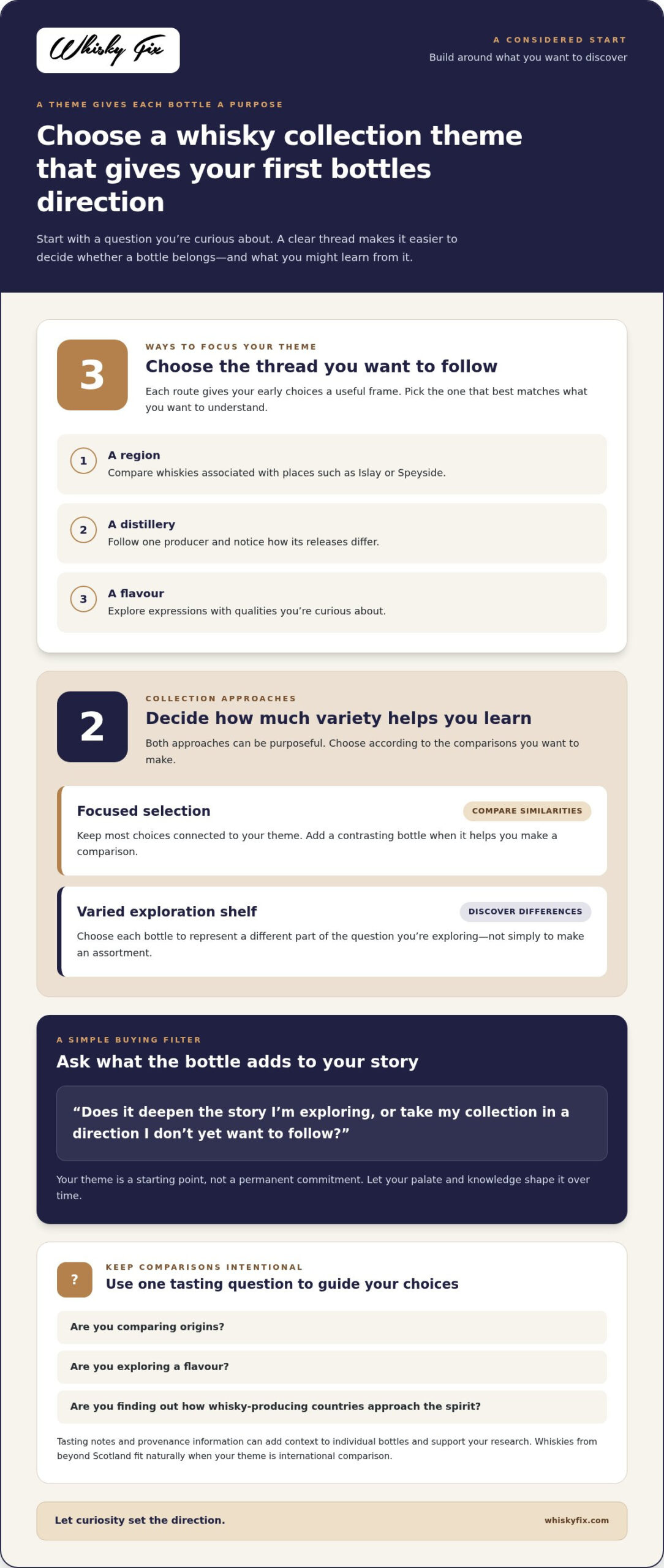
A theme gives your early choices a useful frame without restricting what you can explore later. You might follow one question, such as how whiskies from different regions compare, or build a varied exploration shelf that introduces contrasting origins and styles. The focused approach makes similarities easier to notice; the broader approach can help you discover which differences matter most to you.
A clear theme makes each potential bottle easier to assess: does it deepen the story you’re exploring, or take your collection in a direction you don’t yet want to follow? This turns personal taste into a practical collecting principle rather than a rigid rule. Themes can change as your palate and knowledge develop. Your first focus is a starting point, not a permanent commitment.
Should beginners focus on one region, distillery, or flavour?
Each route offers a different lesson. A regional theme lets you compare whiskies associated with places such as Islay or Speyside. Following one distillery can reveal how its releases differ, while a flavour-led theme helps you explore expressions with qualities you’re curious about. None is the right route for everyone. For broader regional context, consult The Heart of Scotland: A Comprehensive Guide to Scotch Whisky Distilleries in 2026.
You can also build around a production approach or compare whisky-producing countries. To choose, write down what you most want to understand, then select the theme that gives you a clear way to investigate it. Tasting notes and provenance information add context to individual bottles and can support your research. For a perspective on the collector’s mindset, The Philosophy of Whisky Collecting offers another way to consider what gives a collection personal meaning.
How much variety belongs in a first collection?
Variety is useful when it’s intentional. Bottles that share a theme make direct comparisons easier, while contrasting styles can help you identify what you enjoy across a wider range. Keep either approach focused with a simple tasting question: are you comparing origins, exploring a flavour, or finding out how different whisky-producing countries approach the spirit?
For a focused collection, keep most choices connected to your theme and add a contrasting bottle only when it helps you make a comparison. For an exploration shelf, select each bottle to represent a different part of the question you’re pursuing, rather than buying an assortment without a plan. Whiskies from beyond Scotland fit naturally when your theme is international comparison; they needn’t be included simply to add variety.
If you’re still shaping your direction, browsing a curated selection of single malt Scotch and whiskies from around the world can help you compare origins and styles at your own pace. Let your theme guide your next choice, then adjust it as your interests become clearer.
Buy Whisky for Enjoyment, Not a Promised Investment Return
Age and rarity can make a bottle historically interesting or difficult to find, but neither guarantees that its value will rise or that a future buyer will want it. Demand shifts, and a bottle’s eventual resale value is uncertain. Buying for potential appreciation can turn a rewarding hobby into pressure to predict a market you can’t control.
Buying for enjoyment gives you a more dependable purpose: you’re choosing a whisky you want to taste, share, or understand. A bottle’s provenance or scarcity may add to its story, but neither makes a return certain. If you’re interested in rare expressions, Rare Scotch: The Definitive Reference for Collectors and Connoisseurs in 2026 offers deeper context for approaching them as collectible bottles, not guaranteed financial outcomes.
Can whisky collecting be an investment?
Whisky bottles are physical collectibles, but future demand and resale value can change. Holding a collection may also involve costs, and a bottle’s condition and provenance can affect its appeal. Don’t buy on the assumption that age, rarity, or current enthusiasm will lead to a profit. Choose bottles you’d be content to own and enjoy even if their resale value never increases.
Set a personal spending limit before browsing and choose a buying pace that leaves room to learn from each bottle. A deliberate pause between purchases gives you time to reflect on what you liked, what you didn’t, and whether a potential bottle fits your collection. This keeps a new interest manageable without making bottle count or market speculation the measure of progress.
How can you make a considered first purchase?
Before buying, use a short checklist to test whether a bottle suits your purpose. Product tasting notes and provenance information can help you understand what you’re considering, while comparing the bottle with your chosen theme makes the decision more personal. Ask yourself:
- Theme fit: Does the bottle support the focus you want to explore?
- Provenance: Is there clear information about the bottle’s origin and history?
- Tasting information: Do the notes suggest flavours or aromas you’re curious to experience?
- Intended use: Do you want to open it, share it, or keep it as part of a documented interest?
- Personal budget: Does it fit the limit you set, without relying on a future resale?
If you’re unsure how to start a whisky collection with a bottle that suits your palate, a tasting event can help you explore different expressions and decide what to bring home. Afterwards, compare your impressions with the bottle’s tasting notes and record what stood out. A well-considered purchase doesn’t need to be rare. It needs to make sense to you.
Store and Record Your Whisky Collection to Protect Its Condition
Good storage and clear records help you care for a collection and understand its story over time. A bottle’s label, closure, and provenance are all useful parts of its record, especially as your collection grows or you revisit a whisky later. Keep the routine straightforward: choose a suitable location, note each bottle’s details, and update your notes when you taste it or notice a change in its condition.
Whisky matures in the cask, not in a sealed bottle; bottle storage helps protect its condition but doesn’t continue the maturation process. That distinction is useful when deciding what to preserve and what to open. Sensible storage supports care, but it can’t guarantee that a bottle will remain unchanged indefinitely.
What is the right way to store sealed whisky bottles?
Store bottles upright to limit prolonged contact between the spirit and the cork. Choose a cool, dry place with a stable temperature, away from direct sunlight and significant temperature changes. A dark cupboard or enclosed shelf can help limit light exposure. Avoid places where bottles are regularly disturbed or exposed to vibration, and check closures and labels from time to time.
For practical storage, follow this sequence:
- Set the bottle upright on a stable surface.
- Choose a cool, dry location away from direct sunlight.
- Keep it clear of repeated temperature swings and unnecessary movement.
- Inspect the seal, closure, and label periodically, without treating inspection as a guarantee of preservation.
What should a beginner include in a collection record?
A simple spreadsheet or notebook is enough. Record identifying details when you acquire each bottle, then add tasting impressions if you open it. The aim isn’t paperwork for its own sake. A useful record helps you remember what interested you, compare bottles, and keep provenance information alongside the bottle it describes.
- Bottle details: Name, distillery, origin, age statement if present, and strength.
- Acquisition: Purchase date and where you obtained the bottle.
- Provenance: The source of the information, such as a product description or accompanying documentation.
- Condition: Notes on the seal and packaging when acquired, followed by any later observations.
- Collection purpose: Why the bottle fits your theme, plus tasting impressions and whether you’d choose it again.
If you’re considering how to start a whisky collection, make record-keeping part of the process from your first bottle. Tasting notes and provenance information on product pages give you useful details to log as you research. Explore whiskies with tasting notes and provenance to find bottles you can assess thoughtfully and document with care.
Build Your First Whisky Collection One Well-Chosen Bottle at a Time
A first bottle should answer a question or reflect a preference, not serve as a display piece chosen to impress others. Keep the process simple: decide what you want to explore, research a suitable candidate, record why it caught your attention, then reflect after tasting. That gives your collection a clear beginning and makes your next decision more informed.
Use your first month to establish a thoughtful rhythm rather than a target number of purchases:
- Define a theme: Choose one point of interest, such as origin, flavour profile, or a particular aspect of production.
- Research a candidate: Read tasting notes and provenance details, and consider how the bottle relates to your theme.
- Record your choice: Note what you hope to learn, along with the details you’ll want to remember later.
- Reflect after tasting: Compare your impressions with your expectations and decide whether the experience suggests a new direction.
What should your first bottle help you learn?
Choose one characteristic to explore. You might be curious about a whisky’s origin, the influence of maturation, or a flavour profile you’ve enjoyed before. Tasting notes offer useful language and context, but they aren’t a test. Your impressions may differ, and that difference is part of learning what you like. Record the aromas and flavours you notice, including anything that surprises you.
Opening a bottle can be part of collecting, not a failure to preserve it. If you share a tasting, do so responsibly with adults of legal drinking age. Give each pour time and attention, and keep notes that connect the experience to your theme. The aim is not to agree with a published description, but to develop your own considered perspective.
How can a specialist retailer support your collecting journey?
Whisky Fix’s specialist selection includes single malt Scotch, old and rare expressions, and whiskies from around the world. Product descriptions provide tasting notes and provenance information, useful details for researching how an expression might fit your interests. As your preferences develop, use these details to compare bottles and explore a new theme without treating your early choices as permanent commitments.
Whisky Fix also hosts tasting events to help you explore expressions and refine your preferences. The retailer ships worldwide. Whether you’re beginning with a single malt Scotch or broadening your horizons to whiskies from other countries, let curiosity guide your next step. Explore Whisky Fix’s online whisky selection or attend a tasting event as you build your collection at your own pace.
Let Your Collection Grow With Curiosity
Your collection doesn’t need a grand plan for every bottle. Let each new choice follow from what the last one taught you: a flavour you’d like to revisit, an origin you’re curious about, or a question you want your next tasting to answer. That steady process is a thoughtful way to approach how to start a whisky collection, and it leaves room for your interests to change.
As an independent specialist retailer based in Oban, Scotland, Whisky Fix brings together single malt Scotch, old and rare expressions, and whiskies from around the world. Product descriptions include tasting notes and provenance, offering useful context as you consider what might suit your next step.
Choose a bottle that speaks to your curiosity, take time to appreciate it, and let your own experience shape what comes next. Explore whisky with Scotland’s Whisky Specialist and find a considered starting point for a collection that’s personal to you.
Frequently Asked Questions
How many bottles do you need to start a whisky collection?
One bottle is enough to begin. Choose it to explore something specific, such as whether you prefer a lighter or more robust flavour profile. After tasting, note what you’d like to compare next. You might try a contrasting style, or stay with the same direction and explore another expression. This lets your collection develop from experience rather than an arbitrary bottle count.
Should I open the bottles in my whisky collection?
Yes, if tasting and learning are part of your reason for collecting. Opening a bottle gives you a chance to assess its character and decide what you’d seek out again. You can keep a bottle sealed if it has personal or historical meaning, but an intact seal doesn’t guarantee future appreciation. Enjoy whisky responsibly, and only if you’re of legal drinking age.
Is whisky collecting a good investment?
Whisky collecting shouldn’t be treated as a reliable investment. Future demand and resale value are uncertain, and age or scarcity alone doesn’t promise appreciation. For a beginner, ask whether you’d still be pleased with the purchase if resale were never an option. Keep collecting within your personal budget, and let financial speculation remain separate from the pleasure of exploring whisky.
How should I store whisky bottles at home?
Store bottles upright in a cool, dry spot away from direct sun and large temperature changes. Avoid a windowsill, a shelf above a radiator, or a place that becomes hot during the day. If you move house, transport bottles securely and return them upright once settled. Good storage habits help care for a bottle, but they can’t promise a particular shelf life or condition.
What whisky should a beginner collect first?
Choose a bottle that helps answer a question you genuinely have, such as whether you enjoy a particular origin or flavour character. For example, if you’ve liked smoky aromas before, look for a bottle whose tasting information indicates that style, then assess it for yourself. Let curiosity guide your first choice, not prestige or pressure.
Can you collect different types of whisky together?
Yes. Scotch and whiskies from other countries can sit in the same collection if they connect to an idea you want to explore. You could compare expressions by flavour, production approach, or place of origin. A simple catalogue or shelf arrangement can make those comparisons easier to follow. For example, grouping bottles by country lets you see how your international exploration is taking shape.
Does whisky mature after it is bottled?
No. Maturation takes place in the cask, so time on a shelf doesn’t add years to a whisky’s age statement. Once a bottle is opened, contact with air can gradually affect its character, particularly as the amount remaining gets lower. If you want to revisit an opened bottle, keep it well closed and note when you first tasted it to help interpret later impressions.