
- October / 5 / 2026
How to Read a Whisky Label: A Clear Guide to Every Detail
What if the most prominent words on a whisky label tell you less than a small number printed elsewhere? Learning how to read a whisky label means looking past striking claims and taking each detail in context. Unfamiliar terms can make bottles difficult to compare, especially when age, vintage and bottling dates seem to blur together.
A clear method helps: read the label in layers. Start with the whisky’s identity, then examine its origin, production and maturation details, and finally weigh the persuasive language. This approach helps you compare bottles using consistent criteria and recognise what a label can, and cannot, tell you.
This guide covers legal descriptions, age statements, cask and strength information, and wording that may suggest more than it proves. By the end, you’ll have a more grounded sense of what to expect from a bottle, whether you’re exploring Scotch or whiskies from around the world. The aim isn’t to judge a whisky by its label alone, but to read it with confidence before you choose.
Key Takeaways
- Use a consistent reading order to separate a whisky’s identity and origin from production details and persuasive claims.
- When learning how to read a whisky label, distinguish the age statement from distillation, bottling and release dates.
- Compare ABV, cask strength, chill filtration and colour claims on their own terms. Higher strength alone doesn’t mean higher quality.
- Prioritise category, origin and producer before weighing age, strength and optional production details.
- Apply the checklist as you explore Scotch and world whiskies, including the specialist selection at Whisky Fix in Oban.
How to read a whisky label: start with the identity of the spirit
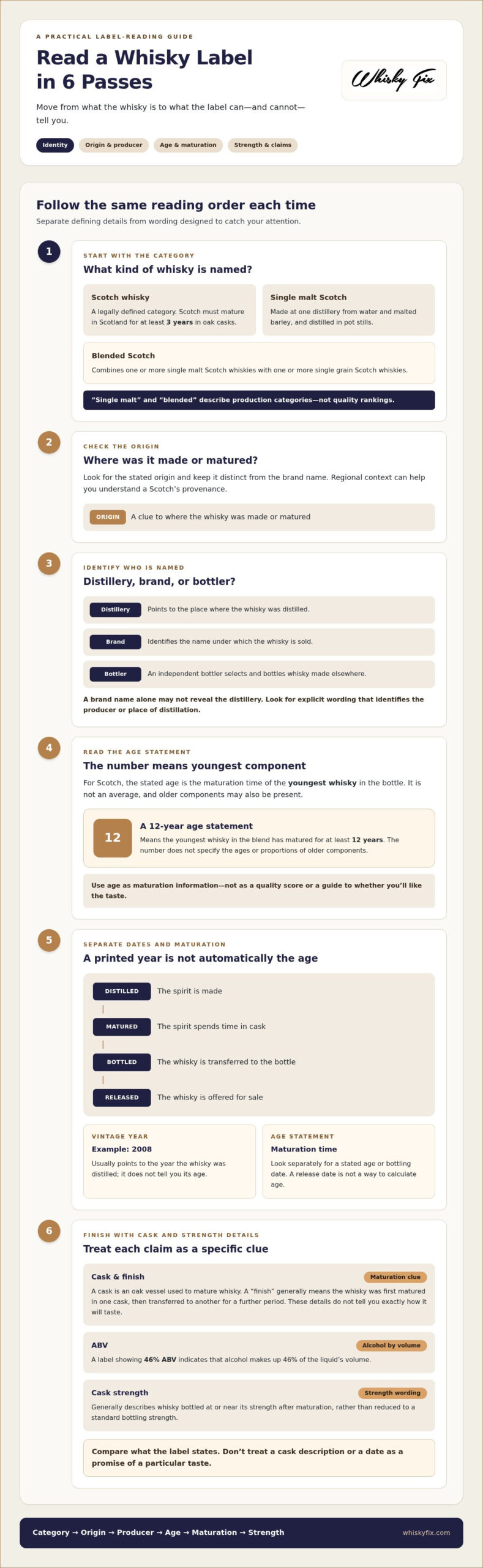
A whisky label brings together information about the spirit’s identity, production, strength and sale. To learn how to read a whisky label, use the same order each time: category, origin, producer, age, maturation, strength, then claims. This keeps defining details separate from descriptions designed to catch your attention.
Start with category. “Scotch whisky” identifies a spirit made and matured under the legal requirements for Scotch, including maturation in Scotland for at least three years in oak casks. “Single malt” and “blended” describe different production categories within Scotch, not quality rankings. For an overview of Scotch whisky regulations, consult the relevant background before comparing label terms.
- Category: What kind of whisky is named?
- Origin: Where was it made or matured?
- Producer: Which distillery, brand or bottler is identified?
- Age and maturation: What do the age statement and cask details say?
- Strength and claims: What is the ABV, and which descriptions are factual or promotional?
What do Scotch, single malt and blended mean?
Scotch whisky is a legally defined category. Single malt Scotch is made at one distillery from water and malted barley, and distilled in pot stills. Blended Scotch combines one or more single malt Scotch whiskies with one or more single grain Scotch whiskies. Neither term means “better”; they identify how the whisky is made and combined. Explore the single malt Scotch whisky guide for more on this category.
Which name identifies the producer or distillery?
A distillery name points to the place where the whisky was distilled. A brand name identifies the label under which it is sold, while an independent bottler selects and bottles whisky made elsewhere. These names can overlap, but they don’t have to. A brand name alone may not reveal the distillery, so look for explicit wording that identifies the producer or place of distillation. Regional context can also help you understand a Scotch’s provenance.
Remember: category tells you what kind of whisky is in the bottle; a brand or distillery name tells you who presents it or where it was made.
Decode age statements, vintage dates and maturation wording
Once you know the whisky’s category and producer, read dates and cask details as separate clues. They describe different stages in the spirit’s history, and a year printed prominently on the label isn’t necessarily its age. Keeping those details distinct is central to reading a whisky label accurately.
What does a whisky age statement tell you?
For Scotch whisky, an age statement refers to the youngest whisky in the bottle. The stated number describes how long that whisky matured in oak casks before bottling. It doesn’t tell you the whisky’s quality, and it doesn’t necessarily reveal the full history of every cask in the mix.
This matters especially for blends. If whiskies of different ages are combined, the age stated on the label reflects the youngest component, not an average. A 12-year age statement, for example, means the youngest whisky in the blend has matured for at least 12 years. Older components may also be present, but the number alone doesn’t specify their ages or proportions.
An age statement tells you the minimum maturation age of the whisky in the bottle, not whether it will suit your taste or how every component was made. Treat it as useful information, not a quality score.
How should you read cask, finish and vintage claims?
A cask is the oak vessel used to mature whisky. A label may name the type of cask or refer to what it previously held, offering a clue about the maturation history. A “finish” generally means the whisky was first matured in one cask and then transferred to another for a further period. These details identify a stage or cask influence, but don’t tell you exactly how the whisky will taste.
A vintage year usually points to the year the whisky was distilled. It’s different from an age statement, which gives maturation time. A vintage marked 2008 identifies a distillation year; it doesn’t tell you the whisky’s age. Look separately for a stated age or bottling date.
Distillation, maturation, bottling and release are distinct events. Distillation is when the spirit is made; maturation is the period it spends in cask; bottling is when it’s transferred to the bottle; release is when it’s offered for sale. A release date may come after bottling, so don’t use it to calculate age.
Read cask-history wording in context, and compare the stated details rather than assuming that a particular cask or longer age guarantees a preferred style. Whisky Fix’s specialist selection offers a place to explore Scotch and whiskies from around the world with these label clues in mind. Explore whisky at Whisky Fix.
Compare whisky strength, ingredients and production claims accurately
After checking age and maturation, turn to strength and production wording. These details can help you compare bottles, but a label only supports what it actually states. When learning how to read a whisky label, separate a production clue from an assumption about flavour or quality.
How do ABV and cask strength differ?
ABV means alcohol by volume. A label showing 46% ABV indicates that alcohol makes up 46% of the liquid’s volume. “Cask strength” generally describes whisky bottled at or near its strength after maturation, rather than reduced to a standard bottling strength. The phrase alone doesn’t establish every detail of whether or how the spirit was adjusted, so interpret it alongside the producer’s specific wording.
Higher ABV isn’t a quality score. Strength can affect how intense a whisky feels, but it doesn’t predict balance, flavour or whether you’ll enjoy it. A lower-strength whisky may suit your preference just as well, and water can change how a dram presents.
What do non-chill-filtered and natural-colour claims mean?
Chill filtration cools whisky and removes particles that could make it appear hazy in certain conditions. A “non-chill-filtered” claim indicates that this filtration step hasn’t been used, but it doesn’t prove that the whisky is more flavourful or superior. Cloudiness under some conditions can be a visual effect, not a sign that a whisky has spoiled.
“Natural colour” is a claim that the whisky’s colour comes from maturation rather than added colouring. Treat it as information about the producer’s stated approach, not a guarantee of age, cask quality or taste. Colour alone is not a reliable way to compare maturation or quality.
| Label wording | What it tells you | What not to assume |
|---|---|---|
| ABV | The alcohol proportion by volume. | That a higher figure means better flavour or quality. |
| Cask strength | The whisky is presented as bottled at or near its post-maturation strength. | That no adjustment was made, or that strength guarantees intensity you’ll enjoy. |
| Non-chill-filtered | The producer says chill filtration was not used. | That filtration determines quality or flavour on its own. |
| Natural colour | The producer says the colour comes from maturation, not added colouring. | That deeper colour means older or better whisky. |
Use these terms to frame questions, not settle them. Compare the stated strength and production details, then assess the whisky on its own merits rather than reading unprinted claims into the label.
Use a simple checklist to interpret and compare whisky labels
A repeatable method makes bottle comparisons clearer and keeps a striking label or prominent number from dominating your decision. Record what each bottle actually says, then separate those facts from what you’d still need to learn through tasting or reliable product information.
What should you check first when comparing two bottles?
- 1. Identify the category. Compare like with like, such as single malt Scotch with single malt Scotch, before weighing other details.
- 2. Note the stated origin. Record the country or region named, while remembering that broad geographic wording and a specific production location don’t necessarily provide the same level of detail.
- 3. Record the producer or bottler. Note whether the label names a distillery, brand or independent bottler. Don’t treat a brand name by itself as proof of where the whisky was distilled.
- 4. Write down age information. Separate an age statement from a vintage or bottling date. If no age is stated, record that as “not stated” rather than trying to infer one.
- 5. Compare maturation details. Note cask type, finishing and other specific production information, but distinguish clear statements from broad descriptions.
- 6. Compare ABV and optional claims. Once the whiskies’ categories and origins are clear, note strength and claims such as non-chill-filtered or natural colour.
- 7. Mark what remains unknown. A label may not explain the full cask history, the proportions in a blend or the precise character you’ll experience in the glass.
How can you avoid common label-reading mistakes?
Keep the comparison balanced. An older age statement or higher ABV is a point of difference, not a verdict on quality. Ornate packaging and evocative tasting language can make a bottle memorable, but they don’t replace concrete production details. Treat flavour or mood descriptions as a guide to the producer’s intended profile, not a guarantee that every drinker will perceive it the same way.
A simple comparison table helps. Use one column for each bottle and rows for category, origin, producer, age or vintage, maturation details, ABV and claims. Add a note beside every entry: stated on label, not stated or needs context. This makes assumptions visible and prevents missing information from being mistaken for a negative or a hidden advantage.
Labels set expectations, but they can’t tell you exactly how a whisky will suit your palate. Further research can clarify unfamiliar production terms; tasting adds personal evidence. This is a practical way to apply how to read a whisky label without reducing your choice to age, strength or packaging alone.
Put your checklist to work as you explore Scotch and world whiskies.
Put label knowledge into practice with a specialist whisky selection
A label is most useful when you connect its details to what you enjoy. Follow the same order as you compare bottles: category, origin, producer, age, maturation, strength, then claims. If you’re drawn to a particular region, style or cask influence, use those stated details to guide your exploration, not to predict exactly how the whisky will taste.
How does label knowledge help you discover a whisky?
Reading labels carefully gives you a clearer basis for choosing what to explore next. Compare a whisky’s category and stated origin with its production details, then consider how those facts align with your preferences. Product descriptions can add context, while tasting is the best way to discover whether the character suits you. For more collector-focused context, explore the guide to rare Scotch.
Keep the evidence in perspective. A label can establish certain details, but it can’t guarantee personal enjoyment or tell the whole story of a whisky. Use reliable product information to clarify unfamiliar terms, then let your own tasting experience shape what you look for in future bottles.
Where can you explore Scotch and whiskies from around the world?
Whisky Fix is an independent specialist retailer based in Oban, Scotland, with a selection of Scotch and international whiskies, including rare and older expressions alongside current releases. The range offers an opportunity to put label knowledge into practice across different styles and origins. Read each bottle’s label as evidence, then compare details across the selection.
As you browse, note which details catch your interest, then use them to compare bottles with clearer expectations. Explore Whisky Fix’s whisky selection and apply your reading order to the Scotch and world whiskies you encounter.
Ready to continue exploring? Discover whiskies at Whisky Fix.
Read labels with confidence and explore further
Learning how to read a whisky label gives you a consistent way to compare bottles. Start with category, origin and producer, then consider age, maturation, strength and other claims. Keep dates distinct: an age statement describes maturation, while a vintage generally identifies a distillation year. ABV and production terms add useful context, but none is a simple measure of quality.
A label can help set expectations, but it doesn’t tell the whole story or guarantee that a whisky will suit your palate. Notice which details are clearly stated and which remain unknown. Use reliable product information to understand unfamiliar wording, then let tasting experience help shape your preferences.
Whisky Fix is an independent specialist retailer based in Oban, Scotland. Its selection spans Scotch and whiskies from around the world, including rare and older expressions alongside current releases. Put your label-reading skills into practice and explore Whisky Fix’s specialist whisky selection.
Each bottle offers a new opportunity to learn. Read the details, trust your own taste and enjoy discovering what you like.
Frequently Asked Questions
How do you read a whisky label?
Read a whisky label in a consistent order: category, origin, producer, age, maturation, ABV, then other claims. This helps you distinguish stated facts from descriptions or assumptions. A label is a useful starting point, but it can’t provide a complete account of flavour, quality or whether you’ll enjoy the whisky. If a technical or legal term is unclear, consult an authoritative source before drawing conclusions.
What does the age on a whisky label mean?
An age statement gives the maturation age of the youngest whisky in the bottle, subject to the rules for its category. In Scotch, that age refers to time matured in oak casks in Scotland. It differs from a vintage, which usually identifies a distillation year, and from a bottling date. Age doesn’t guarantee quality or predict your preference, and whisky labels aren’t all required to display an age statement.
Does older whisky always taste better?
No. Age alone doesn’t establish quality or determine whether you’ll enjoy a whisky. Maturation, cask influence, distillery character and, where relevant, blending all contribute to its profile. An older statement is one useful detail, not a universal measure of superiority. Compare it with the category, origin and production information, then consider your own tasting preferences rather than choosing by the highest number alone.
What does single malt mean on a Scotch whisky label?
Single malt Scotch whisky is made at one distillery from water and malted barley, and distilled in pot stills. Blended Scotch combines one or more single malt Scotch whiskies with one or more single grain Scotch whiskies. The terms describe different production categories, not a ranking of quality. For more detail, read our single malt Scotch whisky guide.
What does ABV mean on a whisky bottle?
ABV means alcohol by volume. It states the proportion of a drink’s volume that is alcohol, communicating the whisky’s alcoholic strength. A higher ABV doesn’t automatically mean a better or more flavourful whisky. Compare the figure alongside the category and maturation details, then consider what strength you prefer. The number is a useful point of comparison, but it can’t tell you on its own how balanced or enjoyable the whisky will be.
What does cask strength mean on a whisky label?
Cask strength generally refers to whisky bottled at or near its strength after maturation, though the precise use of the phrase should be interpreted alongside reliable product information. Bottling strength can vary, and the words alone don’t establish a whisky’s age, quality or flavour. Look at the ABV figure printed on the bottle as a separate, specific statement of alcoholic strength, then consider both details in context.
What is the difference between a whisky vintage and an age statement?
A vintage usually identifies the year the whisky was distilled; an age statement gives its maturation age under the applicable rules. A vintage year alone doesn’t tell you how long the whisky matured or when it was bottled. A distillation year is not a substitute for a stated number of years. Look for age and bottling information separately, and don’t infer either from the vintage date.