
- September / 18 / 2026
Customs and Duties on Alcohol Shipping to Canada: The 2026 Collector’s Guide
Is that rare 30-year-old single malt still a masterpiece if the final price tag doubles at the Canadian border? For many enthusiasts, the dream of securing a bottle with true Scottish provenance is often dampened by the fear of unpredictable costs. Understanding the customs and duties on alcohol shipping to Canada doesn’t have to be a source of anxiety. You likely already know that bringing world-class spirits across the border involves a complex web of regulations, and you’re right to be cautious. Hidden fees or the risk of a bottle being held can turn a curated acquisition into a logistical headache.
This guide provides the clarity you need to master federal excise duties and provincial markups with absolute precision. We’ll show you how to calculate the total cost of your shipment before it ever leaves the warehouse. By the end of this article, you’ll have a clear breakdown of the payment process and the confidence that your premium whisky will arrive safely and legally. We’ll explore the specific 2026 federal rates, provincial liquor board requirements, and the professional standards required to ensure your investment is protected every step of the way.
Key Takeaways
- Understand the distinct roles of the CBSA and provincial liquor boards to avoid border delays and ensure your shipment’s legal compliance.
- Master the specific customs and duties on alcohol shipping to Canada by applying the updated 2026 federal excise rates for spirits exceeding 40% ABV.
- Discover how provincial markups from entities like the LCBO or BCLDB impact your final cost of ownership based on your province of residence.
- Identify the critical invoice details, such as ABV and precise valuation, required to ensure your shipment clears customs without the risk of being held or destroyed.
- Gain peace of mind by learning how specialized packing techniques protect rare expressions during their journey from the heart of Scotland to your collection.
Understanding Canada’s Multi-Layered Alcohol Import Framework
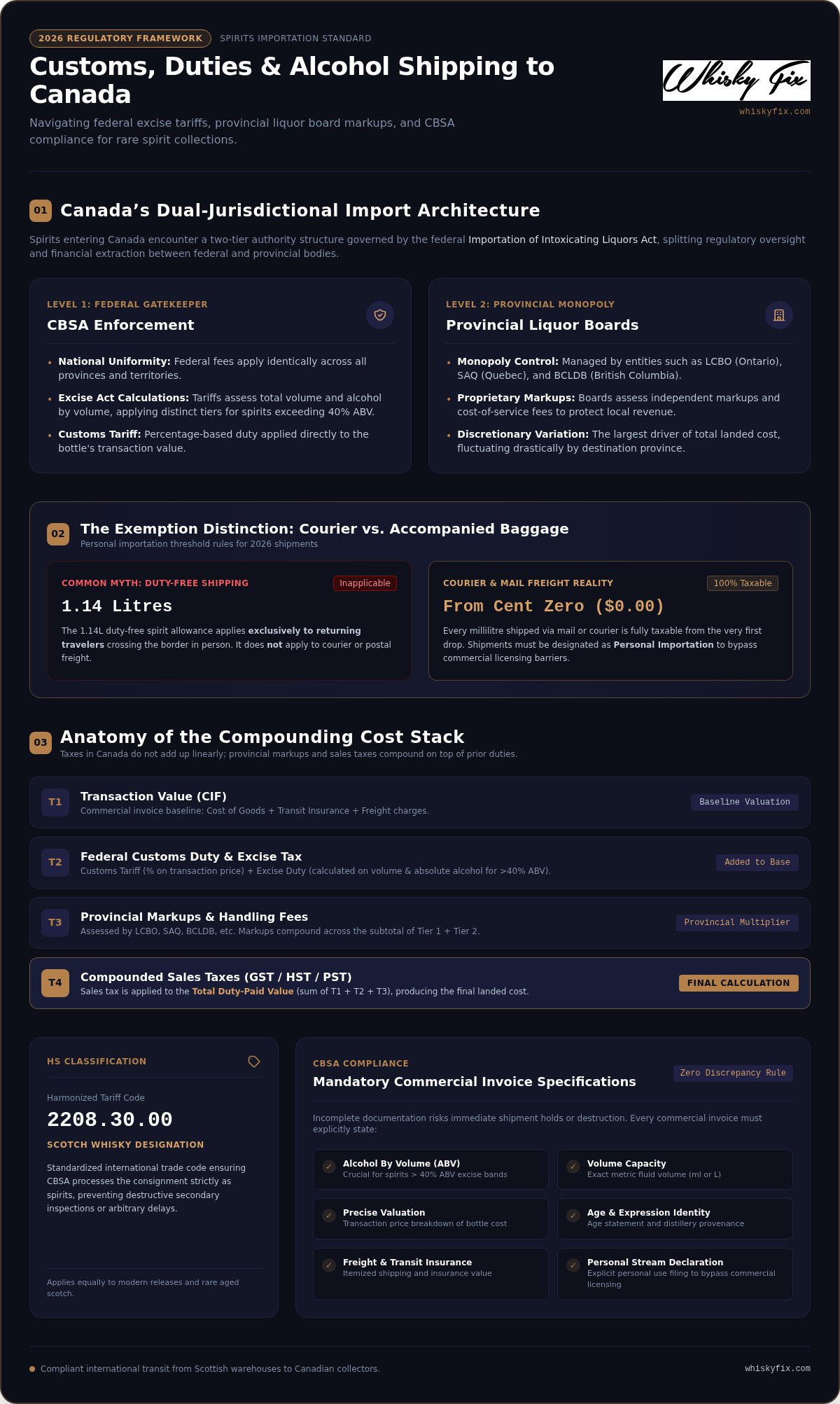
Canada’s approach to importing spirits is unique and often misunderstood by international collectors. The process is governed by a dual-jurisdictional framework where federal and provincial authorities work in tandem. At the federal level, the Canada Border Services Agency (CBSA) serves as the primary gatekeeper. They ensure that every bottle entering the country complies with the Importation of Intoxicating Liquors Act. This legislation is the cornerstone of Canadian alcohol law, effectively granting provincial governments the sole right to control the movement of spirits across their borders. Understanding the customs and duties on alcohol shipping to Canada requires a clear view of this multi-layered system where federal laws set the stage and provincial rules dictate the final cost.
The Federal vs. Provincial Divide
The financial complexity of shipping to Canada arises from how these two levels of government calculate their fees. Federal duties are consistent across the country, focusing on the volume and alcohol by volume (ABV) of the spirit. However, the most significant portion of the cost often comes from provincial markups. These are levied by provincial liquor control boards in Canada, such as the LCBO in Ontario or the SAQ in Quebec. These boards operate as monopolies and apply their own cost-of-service fees and markups to protect local revenue. Finally, sales taxes like GST, HST, or PST are applied not just to the bottle’s value, but to the total duty-paid value, creating a compounding effect on the final price of your acquisition.
Personal Importation Limits for 2026
A common point of confusion for collectors involves the duty-free allowance. While travelers returning to Canada can often bring 1.14 litres of spirits without paying taxes, this exemption doesn’t apply to mail or courier shipments. When you’re calculating the customs and duties on alcohol shipping to Canada, you must assume that every drop is taxable from the very first cent. In 2026, regulations remain strictly focused on the distinction between personal and commercial imports. It’s vital that your shipment is clearly documented for personal use. Commercial shipments require specialized liquor licenses and different customs coding. Failing to distinguish your rare scotch as a personal acquisition can lead to the CBSA holding the bottle indefinitely. By declaring the shipment correctly, you ensure it’s processed under the personal importation stream, which avoids the bureaucratic hurdles of commercial trade while still requiring full payment of provincial markups.
Federal Customs Duties and the Excise Act of 2026
The federal portion of customs and duties on alcohol shipping to Canada is primarily dictated by the Excise Act and the Customs Tariff. While provincial fees vary, federal charges remain constant regardless of where you reside in the country. These charges are applied immediately upon arrival at the border, and they’re calculated based on the precise nature of the spirit and its transaction value. For the collector, this means the price paid in Scotland is only the beginning of the valuation process. Every shipment must be accompanied by a commercial invoice that clearly itemizes the cost of the goods, insurance, and freight.
Decoding HS Codes for Spirits
The Harmonized System (HS) code is the universal language of international trade. For Scotch whisky, the critical classification is 2208.30.00. This code tells the CBSA exactly what’s inside the package, ensuring it’s treated as a spirit rather than a generic beverage. While your bottle may be an rare scotch expression with significant historical value, the HS code remains the same. Accurate documentation from your retailer is non-negotiable; the invoice must clearly state the age, volume, and ABV to prevent unnecessary inspections or delays.
Excise Tax vs. Customs Duty
It’s vital to distinguish between these two federal levies. The federal excise tax is a volume-based charge that targets the amount of absolute alcohol in the bottle. In contrast, customs duty is a percentage-based charge calculated against the bottle’s purchase price. You can review the current Canada Revenue Agency excise duty rates on spirits to understand how these figures are adjusted annually. For 2026, the excise duty rate is applied as a specific dollar amount per litre of absolute ethyl alcohol contained within the spirit.
The “Value for Duty” is the foundation for all subsequent taxes. This figure is based on the purchase price in British Pounds (GBP), which the CBSA then converts to Canadian Dollars (CAD) using the exchange rate in effect on the date of shipment. Fluctuations in the currency market can significantly impact your final assessment. A strong Canadian dollar reduces the taxable base, while a weaker one inflates it. Our expertise in worldwide shipping ensures all currency declarations are precise, helping you avoid overpayment due to clerical errors at the border. This attention to detail is what allows a seamless transition from a Scottish warehouse to a Canadian cellar.
Provincial Liquor Boards: Calculating Markups and Handling Fees
Federal levies are only the first hurdle in the importation process. The most significant variable in the cost of customs and duties on alcohol shipping to Canada is your province of residence. Each provincial liquor board operates as a legal monopoly, and they use a “markup” system to ensure they don’t lose revenue on private imports. This markup is essentially the profit margin the board would have earned if you’d purchased the bottle from their own shelves. Consequently, the final price of a rare single malt can fluctuate by a significant margin depending on whether it’s delivered to Calgary or Toronto.
Beyond the percentage-based markup, boards apply “Cost of Service” charges. These fees cover the administrative labor of processing your individual shipment. You’ll also encounter environmental levies and container recycling fees at the border. While these are usually small amounts per bottle, they’re mandatory components of the final assessment. Understanding these layers is the only way to establish a predictable total cost of ownership for your collection.
Ontario (LCBO) vs. British Columbia (BCLDB)
Ontario remains one of the more expensive jurisdictions for private collectors. The LCBO applies a substantial percentage-based markup to the landed cost, which includes the purchase price, shipping, and federal duties. In contrast, British Columbia’s BCLDB uses a complex tiered system. While BC’s structure can be punishing for entry-level bottles, it often becomes more favorable for high-value collector items in 2026. If you’re importing a bottle worth several thousand pounds, BC’s specific fee caps may offer a slight advantage over Ontario’s strictly percentage-based model.
Quebec (SAQ) and Alberta (AGLC)
Alberta continues to be the most collector-friendly province due to its privatized retail model. The AGLC generally provides a more streamlined path for customs and duties on alcohol shipping to Canada, with predictable flat markups that don’t scale as aggressively as in other provinces. Quebec, however, presents unique challenges. The SAQ requires rigorous documentation and often demands a “Letter of Authorization” before a shipment can be released from customs. This document proves the board has sanctioned the import for personal use. Navigating these provincial nuances is essential to ensure your rare scotch doesn’t get caught in a bureaucratic stalemate at the border.
A Practical Checklist for Shipping Spirits to Canada
Securing a rare expression from a Scottish distillery is a significant investment, and the logistics of its arrival should be handled with equal care. To ensure your bottle clears the border without incident, you must avoid the common pitfall of “stealth” shipping. Marking a package as a gift or misrepresenting its contents is a high-risk strategy that often leads to permanent seizure by the CBSA. Instead, professional collectors rely on transparency and precise documentation to manage customs and duties on alcohol shipping to Canada effectively. Choosing a retailer with established international expertise is the first step in ensuring your bottle is treated with the respect it deserves by customs officials.
Documentation Requirements
Accuracy on the commercial invoice is non-negotiable. This document must state the precise volume (such as 700ml), the alcohol by volume (ABV), and the true transaction value in GBP. Under the Comprehensive Economic and Trade Agreement (CETA), Scotch whisky typically enters Canada duty-free, but you still owe federal excise taxes and provincial markups. A Certificate of Origin can be beneficial to prove the spirit was distilled and aged in Scotland, though for most individual bottles, a detailed commercial invoice from a reputable specialist is sufficient. Always provide your current phone number and email address; the customs broker needs these to contact you for payment the moment the package arrives.
The Delivery and Payment Process
Once the bottle reaches the Canadian border, your chosen courier acts as your customs broker. They’ll pay the required fees on your behalf to speed up the clearance process. You’ll then receive a notification, often via email or SMS, detailing the total “Duties and Taxes Owed.” It’s standard practice for couriers to charge an “Advancement Fee” or “Disbursement Fee” for this service, which is usually a flat rate or a small percentage of the duties paid. Paying these fees promptly through the courier’s online portal is the fastest way to trigger the final delivery to your door.
If you’re ready to add an exceptional bottle to your cellar, our team provides the expert worldwide shipping services necessary to navigate these requirements with ease.
Occasionally, the CBSA may hold a package for a physical inspection. This is a routine part of border security and doesn’t necessarily indicate a problem. If this happens, your courier will provide updates through their tracking system. As long as your documentation is honest and complete, the inspection will conclude, and your package will proceed to its final destination. Patience is a virtue in the world of rare spirits, and a brief delay for inspection is a small price to pay for a fully legal and insured importation.
How Whisky Fix Ensures Your Rare Scotch Reaches Canada Safely
At Whisky Fix, we believe that acquiring a bottle from the heart of Oban is more than a simple purchase; it’s the preservation of liquid history. Successfully managing the customs and duties on alcohol shipping to Canada requires a level of precision that only a specialist can provide. Our approach to worldwide shipping is built on years of experience navigating the specific demands of the CBSA and provincial liquor boards. We provide the transparent, itemized documentation necessary to ensure your shipment is processed without the errors that often plague less experienced retailers.
The physical integrity of your acquisition is just as important as its legal clearance. We employ professional packing techniques specifically engineered for rare scotch and high-value decanters. Our high-impact materials are designed to survive the journey and the hands of customs inspectors alike. Every bottle is carefully cushioned to protect original cartons, labels, and seals. This meticulous attention to detail is part of our commitment to delivering the finest single malt scotch whisky to your door in the same condition it left our shelves in Scotland.
Expertise in High-Value Logistics
Collectors trust our Oban-based team because we act as a bridge between traditional heritage and modern global logistics. We handle the nuances of the Canadian market with the same steady hand we use when importing scotch whisky to the USA. Our track record with Canadian customs clearance is built on honesty and accuracy, ensuring that the customs and duties on alcohol shipping to Canada are calculated correctly from the start. We take pride in our role as a trusted curator, managing the complexities of the border so you can focus on the enjoyment of your collection.
Your Next Step in Collecting
Your journey toward a more refined collection begins with a single selection from our Old & Rare inventory. We encourage you to browse our current offerings, where provenance and authenticity are always guaranteed. If you require a predictable estimate of the total cost of ownership for a specific bottle, contact our team for a bespoke shipping quote tailored to your province. Join a global community of enthusiasts who rely on our expertise to bring the best of Scotland’s distilleries directly to their private cellars.
Securing Your Next Masterpiece with Confidence
Navigating the customs and duties on alcohol shipping to Canada is a manageable process when you apply the right technical knowledge. You now have the tools to distinguish between federal excise rates and the specific markups applied by your provincial liquor board. By prioritizing transparent documentation and selecting a courier that understands the role of a customs broker, you eliminate the uncertainty that often surrounds international spirits acquisition. Accurate valuation and a clear understanding of your province’s unique fee structure are the keys to a predictable and successful delivery.
As a specialist retailer based in Oban, Scotland, Whisky Fix serves as your bridge to the world’s most elusive expressions. We bring decades of expertise in rare spirit logistics to every shipment, ensuring that your investment is protected by secure, tracked international shipping and professional packaging. Explore our collection of Rare Scotch ready for worldwide delivery and discover how seamless the importation process can be. Your collection deserves the authenticity of a direct Scottish source, and we’re here to ensure it arrives exactly as intended. We look forward to helping you secure your next landmark bottle.
Frequently Asked Questions
Can I ship whisky to Canada as a gift to avoid duties?
Shipping whisky as a gift doesn’t allow you to avoid duties or taxes. While Canada allows a $60 exemption for many gift items, alcohol and tobacco are strictly excluded from this rule. Every bottle shipped into the country is subject to the full assessment of federal and provincial fees regardless of its status as a gift. Attempting to mislabel the package can lead to seizure by the CBSA and permanent loss of your bottle.
What is the average total percentage of duty and tax for Ontario residents?
For Ontario residents, the total percentage of duty and tax often falls between 60% and 90% of the bottle’s purchase price. This figure includes the federal excise duty, the LCBO’s significant provincial markup, and the 13% HST. The final cost of customs and duties on alcohol shipping to Canada depends heavily on the initial valuation in GBP. High-value collectors should prepare for these compounding layers when budgeting for a rare acquisition.
Does the age of the whisky affect the amount of customs duty I pay?
The chronological age of a whisky doesn’t change the specific excise rate, but it significantly impacts the total duty owed. Federal customs duty is a percentage-based calculation applied to the purchase price. Since a rare, aged expression commands a higher market value, the resulting duty will be higher than that of a younger bottle. The HS code remains 2208.30 regardless of the vintage, but the valuation dictates the final tax bill.
Will my bottle be opened by Canada Border Services Agency (CBSA) during inspection?
Your bottle may be opened, though it’s not a certainty for every shipment. The Canada Border Services Agency reserves the right to inspect any package to verify the contents against the provided invoice. If an inspection occurs, officers typically check the seal and ABV to ensure compliance with federal law. They’ll reseal the package with official CBSA tape. Providing clear, professional documentation helps minimize the likelihood of an invasive physical inspection.
What happens if I refuse to pay the duties on my shipment?
If you refuse to pay the assessed fees, the courier will eventually return the package to the sender or declare it abandoned for destruction. You won’t receive the bottle, and you may still be responsible for return shipping costs and administrative fees. It’s vital to understand the customs and duties on alcohol shipping to Canada before your bottle leaves Scotland to ensure you’re comfortable with the final investment required for your collection.
Is there a limit on the number of bottles I can import at once for personal use?
There is no strictly defined bottle limit for personal use, but importing large quantities can trigger a commercial investigation. CBSA officers look for signs that a shipment is intended for resale rather than a private collection. For a seamless experience, we recommend shipping smaller, curated selections of one to three bottles at a time. This approach confirms the shipment’s status as a personal acquisition and avoids the complex licensing requirements of commercial spirits trade.
Do I need a liquor license to import a single bottle of rare scotch?
You don’t need a liquor license to import a single bottle of rare scotch for your private collection. Individual collectors are permitted to import spirits under the personal use stream, provided they settle all federal duties and provincial markups upon arrival. The courier acts as your agent during this process, handling the technical communication with customs officials. As long as you aren’t selling the spirit, your status as a private enthusiast is fully recognized.