
- October / 21 / 2026
Calculating ROI on Collectible Whisky: Costs and Value
A rare bottle can be desirable without being profitable. For calculating ROI on collectible whisky, subtract all purchase and selling costs from the sale proceeds, then divide the result by your total investment cost and multiply by 100. A £1,000 bottle sold for a £1,200 hammer price appears to have gained 20% before costs, but fees can turn that apparent rise into a net loss. The UK tax question is separate: cask whisky is often discussed as a wasting chattel because evaporation and declining strength give it a predictable life of less than 50 years, while the chattel disposal threshold mentioned for bottled whisky is £6,000.
When calculating ROI on collectible whisky, it’s easy to focus on age, rarity or a headline auction result. A sound estimate also accounts for provenance, condition, demand, transaction costs and holding period, while recognising that past performance cannot remove market risk. This article explains how to calculate net and annualised returns, interpret historical price data and weigh factors that can influence a bottle’s value, helping you assess potential returns with a clearer view of costs and uncertainty.
Key Takeaways
- Include purchase, storage and selling expenses, along with opportunity cost, to see whether a bottle’s return is genuinely positive.
- Compare historical prices for similar bottles and use a holding period that makes the comparison meaningful.
- Treat ROI as a measure of return, not risk: market shifts and limited demand can affect what a bottle ultimately sells for.
- Distinguish an auction’s hammer price from your net proceeds after fees and other transaction costs.
- Assess provenance, condition, release recognition and buyer demand alongside rarity when judging a bottle’s potential value.
Accounting for investment costs and operating expenses
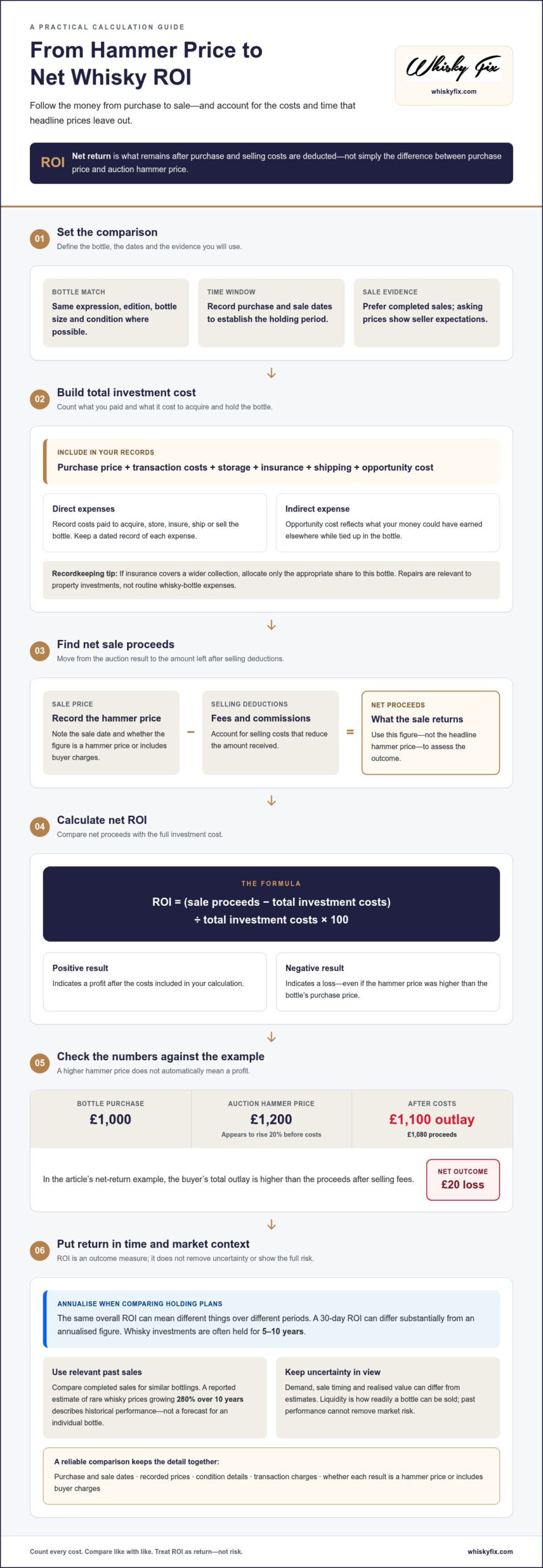
Include the bottle’s purchase price, transaction costs, storage, insurance, shipping and opportunity cost in your calculation. Storage, insurance and shipping reduce ROI by increasing the capital committed or lowering sale proceeds, so count these expenses across the holding period.
Ongoing and Indirect Expenses
Ongoing and indirect expenses affect an investment’s net return beyond the bottle’s purchase price. Direct costs include shipping, storage and insurance paid to acquire, hold or sell a bottle. Opportunity cost is indirect: it reflects what your money could have earned elsewhere.
Repairs are relevant to property investments, not routine whisky-bottle expenses. For whisky, record the costs directly related to acquiring, holding or selling the bottle.
Keep a dated record of each expense, including storage, insurance and shipping. If insurance covers a wider collection, allocate only the appropriate share to the bottle. This keeps costs from disappearing into a general household or collection budget and makes comparisons between bottles more meaningful.
Net Returns After Selling Costs
Net return is what remains after deducting purchase and selling costs from the sale proceeds. It matters because a high auction hammer price alone does not show whether the bottle made a profit.
Use this formula: ROI = (sale proceeds minus total investment costs) ÷ total investment costs × 100. Include the purchase price and all direct and indirect expenses in total investment costs. Brokerage fees and commissions are direct costs; the opportunity cost of tying up capital is indirect. A positive result indicates a profit, while a negative result indicates a loss.
For example, a bottle bought for £1,000 and sold at a £1,200 hammer price appears to have risen by 20% before costs. But the net-return example has a buyer’s total outlay of £1,100 and proceeds of £1,080 after selling fees. The buyer loses money despite the higher hammer price.
Separate purchase costs, holding expenses and selling deductions in your records. This breakdown shows which expenses have the greatest effect on the final return and whether an apparent gain remains after costs.
Improving ROI calculation accuracy with historical data and suitable time periods
Historical prices help put a bottle’s potential return in context, but comparisons need to match the whisky and measurement period. A useful analysis pairs relevant past sales with a clearly defined holding period.
Historical Prices and Returns
Historical prices record past bottle sales, while historical returns measure how values changed over a chosen period. Use them to assess whether an assumed resale value is supported by comparable whisky sales, rather than relying on an exceptional result.
One reported estimate says rare whisky prices grew by 280% over 10 years. Treat that as historical market performance, not a forecast for an individual bottle. Compare the same expression, edition, bottle size and condition where possible. Auction results for a different release may reflect different scarcity, provenance or buyer interest.
When checking recent prices, distinguish completed sales from asking prices. An asking price reflects a seller’s expectation; a completed sale shows what a buyer paid. Record the sale date and whether the figure is a hammer price or includes buyer charges. Compare like with like before using past values in your ROI estimate.
Holding Period and Payback
The holding period is the time between buying and selling a bottle. Payback occurs when net proceeds recover the original outlay. Both matter because the same overall ROI can represent different results over different periods.
ROI alone doesn’t state how long an investment took to produce its return. A 30-day ROI can differ substantially from an annualised figure. Whisky investments are often held for 5-10 years, so calculate the elapsed period and compare annualised returns when evaluating different holding plans.
Use accurate, complete historical data that matches the bottle being assessed. Keep purchase and sale dates, recorded prices, condition details and transaction charges together. A comparison period that is too short may be distorted by isolated sales; one that is too long may reflect demand or market conditions that no longer apply.
For US auction transactions, buyer charges and seller commissions follow the auction’s terms and affect the buyer’s outlay or the seller’s net proceeds. Tax calculations generally start with the difference between sale proceeds and cost basis, with the applicable treatment depending on the transaction and tax rules.
Payback is not the same as profit. A collectible bottle usually produces no cash flow while held, so you recover the outlay through a sale. Compare net sale proceeds with the original outlay, then account for the years elapsed. A longer wait can lower the annualised return, even if the final sale price exceeds the purchase price.
For a practical comparison, review whisky bottlings alongside the historical records you use in your analysis.
ROI limitations, including uncertainty and risk
ROI summarises an outcome, but it cannot capture every uncertainty involved in selling collectible whisky. Use it alongside market evidence and the conditions that could change demand or liquidity.
Uncertainty and Market Liquidity
Market uncertainty means demand, sale timing or realised value may differ from your estimates. Liquidity describes how readily a bottle can be sold. Both matter because ROI uses a sale value, but finding a buyer at that value may take time.
Rare whisky indices illustrate how market movements can reverse. An index rising from 100 to 150 represents a 50% increase for its tracked group under that methodology. A fall from 150 to 135 is a 10% decline from the higher level. Neither movement predicts the result for a particular bottle.
Parts of the rare whisky market rose rapidly during the late 2010s and early 2020s, before demand cooled and several indices fell from previous highs. A concentrated market can make headline performance especially sensitive to a small group of sought-after expressions. Compare an index’s composition with the bottle you’re evaluating, rather than treating the index as a personal portfolio return.
Liquidity is another constraint. A bottle may interest only buyers seeking its particular distillery, edition or provenance. If you need to sell quickly, a smaller pool of interested buyers can limit your options or affect the price you achieve. Keep estimated values separate from completed sale prices in your analysis.
Limits of ROI for Decisions
ROI is a percentage comparing return with investment cost, but it does not measure risk or the possibility of losing money. Two purchases with similar estimated ROI can differ in demand, liquidity and exposure to market changes.
Use ROI as one decision tool, not a standalone verdict. Before buying, compare the expected return with a lower-value outcome, the holding period and ease of resale. For example, a bottle aimed at a narrow collector audience may carry different liquidity risk from one with broader recognition, even if both have the same projected ROI.
Check what the calculation leaves out. A single ROI figure does not show when returns arrive, how uncertain the resale estimate is or whether one bottle dominates a collection’s results. Review each bottle separately, then consider how much your overall outcome depends on that expression or market segment.
Finally, distinguish historical performance from a forward-looking estimate. An index’s 50% rise describes its tracked group over a specified movement, not a guaranteed result for your next purchase. A sound decision combines ROI with evidence quality, market concentration and your ability to hold through changing demand.
Buying whisky through auctions and platforms
A collectible whisky’s auction result is only one part of its investment picture. For a useful comparison, separate the hammer price from your total buying cost and eventual net proceeds.
Those figures show how much a quoted price can differ, but they do not establish an individual buyer’s return. ROI also depends on the purchase date, actual transaction price, holding costs and amount received after resale.
Before bidding, identify what each displayed figure represents. A catalogue estimate, opening bid, hammer price and final buyer payment are different measures. The hammer price is the winning bid before any applicable buyer charges. Your total purchase cost should include charges specified in the auction terms, plus relevant transport, insurance and currency conversion costs.
Set a maximum bid based on expected resale value, not the excitement of a live auction. First estimate likely net proceeds from comparable completed sales, then subtract the costs of buying, holding and selling. The remainder is the maximum available for the bid if you want to preserve your target return. If that figure is below the seller’s reserve or current bid, walking away protects your analysis.
Platform records need careful interpretation. Compare the same Macallan Edition No 1 release, bottle size and condition, and distinguish completed transactions from listings that remain unsold. A listed price shows what a seller seeks, not what a buyer has paid. Record the date and sale format for each comparison so you don’t treat different market moments as equivalent.
Descriptions also affect value. For a numbered release, check whether the listing clearly identifies the bottle and packaging, and whether its stated provenance supports the comparison. A damaged presentation box or missing records can make one lot different from another, even when both display the same whisky name. Treat the lot description as evidence, not a substitute for a completed sale.
Resale calculations require equal care. A seller’s commission or other platform charge reduces the amount received, while shipping and insurance may add costs. Terms vary by transaction, so enter the applicable amounts in your records rather than assuming a standard rate. Convert purchase and sale amounts consistently when currencies differ.
Keep a transaction record for every purchase: platform, date, lot details, bid, charges, delivery costs and any later sale proceeds. This record makes auction buying comparable with other routes and helps distinguish a valuable bottle from a profitable investment.
Add the applicable buyer charges specified in the auction terms to the hammer price when calculating your purchase cost. Subtract the seller’s commission and other applicable platform charges from the sale price to estimate net proceeds. This section does not provide a basis for calculating US taxes.
Factors affecting collectible whisky value
A bottle’s age or scarcity alone does not determine its value. Collectible demand depends on how several features work together, so assess each bottle’s identity, provenance, condition and buyer appeal before applying an ROI formula.
Recognition can outweigh age. A recognised discontinued 12-year-old release may attract more demand than an obscure 30-year-old bottling. That comparison shows why age is not a reliable proxy for value: buyers may prize a familiar release with a clear collecting history over an older bottle with limited recognition. Compare interest in the specific expression, not just the age statement.
Scarcity also needs context. A numbered release of 200 bottles is structurally scarcer than one of 20,000 bottles, but that doesn’t necessarily make it more valuable. Limited production matters when collectors also want that release. Consider scarcity alongside the distillery’s reputation, the expression’s recognition and evidence of demand. A small edition without an interested audience may not command a premium.
Provenance helps establish a bottle’s history and authenticity. Clear ownership records and consistent details can increase confidence in what is being offered. A listing with an unclear origin, for example, gives buyers less assurance than one with a traceable history. That difference can influence demand and the price buyers are willing to offer, even for bottles with the same label.
Condition affects how closely a bottle matches the examples used in a valuation. Inspect the fill level, label, closure and packaging, and record any visible damage or missing components. A bottle with compromised presentation may not be directly comparable with a well-preserved example. For owners assessing the capital tied up in a collection, condition notes make later comparisons more precise.
Alcohol strength is another detail, but a higher figure doesn’t guarantee stronger collectibility. A 55% ABV whisky with unclear provenance and weak demand may be less collectible than an established 43% official bottling. The example illustrates the interaction between specification, authenticity and buyer interest. Evaluate these factors together rather than assigning value from strength alone.
Apply these observations to comparable releases before estimating a future sale value. Separate features inherent to the bottle, such as its edition and age statement, from factors that shape buyer confidence, such as provenance and condition. Then use the closest comparison in your ROI calculation. A single percentage cannot explain why one release attracts attention while another is overlooked.
Explore collectible whisky expressions and compare their release details as you assess which characteristics matter to your collecting goals.
Whisky Fix: Single Malt Scotch Whisky
Whisky Fix offers Single Malt Scotch Whisky and Old & Rare bottles for collectors considering their next purchase. Compare expressions by distillery, age statement, release character and provenance, then apply the cost and value factors discussed above. These details can inform your collecting decision, but they do not replace your own assessment of resale demand, holding costs or risk.
Explore the range of Single Malt Scotch Whisky when you’re seeking a bottle to enjoy or add to a collection. Whisky Fix also offers Worldwide Shipping, making its selection accessible to customers internationally. For a considered next step, browse the available whiskies on Whisky Fix’s website, or contact Whisky Fix with your enquiry.
Make Your Next Whisky Decision With Purpose
Before your next purchase, decide what role you want the bottle to play: a whisky to enjoy, a piece of collecting history or an asset whose potential you’ll assess over time. That purpose gives your research a useful focus and keeps calculating ROI on collectible whisky connected to the qualities that matter to you, rather than reducing every bottle to a percentage.
Whisky Fix offers Single Malt Scotch Whisky, Old & Rare and Scottish Gin. Explore these offerings with your priorities in mind, whether you’re starting a collection or considering a distinctive addition. A thoughtful choice can balance personal appreciation with a clear-eyed view of value.
Contact Whisky Fix about your whisky and take the next step in building a collection that reflects your interests. Your next discovery can begin with a considered decision.
Frequently Asked Questions
Is Whisky a Wasting Asset for UK Capital Gains Tax?
Cask whisky is often discussed as a wasting chattel because evaporation and declining alcoholic strength give it a predictable life of less than 50 years. Bottled whisky has a different consideration: the UK chattel disposal threshold mentioned for it is £6,000. These points distinguish cask from bottled whisky, but they don’t establish the tax treatment of every disposal. The asset type and the circumstances of the sale matter.
What Is ROI, and How Do You Calculate It?
ROI expresses an investment’s net profit as a percentage of its total cost. Subtract total investment costs from proceeds, divide that result by total investment costs, then multiply by 100. For example, proceeds of £1,080 against a total outlay of £1,100 produce a loss, not a gain. Keep the currency consistent and include relevant costs in the calculation for a meaningful result.
What is ROI?
ROI, or return on investment, measures an investment’s result against the capital committed to it. A positive percentage indicates that proceeds exceeded the costs included in the calculation; a negative percentage indicates a loss. ROI is useful for comparing outcomes, but the figure alone does not show how long the investment was held or how easily it could be sold.
What is a good ROI?
There is no single ROI percentage that is good for every whisky purchase. A useful benchmark depends on your holding period, total costs, risk tolerance and the returns available from other uses of your capital. Compare investments over equivalent periods and include the same cost categories. A high percentage based on an uncertain resale estimate may be less useful than a lower return supported by relevant completed sales.
How do you calculate ROI on collectible whisky?
For calculating ROI on collectible whisky, subtract the bottle’s full investment costs from its net sale proceeds, divide by those costs, then multiply by 100. This makes the result clearer than comparing the purchase price with the auction hammer price alone.
How do whisky prices differ by distillery, age, rarity, and bottle condition?
Price depends on how these characteristics combine with recognition and buyer demand. A recognised discontinued 12-year-old release may draw more interest than an obscure 30-year-old bottling. A numbered edition of 200 bottles is scarcer than one of 20,000, but scarcity alone doesn’t establish value. Condition and provenance also shape comparability: an established 43% ABV official bottling may be more collectible than a 55% ABV bottle with unclear provenance and weak demand.
How can you estimate a collectible whisky bottle’s resale value?
Start with completed sales of the same expression, then narrow your comparisons by bottle size, condition, packaging and provenance. Distinguish achieved sale prices from asking prices, which reflect sellers’ expectations rather than completed transactions. For example, a sale of the same release in sound condition is a closer comparison than an older bottle from another distillery. Record the sale date and format, then account for differences before using the comparison in an estimate.
How do whisky investment returns compare with stocks, gold, and wine?
Comparisons depend on the asset and measurement period. One reported figure puts cask whisky returns at 62% since 2018, compared with 58% for gold. The S&P 500 had an average annual return of over 10% from 1957 through 2024. These figures use different periods and asset types, so they aren’t direct equivalents to returns on individual bottles. Wine comparisons also depend on the index or bottles selected.