

- October / 17 / 2026
Best Whisky to Drink Neat: 2026 Guide to Standout Sips
The smoothest whisky isn’t always the best whisky to drink neat. A gentle pour can seem muted if you’re looking for depth, while a bolder dram may reveal fruit, spice or coastal character as you sip. Rather than choosing the mildest bottle, look for a whisky whose character suits the way you enjoy drinking.
A neat whisky offers more to explore than intensity alone. Aroma, texture, finish and cask influence all shape the experience. Knowing what to notice can also make different styles easier to compare. This guide looks at distinctive Scotch single malts and the details that can help you decide what might suit your palate.
From Isle of Raasay The Chinkapin, matured fully in Chinkapin oak casks, to Oban 14 Year Old’s citrus, spice and sea-salt notes, each bottle offers a different direction. NC’NEAN Quiet Rebels Matthew brings a sweet, salty, tropical-fruit character, while Ardbeg 15 Year Old Trudernish offers another Islay profile to explore. Whisky Fix, Scotland’s Whisky Specialist, is based in Oban and offers these distinctive single malts for comparison. Look beyond “smooth” and choose a neat dram whose character you’d like to savour.
Key Takeaways
- The best whisky to drink neat depends on the flavours and drinking style you enjoy, not on smoothness alone.
- A simple tasting sequence helps you notice aroma, texture and finish beyond the first sip.
- Compare the four featured Scotch whiskies by their tasting notes and maturation details to find styles worth exploring.
- Use flavour preferences, provenance and cask influence to narrow your shortlist, while remembering that tasting is personal.
- Whisky Fix’s specialist selection offers a starting point for exploring distinctive Scottish single malts.
What makes a whisky one of the best whiskies to drink neat?
Neat whisky can be rewarding without fitting one universal flavour profile. Some drinkers prefer a gentle, rounded sip; others look for spice, smoke or a pronounced coastal edge. The best whisky to drink neat is not necessarily the mildest. It’s the one whose aroma, palate and finish make you want to take another considered sip.
“Neat” means whisky served without ice or a mixer. Adding water is a separate, optional adjustment. A few drops may change how a whisky’s aromas and flavours present, but you don’t have to add any. Taste it as served first, then decide whether water makes the experience more enjoyable for you.
A useful definition is simple: a good neat whisky suits the drinker’s preferred character. Balance matters, but it doesn’t mean every flavour must be soft or subtle. A whisky can be intense and still feel well-integrated, with its aromas, flavours and finish working together. General background on whisky styles and production is available in What is Whisky?
Does smoothness make a whisky better neat?
Smoothness usually describes how a whisky feels to drink, including its perceived warmth or softness. It’s only one part of the experience. A mellow whisky may be comfortable but less expressive to someone seeking layers of flavour. A bold dram may offer greater intensity without tasting harsh. Smoke, spice and richness don’t rule a whisky out for neat sipping. Preference and balance matter more than softness alone.
Which flavour profiles can you explore neat?
Think of tasting notes as directions to explore, not a ranking of quality. Fruity profiles may suggest fresh or dried fruit; sweet notes can recall honey or confectionery; coastal character may evoke salt and sea air. Spicy whiskies bring a warming, aromatic quality, while smoky styles can range from delicate to assertive. These descriptions can help you identify what appeals, though individual impressions vary.
Region and production provide useful context, but neither predicts exactly what you’ll enjoy. A single malt Scotch whisky guide can help explain how Scotch categories and regional identities fit into the broader picture. Use those cues as a starting point, then pay attention to the tasting notes and your own response.
To judge whether a style suits you, consider three questions:
- Which flavours do you naturally gravitate towards: fruit, sweetness, coastal notes, spice or smoke?
- Do you prefer a softer impression, or do you enjoy more pronounced warmth and intensity?
- Does the finish leave you curious to revisit the whisky, or does another style sound more appealing?
There’s no need to settle on one profile for every occasion. Comparing contrasting styles can reveal whether you favour delicacy, depth or a particular flavour direction. Use those preferences to guide your next pour instead of treating “smooth” as a universal verdict.
How to taste whisky neat and notice more than the first sip
A considered tasting doesn’t require specialist vocabulary or elaborate equipment. A small pour, a suitable glass and a few unhurried moments can help you notice how a whisky develops. Start with the whisky as served and give it a brief moment to settle before tasting. This gives you a reference point for comparing drams and deciding what you enjoy.
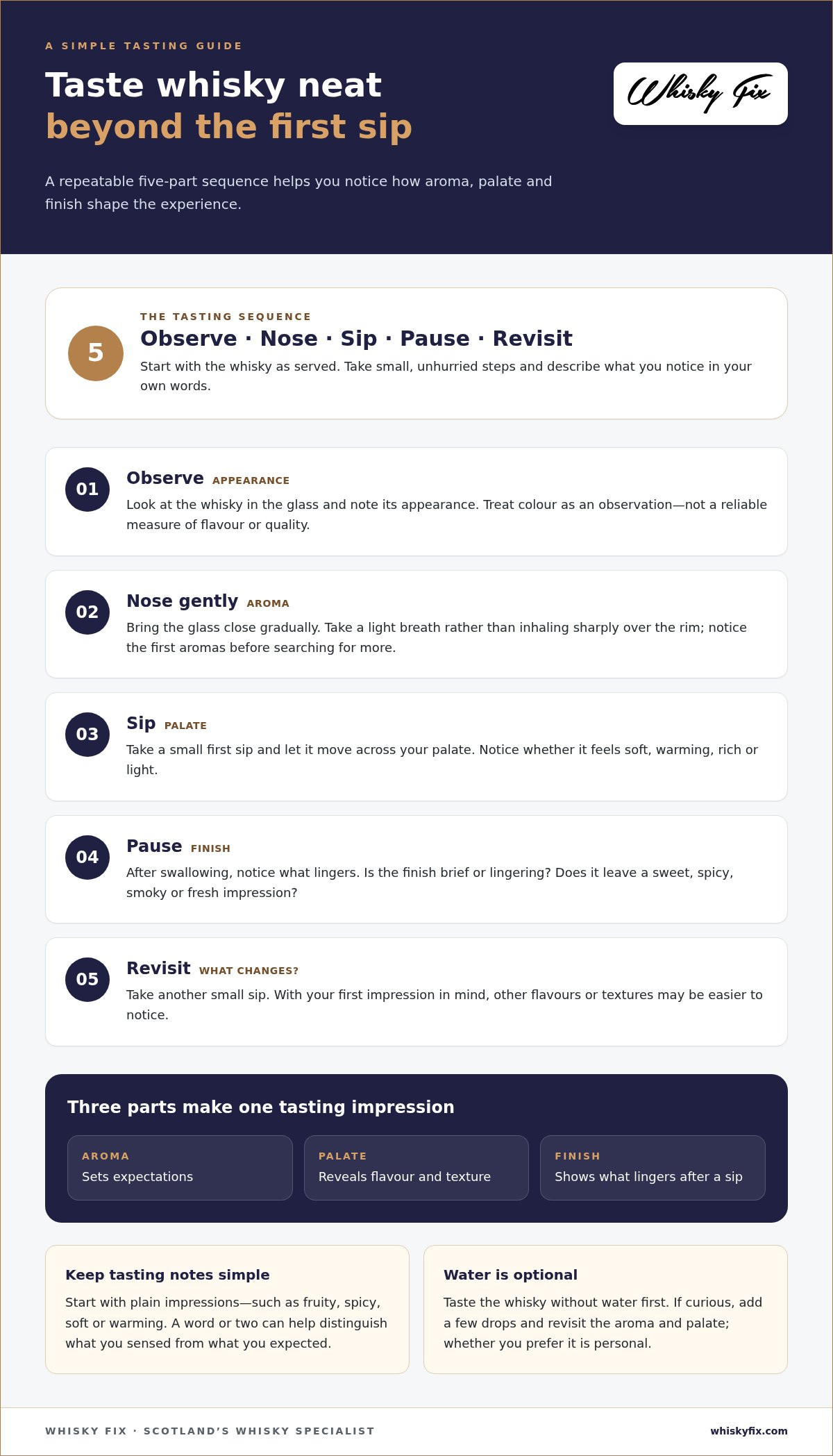
Follow a repeatable sequence: observe, nose gently, sip, pause and revisit. There’s no need to identify every note. Start with simple impressions, such as fresh or dried fruit, sweet or savoury, light or full-bodied. Aroma, palate and finish form a tasting impression together: the aroma sets expectations, the palate reveals flavour and texture, and the finish shows what lingers after a sip.
- Observe: Look at the whisky in the glass and note its appearance. Treat colour as an observation, not a reliable measure of flavour or quality.
- Nose gently: Bring the glass close gradually. Take a light breath rather than inhaling sharply over the rim, and notice the first aromas before looking for more.
- Sip: Take a small first sip. Let it move across your palate, then notice whether it feels soft, warming, rich or light.
- Pause: After swallowing, pay attention to the finish. Is it brief or lingering? Does it leave a sweet, spicy, smoky or fresh impression?
- Revisit: Take another small sip and see what changes. Once you know your first impression, other flavours or textures may be easier to notice.
How should you nose and sip a neat whisky?
Go gently. Holding the glass a little away from your nose at first can help you approach the aroma without being overwhelmed by alcohol warmth. Move closer as comfortable and take brief, easy breaths. On the palate, let a small sip coat your mouth before assessing it. After swallowing, describe the finish in plain language: perhaps it feels warm, dry, sweet or smoky, or fades quickly.
There’s no need to force a tasting note. If the first impression is simply “fruity” or “spicy”, that’s useful. If you’re comparing pours, write down a word or two. Short notes can help distinguish what you sensed in the glass from what you expected to find. For background on Scotch and its heritage, the Scotch Whisky Association offers industry information.
When should you add water to whisky?
Taste the whisky without water first so you have a personal reference point. If you’re curious, add a few drops and revisit the aroma and palate. Water can change how a whisky presents, but the result is a matter of preference. You may enjoy the adjusted pour, or prefer the original. It isn’t a required step, and no single approach improves every whisky for every drinker.
Use the same sequence with each dram, changing only one thing at a time. That makes comparisons clearer and helps you recognise the character you seek in the best whisky to drink neat. To explore Scottish single malts and compare styles, browse Whisky Fix’s Scotch whisky selection.
Four Scotch whiskies to drink neat, compared by character
These four single malts offer different starting points for a neat pour: a broad set of tasting notes, a sweet-and-salty profile, an Islay whisky with several stated cask types, and a distinctive Chinkapin oak story. The best whisky to drink neat depends on which details draw you in. Use this comparison to find a direction, not to rank the bottles.
| Whisky | Region | Stated maturation or tasting details | May suit a preference for |
|---|---|---|---|
| Oban 14 Year Old | Highlands | Cloves, citrus, light spices, sea-salt, dried fruit, honey and orange | A broad profile combining coastal, fruity, sweet and spicy notes |
| Isle of Raasay The Chinkapin | Highlands | Peated and unpeated spirit matured separately, then married; fully matured in Chinkapin oak. 50.2% ABV, natural colour and non-chill-filtered. | A distinctive cask story and interest in both peated and unpeated spirit |
| Ardbeg 15 Year Old Trudernish | Islay | Matured in bourbon, new charred oak casks and Oloroso sherry butts | Exploring a whisky’s stated cask influences and Islay provenance |
| NC’NEAN Quiet Rebels Matthew | Highlands | Described as sweet and salty, with tropical fruit, richness and freshness | A fruit-led profile with both sweet and savoury character |
Which neat Scotch suits a coastal, balanced or fruit-led preference?
Oban 14 Year Old is worth considering if you enjoy several directions in one tasting profile. Its listed notes range from citrus, orange and dried fruit to cloves, light spices, sea-salt and honey. NC’NEAN Quiet Rebels Matthew offers a different combination, pairing tropical fruit and sweetness with saltiness, richness and freshness. Ardbeg 15 Year Old Trudernish provides a cask-led point of comparison, with Islay provenance and maturation in bourbon, new charred oak casks and Oloroso sherry butts. These details can guide your choice without guaranteeing how a whisky will taste to you.
In brief: Oban 14 stands out for its varied coastal, citrus, spice and honey notes; NC’NEAN Quiet Rebels Matthew for its sweet-salty tropical-fruit character; and Ardbeg 15 Year Old Trudernish for its Islay origin and stated cask influences.
Which bottle offers a distinctive cask story?
Isle of Raasay The Chinkapin stands apart for its maturation approach. Its peated and unpeated spirit is matured separately before being married, and the whisky is described as an industry first for full maturation in Chinkapin oak casks. It is bottled at 50.2% ABV, with natural colour and no chill filtration. This provenance makes it worth considering if cask choice and production details are part of what you enjoy exploring.
Instead of searching for one universal winner, decide what you’d like to explore first: a broad set of tasting notes, a sweet-salty fruit profile, Islay cask influences or a distinctive oak maturation. Each gives you a different reason to pour a whisky neat.
How to choose the best whisky to drink neat for your palate
A useful shortlist starts with your own taste, not a bottle’s reputation. Decide which flavour direction appeals, read the whisky’s stated tasting notes and production details, then compare options that share those qualities. This gives you a reasoned starting point without assuming that a region, age statement or strength can predict exactly how you’ll experience a dram.
- Choose a flavour direction. Decide whether fruit, sweetness, coastal character, spice or smoke sounds most inviting.
- Read the details. Look for tasting notes, region and maturation information that connect with that preference.
- Compare a small shortlist. Consider what distinguishes each bottle, then taste when you can and note which profile you prefer.
For example, if you’re drawn to fruit and a sweet-savoury contrast, a description such as tropical fruit, sweetness and saltiness may be a useful clue. If cask provenance interests you, look for a specific maturation story rather than relying on a broad flavour label. Treat tasting notes as informed guidance, not a promise that you’ll detect every element or enjoy the whisky in the same way as someone else.
How do region and cask details help narrow the choice?
A region gives useful geographic context, but it doesn’t guarantee a particular flavour. Compare it with the product’s own details. Ardbeg 15 Year Old Trudernish is from Islay and is matured in bourbon, new charred oak casks and Oloroso sherry butts. Isle of Raasay The Chinkapin has a more unusual story: its peated and unpeated spirit is matured separately before being married, then fully matured in Chinkapin oak.
These descriptions help you compare provenance and production choices, but they can’t tell you conclusively which bottle will suit your palate. For more context on Scotland’s distilleries and regional identities, explore the Scotch whisky distillery guide.
Should beginners choose a lower-strength whisky?
ABV means alcohol by volume, a measure of a drink’s alcohol content. A higher figure doesn’t automatically mean a whisky is better neat, just as a lower figure doesn’t guarantee a softer or more enjoyable sip. Start with a small pour, taste attentively and decide whether the strength suits you. If you choose to add water, make it a personal adjustment rather than a rule.
Age and strength are separate details. Oban 14 Year Old and Ardbeg 15 Year Old Trudernish have age statements, while Isle of Raasay The Chinkapin is stated at 50.2% ABV. Those facts help identify and compare the whiskies; on their own, they don’t establish quality or smoothness. Let the flavour notes, maturation information and your own tasting experience guide your choice.
Ready to compare styles? Explore Whisky Fix’s Scotch whisky selection and look at bottles by their character and provenance.
Explore neat-drinking Scotch with Whisky Fix
There’s no single bottle that suits every palate. The four Scotch whiskies compared here offer different reasons to explore a neat pour: Oban 14 Year Old’s varied tasting notes, NC’NEAN Quiet Rebels Matthew’s sweet-salty fruit character, Ardbeg 15 Year Old Trudernish’s stated cask influences, and Isle of Raasay The Chinkapin’s distinctive maturation story. Let the details guide your curiosity, then decide which style appeals to you.
What makes these Whisky Fix Scotch selections distinct?
Each bottle offers a different starting point for exploring character and provenance. Oban 14 Year Old is listed with cloves, citrus, light spices, sea-salt, dried fruit, honey and orange. NC’NEAN Quiet Rebels Matthew is described as sweet and salty, with tropical fruit, richness and freshness. Ardbeg 15 Year Old Trudernish is from Islay and is matured in bourbon, new charred oak casks and Oloroso sherry butts.
- Oban 14 Year Old: Consider its range of citrus, fruit, spice, honey and coastal notes.
- NC’NEAN Quiet Rebels Matthew: Explore a profile described as sweet, salty, rich, fresh and tropical-fruited.
- Ardbeg 15 Year Old Trudernish: Look to its Islay origin and stated bourbon, new charred oak and Oloroso maturation.
- Isle of Raasay The Chinkapin: Note its 50.2% ABV, natural colour and non-chill-filtered status.
The Chinkapin’s cask story is especially distinctive: its peated and unpeated spirit is matured separately, then married, and the whisky is described as an industry first for full maturation in Chinkapin oak casks. Whisky Fix is an independent specialist based in Oban, Scotland, and Scotland’s Whisky Specialist. Its Scotch selection gives you a way to compare bottles through their stated character and provenance, rather than rely on one definition of a perfect neat dram.
How can readers continue exploring Scottish whisky?
Once you’ve identified a flavour direction you enjoy, use it to guide your next comparison. You might explore another distillery or region, then read its tasting notes and maturation details with the same curiosity. Look for specific information about origin and production, and treat it as context for tasting, not a guarantee that you’ll find the same flavours in the glass.
For adults of legal drinking age in their country, exploring Scotch can be a thoughtful way to discover how varied its character can be. If one of these profiles suits your palate, explore Whisky Fix’s Scotch whisky selection and choose a bottle whose stated details interest you.
Let your next neat pour reflect your palate
Finding the best whisky to drink neat is an ongoing pleasure, not a test with one correct answer. As you explore, keep a short record of the flavours and finishes you’d choose again. Over time, those notes can reveal whether your taste leans towards fruit, coastal character, spice, smoke or something less easily described.
Whisky Fix is an independent specialist retailer based in Oban, Scotland, with a selection of single malts from Oban, Isle of Raasay, Ardbeg and NC’NEAN. Let each bottle’s provenance and character spark a new question: which distillery or style would you like to discover next? For adults of legal drinking age in their country, that curiosity can make choosing a neat dram more personal and rewarding.
Explore Scotch whisky at Whisky Fix and follow the flavours that interest you. Your next favourite may be the pour that surprises you.
Frequently Asked Questions
What does it mean to drink whisky neat?
Drinking whisky neat means serving it on its own, without ice or a mixer. It’s a straightforward way to experience a spirit’s aroma, taste and texture without another ingredient changing them. Water is a separate choice, not a mixer: you can add a little if you wish, but the pour is neat when served without ice or other additions. The best whisky to drink neat is ultimately the one you enjoy this way.
Is whisky better neat or with a little water?
Neither serving style is automatically better; it depends on the whisky and your preference. A few drops of water may shift the aromas or soften the palate, while an undiluted pour gives you its bottled character more directly. Try a small sip first, then add a little water to the remaining whisky and compare. If you prefer the original taste, leave it as it is. There’s no need to follow a fixed tasting rule.
Can you drink any type of whisky neat?
You can try different whisky styles neat, including Scotch, Irish, American and Japanese whisky, provided you’re of legal drinking age where you live. Style alone doesn’t determine whether a pour will suit you. A blended whisky may be your preference just as readily as a single malt. Begin with a modest serving, take your time, and choose another way to serve it if the alcohol strength or flavour feels too intense.
What is the best glass for drinking whisky neat?
A tulip-shaped glass is a helpful choice for tasting because its narrower opening gathers aromas near the rim. A small wine glass can also work if that’s what you have. A tumbler is suitable for a relaxed pour, though its wide opening disperses aromas more readily. You don’t need a special glass to enjoy whisky. Choose clean glassware with enough room to swirl gently without spilling.
Should whisky be served at room temperature?
Room temperature is a practical starting point for serving whisky neat. Very cold whisky can seem less aromatic, while a warm room or a glass held for a long time may make the alcohol seem more prominent. You don’t need a thermometer: serve the pour comfortably cool or neutral to the touch, away from direct heat. If it seems too warm, give it a moment to settle before tasting.
Does whisky go bad after opening?
Whisky doesn’t spoil like fresh food, but its character can change after opening as air enters the bottle. To preserve it, close the cap firmly, store the bottle upright and keep it away from direct sunlight and strong temperature swings. A bottle with only a small amount left has more air inside, so its flavours may shift faster. Check for an unexpected change in aroma or taste before serving.
Is older whisky always better to drink neat?
No. An age statement tells you how long the whisky was matured in cask, not whether you’ll prefer its flavour or texture. A younger whisky may suit your palate more than an older one, depending on its character and your taste. Treat age as one piece of information alongside tasting notes and maturation details. When comparing bottles, focus on what you enjoy in the glass rather than choosing by age alone.
Can you drink cask-strength whisky neat?
Yes, cask-strength whisky can be served neat, but its higher alcohol content may make the first sip feel intense. Pour a small amount and taste cautiously rather than taking a large sip. You can add a few drops of water if you prefer, then decide whether the adjusted taste works better for you. Cask strength doesn’t mean water is compulsory, nor does it make a whisky inherently superior.