

- September / 5 / 2026
Best Scottish Gins for Cocktails: 2026 Selection
Scottish gin is the whisky-drinker’s choice, offering a structural integrity and regional provenance that mass-market spirits often lack. It is easy to feel overwhelmed by the current gin boom, especially when so many craft options seem to lose their distinct character the moment they are mixed with tonic or vermouth. Finding the best scottish gin for cocktails requires a deeper understanding of the botanical profiles that define Scotland’s rugged landscapes, from the salt-sprayed Hebrides to the earthy Highlands. You deserve a spirit that maintains its personality even when paired with the boldest ingredients.
We have curated this 2026 selection to help you elevate your home mixology with authentic spirits that hold their own in any glass. This guide provides a clear path through the noise, offering a list of gins categorized by their cocktail suitability. You will discover which coastal botanicals create a bracing Martini and which highland spices provide the backbone for a robust Negroni. By exploring the unique distillation traditions of our home in Oban and beyond, you can confidently select rare expressions that reflect true craftsmanship. Whether you are a seasoned enthusiast or a curious newcomer, these recommendations ensure your next pour is both authentic and exceptional.
Key Takeaways
- Learn how Scotland’s whisky heritage and traditional pot-still distillation create gins with a structural integrity that thrives in complex cocktails.
- Understand the influence of terroir by distinguishing between the salinity of coastal gins and the earthy spice of highland botanical profiles.
- Identify the best scottish gin for cocktails based on specific drink requirements, from high-ABV Martini bases to robust spirits for a classic Negroni.
- Discover professional preparation secrets, including the critical role of temperature control and the impact of large-format clear ice on dilution.
- Gain access to rare craft expressions with guaranteed provenance and worldwide shipping through our specialist curation in Oban.
What Makes Scottish Gin the Superior Choice for Cocktails?
Scottish gin represents a standard of distillation that prioritises regional provenance and technical precision. While London Dry has long been the industry benchmark, the 2026 market shows a clear shift toward regional expressions that offer more than just a juniper punch. The best scottish gin for cocktails is defined by its use of local, hand-foraged botanicals and traditional pot-still methods. These techniques create a spirit with enough structural integrity to survive heavy dilution in complex recipes.
The Scottish Gin Revolution: From Niche to Global Icon
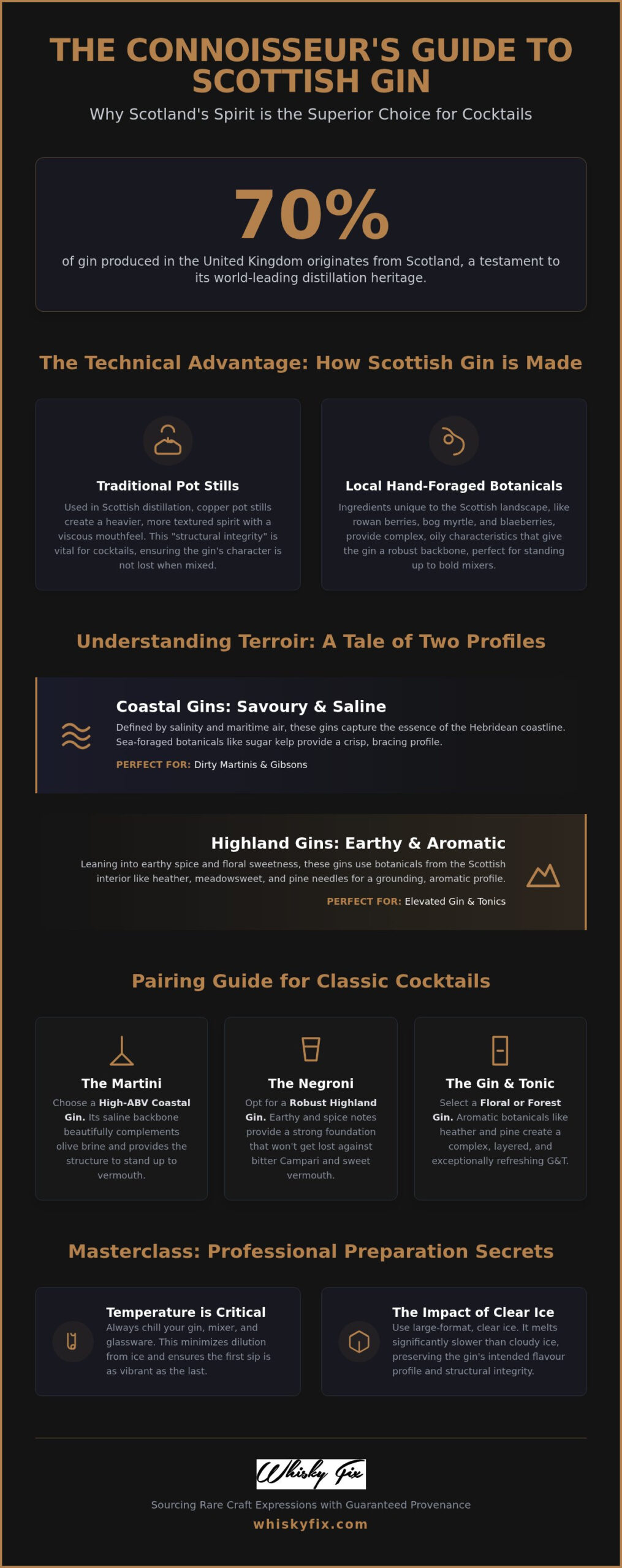
Scotland produces approximately 70% of the gin made in the United Kingdom. This dominance isn’t merely a matter of volume; it’s the result of a small-batch philosophy that ensures every bottle maintains a complex, layered profile. This movement began as a way for whisky distilleries to utilise their stills during maturation, but it has evolved into a world-leading category in its own right. Scottish Gin is a spirit of regional provenance and technical precision that serves as a bridge between ancient distilling traditions and modern mixology.
The Technical Advantage: Pot Stills and Hand-Foraged Botanicals
Copper pot stills are central to the quality of premium Scottish spirits. Unlike continuous column stills used for mass-market production, pot stills produce a heavier, more textured mouthfeel. This viscosity is vital for emulsification in drinks like the Martini, where the gin must carry the weight of the vermouth. Unique ingredients such as rowan berries, bog myrtle, and blaeberries provide “oily” characteristics that are absent in standard grain spirits. Even globally recognised brands like Hendrick’s Gin demonstrate this Scottish innovation by using non-traditional botanicals like rose and cucumber to create a distinct, cocktail-ready profile.
Many of these expressions come from legendary whisky distilleries, sharing the same mineral-rich water sources and the expertise of master distillers. These artisans understand how to build a “backbone” in a spirit, ensuring the gin doesn’t disappear when mixed with aggressive ingredients like Campari or citrus. By choosing a spirit rooted in this heritage, you ensure that your home bar features the best scottish gin for cocktails, providing a robust foundation for any classic or contemporary recipe. The shift from generic spirits to these regional powerhouses marks a new era for the discerning cocktail enthusiast.
Understanding Terroir: Coastal vs. Highland Botanical Profiles
Terroir is often associated with the vineyards of France, yet it is equally vital in the Scottish distilling tradition. The concept of “Spirit of Place” translates directly to the glass through the use of indigenous botanicals that reflect the local ecosystem. As the growth of the Scottish gin industry continues to accelerate, distillers are moving away from generic flavour profiles in favour of expressions that tell a story of origin. Selecting the best scottish gin for cocktails requires an appreciation for these regional nuances, as the botanical backbone of a spirit will dictate its performance in a mix.
Coastal Gins: The Secret to the Perfect Savoury Martini
Coastal expressions are defined by salinity, maritime air, and the inclusion of sea-foraged ingredients like sugar kelp. These gins capture the essence of the Hebridean coastline, providing a crisp and slightly saline profile that is often absent in inland spirits. This maritime influence serves as a natural enhancer for savoury cocktails. In a Dirty Martini, the subtle saltiness of the gin complements the olive brine, while in a Gibson, it provides a sharp contrast to the pickled onion. These gins provide a bracing, atmospheric experience that mimics the Atlantic spray, ensuring the spirit remains the star of the drink.
Highland and Floral Gins: Elevating the Classic G&T
Highland and forest-based gins lean into the earthy spice and floral sweetness of the Scottish interior. Ingredients like heather, meadowsweet, and pine needles create a profile that is both grounding and aromatic. These spirits often draw from the same mineral-rich water sources and ancient landscapes described in The Connoisseur’s Guide to Single Malt Scotch Whisky. When paired with a premium tonic water, the floral notes of heather act as a counterpoint to the bitterness of quinine, resulting in a more balanced and sophisticated G&T. The presence of woodsy pine provides a structural depth that prevents the cocktail from becoming overly sweet.
Matching the terroir of your gin to the mood of your evening is a hallmark of a true connoisseur. A coastal gin suits a cold evening by the fire, whereas a floral Highland spirit is the perfect accompaniment to a bright afternoon. If you are looking to explore these regional profiles further, you can browse our curated selection of premium Scottish spirits to find the perfect match for your home bar. Understanding these profiles ensures that you are always using the best scottish gin for cocktails, tailored specifically to your taste and the specific requirements of your recipe.
The Best Scottish Gins for Classic Cocktails in 2026
Selecting the best scottish gin for cocktails requires more than just picking a premium label; it involves matching the spirit’s structural integrity to the specific requirements of the drink. A gin that shines in a delicate Martini may vanish when confronted with the bitter complexity of a Negroni. In 2026, the trend has moved toward specialized expressions where distillers prioritize a lead botanical profile designed to anchor specific classic recipes. At Whisky Fix, our curation focuses on these functional differences, ensuring your home bar is equipped with spirits that perform with technical precision.
Best for Martinis: The Structural Powerhouses
A Martini is a transparent drink that offers no place for a spirit to hide. For this reason, you should prioritize gins with a silky, viscous texture. Expressions from Islay and the West Coast are particularly renowned for this mouthfeel, often achieved through the use of local botanicals like sugar kelp or gorse. The “sweet spot” for vermouth integration is generally between 43% and 46% ABV. This higher alcohol content provides the necessary heat to carry the botanical oils through the chill of the glass. Look for clean, mineral-heavy profiles that offer a sharp juniper line, providing a crisp finish that complements a lemon twist or a savory olive.
Best for Negronis: The Bold and Spicy Contenders
The Negroni is a test of a gin’s endurance. To stand up to the aggressive profiles of Campari and sweet vermouth, a gin must possess a robust, spicy backbone. We recommend seeking out Scottish gins that utilize warm botanicals like cinnamon, cassia bark, or black pepper. These ingredients prevent the cocktail from becoming cloying, cutting through the sugar to maintain a dry, sophisticated balance. Pairing these bold spirits with the artisanal vermouths available in our Oban shop creates a drink with immense depth. These “workhorse” gins ensure that the juniper remains present from the first sip to the last, even as the ice begins to melt.
Best for G&Ts: The Botanical All-Stars
For a refreshing Tom Collins or a standard highball, you need a gin that “blooms” when it meets carbonation. Citrus-forward Scottish gins are the superior choice here, as the effervescence of the tonic releases volatile aromatics like lemon peel and coriander seed. The garnish is not merely decorative; it should match the gin’s lead botanical to enhance the sensory experience. Whether you are using a floral Highland spirit or a zesty coastal expression, the goal is a bright, uplifting drink. For those seeking truly elevated mixology, our “Old and Rare” gin expressions offer a level of complexity and historical provenance that transforms a simple highball into a curated tasting event.
Masterclass: How to Prepare Cocktails with Premium Scottish Spirits
Preparing a cocktail with a high-integrity spirit requires a technical approach that respects the distiller’s work. When you use the best scottish gin for cocktails, you aren’t just mixing ingredients; you’re managing dilution and temperature to highlight specific botanicals. Start by keeping your craft gin in the freezer if you intend to make a Martini. This ensures the spirit is at its most viscous before it ever touches ice, allowing for a bracingly cold drink without immediate water ingress. Temperature control is the primary tool for maintaining the “spine” of a premium gin.
Ice quality is equally paramount. Always opt for large-format clear ice rather than small, cloudy cubes from a standard tray. Clear ice is denser and melts significantly slower, giving you a wider window of “perfect” dilution. For a garnish, follow a “less is more” philosophy. A single peel of lemon or a sprig of local heather is often enough to complement the lead botanical without overwhelming the delicate spirit. Over-garnishing is a common mistake that masks the very nuances you’ve paid to enjoy.
The Importance of Dilution and Temperature
High-botanical gins react differently to agitation. Stirring a spirit-forward cocktail in a mixing glass is the preferred method for preserving the texture of foraged oils. Shaking can “bruise” these delicate notes by introducing too much air and rapid dilution. You might notice a slight cloudiness, known as the louche effect, when certain Scottish gins are chilled. This isn’t a flaw; it’s a sign of high oil content and superior quality, indicating that the spirit hasn’t been over-filtered. Using a mixing glass allows you to control this process with precision, resulting in a crystal-clear, silky mouthfeel.
Glassware and Presentation: Beyond the Copa
The vessel you choose dictates how aromas reach your palate. A Nick & Nora glass is ideal for Martinis or spirit-forward serves, as its narrow rim concentrates the juniper and mineral notes toward the nose. Conversely, a classic Balloon glass or Copa is best for a G&T, providing ample space for the botanicals to “bloom” as the carbonation rises. The shape of the glass directly affects your perception of the spirit’s complexity. For more insights on selecting the right tools for your home bar, see our guide on The Art of Whisky Gifting: Beyond the Bottle.
Mastering these techniques ensures that every pour justifies the investment in a premium bottle. You can browse our full range of professional barware and rare Scottish spirits to perfect your home mixology setup today.
Sourcing Rare Scottish Gins: The Whisky Fix Advantage
Finding authentic spirits in a saturated market is increasingly difficult. For the discerning collector, purchasing from a specialist based in Oban, the heart of the West Highlands, provides a guarantee of provenance that generic retailers cannot replicate. We serve as a vital link between traditional Scottish craft and a modern global audience, ensuring that every spirit in our collection reflects the heritage of its origin. Our location in Oban is not merely a postal address; it is a point of access to the most remote and innovative distilleries in the country. This local perspective is essential for identifying the best scottish gin for cocktails, as we understand the water sources and botanical landscapes that define these spirits.
Expert Curation from the Heart of Oban
Our team selects every gin using the same exacting standards applied to our Old & Rare single malt collection. This technical approach allows us to look beyond attractive packaging to find spirits with genuine structural integrity. Because of our deep-rooted relationships with Hebridean and Highland distillers, we often secure limited edition releases and “distillery-only” style bottles that never reach the wider market. These rare expressions offer a level of complexity and historical value that elevates any home bar. For those looking to share this passion, our selection of Whisky Inspired Gifts provides the perfect accompaniment for any gin enthusiast.
We also facilitate discovery through curated tasting events, where experts guide you through the nuances of regional botanical profiles. These sessions bridge the gap between education and enjoyment, helping you identify which spirits will best suit your personal mixology style. Understanding the “why” behind a gin’s flavour profile is what transforms a hobbyist into a true connoisseur.
Global Shipping for the Discerning Collector
In 2026, distance is no longer an obstacle to building a world-class collection. Our worldwide shipping service is designed to handle rare and old expressions with the care they deserve, ensuring safe transit to collectors across the globe. Our global shipping infrastructure is built on years of experience handling fragile, high-value whiskies, meaning your gin arrives in pristine condition regardless of your location. We monitor international spirits trends from a Scottish perspective, allowing us to provide insights that generic shops overlook. By choosing a specialist curator, you gain access to the best scottish gin for cocktails with the confidence that each bottle is authentic and of the highest quality.
Explore our curated Scottish Gin collection
Elevate Your Home Mixology with Authentic Scottish Craft
Choosing a spirit with regional provenance and technical precision is the essential first step toward a superior cocktail. You now understand how coastal salinity and highland spice interact with classic ingredients to move beyond generic recipes. The structural integrity found in these gins, often born from centuries of whisky-making expertise, ensures your drinks remain balanced and bold. By matching terroir to your chosen recipe, you transform a simple serve into a sophisticated sensory experience.
Finding the best scottish gin for cocktails is an exploration of our nation’s rich distilling heritage. At Whisky Fix, we act as your expert curator, offering a selection that is meticulously chosen in our Oban shop. We specialise in rare and limited spirits that provide the complexity and authenticity your home bar deserves. Our team prioritises craftsmanship and provenance above all else, ensuring every bottle in our collection meets the highest standards of excellence.
With worldwide shipping available to over 50 countries, we bring the very best of the Highlands and Islands directly to your doorstep. Browse our curated selection of premium Scottish Gins to find your next exceptional bottle. We look forward to helping you refine your mixology and celebrate the unparalleled craftsmanship of Scottish distillation.
Frequently Asked Questions
What is the best Scottish gin for a classic Gin and Tonic?
The best scottish gin for cocktails like the classic G&T is typically a citrus-forward or floral expression. These botanicals are designed to bloom when they meet carbonation, releasing aromatic oils that complement the bitterness of quinine. Highland spirits using meadowsweet or rose are excellent choices. You should always match your garnish to the lead botanical of the gin to enhance the sensory experience of the highball.
How does Scottish gin differ from traditional London Dry gin?
Scottish gin is defined by its regional provenance and use of hand-foraged botanicals rather than a specific production method. While London Dry is a legal classification requiring all flavours to be added during distillation, Scottish spirits often incorporate unique ingredients like sugar kelp or bog myrtle. This focus on terroir creates a spirit with a distinct sense of place that reflects the rugged landscapes of the Highlands and Islands.
Which Scottish gin is best for a dry Martini?
For a dry Martini, you should select a Scottish gin with a high ABV, typically between 43% and 46%. This alcohol content provides the necessary structural integrity to carry botanical oils through the chill of the glass. Coastal gins from the West Coast or Islay are particularly favoured for their mineral-heavy profiles and silky mouthfeel. These characteristics ensure the spirit remains the star of the drink without being overshadowed by the vermouth.
Can I use rare Scottish gins in cocktails, or should they be sipped neat?
You can certainly use rare Scottish gins in cocktails, provided the recipe is spirit-forward. Drinks like the Martini or Negroni are ideal because they allow the complexity of a premium spirit to shine without masking it with heavy mixers. Using a rare expression from our curated collection in Oban adds a layer of historical provenance and technical depth to your mixology that standard supermarket gins simply cannot match.
Does Whisky Fix ship Scottish gin to the USA and internationally?
Whisky Fix provides reliable worldwide shipping to over 50 countries, including the USA. We specialise in the safe transit of rare and old expressions, ensuring your bottles arrive in pristine condition regardless of your location. Our global shipping infrastructure is built on years of experience handling high-value whiskies. This allows enthusiasts from across the globe to access the best scottish gin for cocktails directly from the heart of the West Highlands.
What are the most common botanicals found in Scottish craft gins?
Scottish craft gins frequently feature indigenous ingredients that reflect the local landscape. Common botanicals include rowan berries for tartness, bog myrtle for a herbal spice, and heather for floral sweetness. Coastal distilleries often incorporate sugar kelp to introduce a subtle salinity. These hand-foraged elements distinguish Scottish spirits from mass-market options, providing a complex botanical backbone that is essential for creating sophisticated and balanced cocktails at home.
Why are many Scottish gins produced by whisky distilleries?
Many Scottish gins are produced by whisky distilleries because gin production provides an immediate revenue stream while whisky matures in casks. This maturation process can take years, so distillers utilise their existing copper pot stills and mineral-rich water sources to create premium gin. This shared heritage ensures that the gin benefits from the same technical precision and craftsmanship as world-renowned single malts, resulting in a spirit of exceptional quality.
How should I store my premium Scottish gin to keep it fresh?
You should store your premium Scottish gin upright in a cool, dark place to prevent the oxidation of delicate botanical oils. Unlike wine, spirits don’t age in the bottle, but exposure to direct sunlight can degrade the flavour profile over time. If you frequently prepare Martinis, we recommend keeping your bottle in the freezer. This maintains the liquid’s viscosity and ensures your cocktails are served at the optimal temperature for maximum enjoyment.