
- September / 14 / 2026
Best Japanese Whisky for Beginners: 2026 Guide
The bottle on the shelf looks authentic, yet there’s a high probability the liquid inside was never distilled in Japan. For years, the industry operated in a gray area where imported spirits were bottled locally and sold under the guise of East Asian craftsmanship. As of March 2026, new JSLMA regulations have finally turned the tide; it’s now much simpler to identify the best Japanese whisky for beginners without falling for deceptive marketing. You want a bottle that captures the celebrated “harmony” of the region, but the fear of overpaying for a non-authentic blend is a valid concern for any newcomer.
We understand that the world of Japanese spirits can feel like a complex puzzle of supply shortages and distinct distillery styles. This guide simplifies your search by highlighting approachable expressions that offer genuine value and a true sense of provenance. You’ll learn to distinguish between the delicate fruitiness of Suntory and the robust character of Nikka while discovering how to spot the official “JW” authentication logo. From bright highball staples to velvety single malts, we’ve curated a selection of gateway bottles that deliver the precision and elegance this category is famous for.
Key Takeaways
- Master the 2026 JSLMA labeling standards so you can confidently identify genuine Japanese spirits and avoid deceptive, non-authentic imports.
- Discover how to select the best Japanese whisky for beginners by focusing on the signature “silky” texture and delicate floral notes that define the region’s style.
- Compare the distinct philosophies of Suntory and Nikka to find which iconic house matches your personal flavor preferences.
- Perfect your serving technique with professional tips on the Japanese highball and the proper use of glassware for neat pours.
- Gain insight into the emerging craft scene, where smaller distilleries are introducing bold new profiles to the global market.
What Makes Japanese Whisky Different from Scotch?
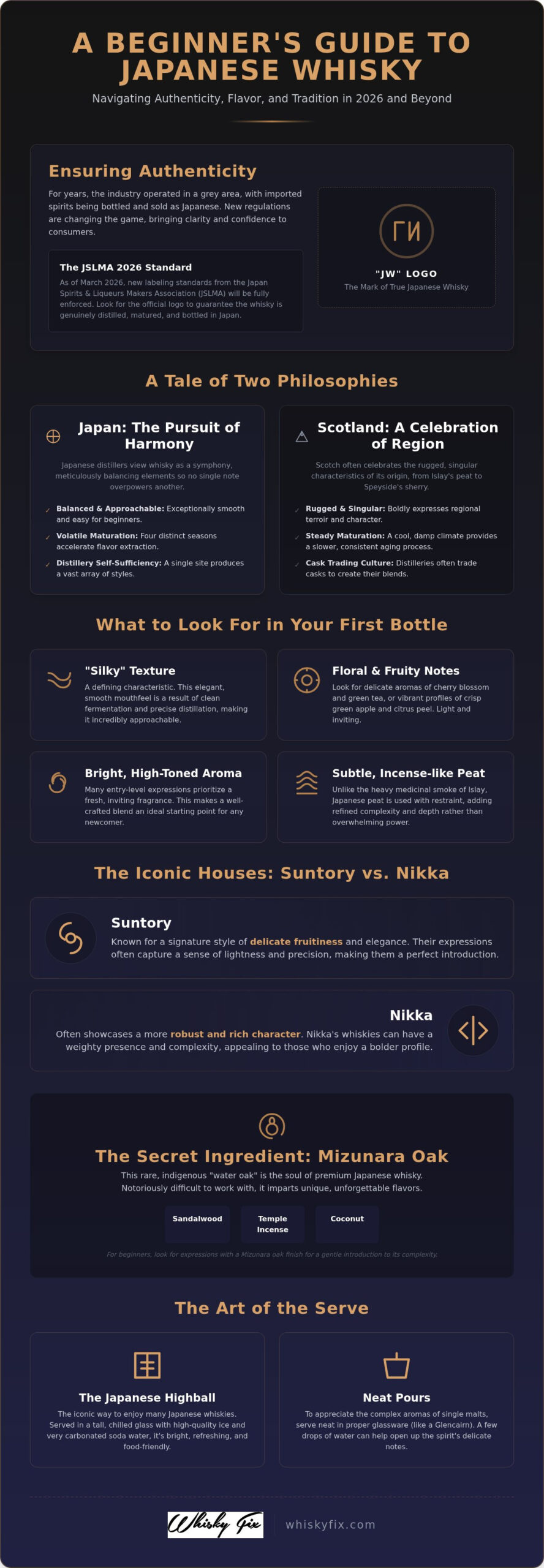
The history of Japanese whisky is inextricably linked to Scotland. In the early 20th century, Masataka Taketsuru traveled to Glasgow to learn the chemistry of distilling, eventually returning to Japan with a Scottish bride and the technical blueprints that would launch an industry. While the foundation is Scottish, the evolution is entirely Japanese. The most significant departure lies in the philosophy of “Harmony.” Scotch often celebrates the rugged, singular characteristics of its region, such as the medicinal peat of Islay or the heavy sherry of Speyside. Japanese distillers, however, view whisky as a symphony. They prioritize a meticulous balance where no single element overpowers another. This pursuit of equilibrium makes the best Japanese whisky for beginners exceptionally approachable; it lacks the aggressive “bite” often associated with younger spirits.
Japan’s environment also plays a silent, vital role. The nation’s four distinct seasons create a more volatile maturation process than the steady, damp climate of the Scottish Highlands. Hot summers and cold winters cause the spirit to expand and contract within the wood more frequently, which can accelerate the extraction of flavors. Additionally, Japanese distilleries operate with a level of self-sufficiency rarely seen in Europe. Because domestic distilleries rarely trade casks with competitors, a single site must produce a vast array of styles. They achieve this by using various still shapes, sizes, and worm tubs, resulting in a diverse portfolio from a single source.
The Pursuit of Purity and Precision
Japanese production is defined by “Kaizen,” or the relentless pursuit of continuous improvement. This manifests in the technical precision of their fermentation. Distillers often utilize dozens of different yeast strains and vary fermentation times to create specific flavor precursors. Water quality is equally paramount. The soft, mineral-rich waters of the Yamazaki and Hakushu springs are legendary for their ability to produce a clean, “silky” mouthfeel. For a newcomer, this technical rigor translates into a spirit that feels polished and refined on the palate. The best Japanese whisky for beginners often highlights this purity, offering a clarity of flavor that is easy to navigate.
Mizunara Oak: The Secret Ingredient
You cannot discuss Japanese whisky without mentioning Mizunara oak. This indigenous “water oak” is notoriously difficult to work with; the trees must be at least 200 years old before they can be felled, and the wood is prone to leaking. Despite these challenges, it’s the soul of premium Japanese blending. Mizunara imparts unmistakable notes of sandalwood, agarwood, and coconut, often described as “temple incense.” When searching for a gateway bottle, look for expressions that use Mizunara as a finish rather than a full maturation. This provides a delicate introduction to the exotic, spicy complexity that defines high-end Japanese spirits.
The Beginner’s Palate: What to Look for in Your First Bottle
For a newcomer, the first encounter with Japanese whisky is often a revelation in texture. Unlike the oily or heavy weight of some Highland malts, Japanese spirits are celebrated for a “silky” mouthfeel. This elegance is a deliberate result of clean fermentation and precise distillation. When identifying the best Japanese whisky for beginners, the focus should be on this effortless glide across the palate. You’ll often find a spectrum ranging from delicate floral notes, reminiscent of cherry blossoms and green tea, to vibrant fruity profiles of crisp green apple and citrus peel. These lighter expressions provide a gentle introduction without the overwhelming intensity found in other regions.
Fragrance plays a vital role in the appreciation of these spirits. Many entry-level bottles prioritize a bright, “high-toned” aroma that feels fresh and inviting. This accessibility is why a well-crafted blend is often cited as the best Japanese whisky for beginners. While single malts offer a deep dive into a specific distillery’s character, a blend provides a curated experience that balances sweetness, acidity, and grain influences. If you’re eager to start your journey, exploring a curated selection of Japanese spirits can help you identify these nuances before committing to a rare single malt.
Smoke is another element to consider, though it’s used with extreme restraint in Japan. Peat here doesn’t mimic the medicinal, iodine-heavy smoke of Islay. Instead, it leans toward a refined, “incense-like” quality that adds depth without dominance. This subtle earthiness is more about complexity than power. It rewards the patient taster who looks for layers rather than a singular bold statement. This understated approach ensures that even peated Japanese whiskies remain approachable for those just starting to build their palate.
Understanding the Blend
Japanese blending is a prestigious art form rather than a secondary category. Master blenders achieve consistency and complexity by marrying multiple components, often including “Pure Malt” (a vatting of single malts from different distilleries) and grain whiskies. In Japan, a high-quality blend is a mark of extreme craftsmanship, often commanding as much respect as a vintage single malt. These expressions are designed to be harmonious, making them the perfect entry point for novices who want to experience the full breadth of a house style in a single glass.
Decoding the Label
In the 2026 market, “No Age Statement” (NAS) bottles are the standard. Due to the global shortage of aged stock, distilleries focus on flavor profiles rather than a specific number of years in the wood. Beginners should also learn to recognize key kanji on labels: Yamazaki (山崎), Hibiki (響), and Hakushu (白州). Understanding these markers is essential for anyone following a guide to collecting Japanese whisky or simply looking for an authentic pour. Single grain whisky is typically produced in continuous column stills from corn or wheat; it provides a sweet, mellow foundation that softens the intensity of malt in a blend.
Top Japanese Whiskies for Beginners in 2026
Selecting the best Japanese whisky for beginners in 2026 requires looking beyond the hype of rare vintage age statements. The market has split into ultra-collectible unicorns and highly accessible, flavor-driven expressions designed for immediate enjoyment. While the legendary houses of Suntory and Nikka remain the standard-bearers, the rise of craft distilleries like Chichibu and Mars Shinshu offers a modern alternative for the curious novice. Finding the sweet spot involves balancing price-point anxiety with the desire for a bottle that justifies its reputation through complexity and balance.
Suntory: The Masters of Elegance
Suntory’s portfolio is defined by its pursuit of refined hospitality and technical precision. Hibiki Japanese Harmony is the quintessential entry point; it’s a blend of malt and grain whiskies that delivers a profile of honey, orange peel, and white chocolate. For those seeking a fruit-forward introduction to single malts, Yamazaki Distiller’s Reserve utilizes wine-cask and Mizunara-cask maturation to provide notes of strawberry and dried cherry. Finally, Hakushu Distiller’s Reserve, known as the “Forest Distillery” malt, provides a crisp profile of peppermint and melon with a whisper of pine-needle smoke.
Nikka: The Bold and the Brave
If Suntory is about elegance, Nikka represents the robust, experimental side of Japanese distilling. Nikka From The Barrel is an iconic, high-proof blend that packs an intense punch of toffee and winter spices. It’s a favorite for those who appreciate a full-bodied spirit. Nikka Coffey Grain is an exceptional choice for bourbon drinkers. Its corn-based mash bill and continuous distillation result in a creamy, vanilla-heavy sweetness. For a more delicate experience, Miyagikyo Single Malt showcases the elegant side of Nikka, emphasizing sherry-cask influence with notes of cocoa and cooked fruit.
The 2026 landscape is increasingly shaped by craft pioneers who challenge the status quo. Chichibu, led by Ichiro Akuto, produces small-batch expressions that have gained a cult following for their depth and maturity beyond their years. Similarly, Mars Shinshu, located at high altitudes in the Japanese Alps, creates whiskies with a unique mountain-influenced maturation. We curate a selection that bridges these craft innovators with the established giants. Our global shipping service ensures that whether you’re seeking the best Japanese whisky for beginners or a luxury single malt, these authentic spirits are accessible to enthusiasts worldwide.
The Art of the Serve: How to Enjoy Japanese Whisky
The Japanese highball is a masterclass in technical precision. It transforms a potent spirit into a refreshing, effervescent companion that highlights the subtle nuances of the grain. For many enthusiasts, this serve represents the best Japanese whisky for beginners because the carbonation lifts the delicate floral and citrus notes often found in Japanese blends. Temperature is critical to this experience. Both the glassware and the spirit should be thoroughly chilled before assembly to prevent the ice from melting too rapidly and diluting the flavor profile. This meticulous attention to detail ensures that the whisky remains the protagonist of the drink.
Mastering the Highball at Home
Achieving the perfect highball requires a disciplined 1:3 ratio of whisky to sparkling water. Start by filling a tall glass with high-quality, clear ice to minimize unwanted aeration and dilution. Pour the whisky over the ice and stir approximately 13 times to chill the liquid. Gently add the carbonated water, pouring it down the side of the glass to preserve the bubbles. A single “long” stir is sufficient; over-manipulation will dissipate the carbonation. Light, vibrant blends are ideal for this method, while complex single malts are better reserved for sipping neat. If you wish to share these techniques with others, consider how to host a tasting event that focuses on these refined preparation methods.
Drinking neat remains the most direct way to evaluate a spirit’s complexity. A Glencairn glass is the preferred tool for this ritual, as its tulip shape concentrates the aromas at the rim. For high-proof expressions, such as Nikka From The Barrel, adding a single drop of room-temperature water can “open” the whisky, releasing hidden layers of sandalwood and spice. Alternatively, the traditional Mizuwari method involves mixing two parts water with one part whisky over ice. This approach is designed to lower the alcohol by volume, making the spirit a graceful accompaniment to a multi-course meal.
Japanese spirits excel in culinary pairings due to their inherent balance. The clean acidity of a grain-heavy blend cuts through the richness of fatty tuna or salmon in sushi. Conversely, the refined, “incense-like” smoke of a peated malt pairs exceptionally well with grilled meats or dark, bitter chocolate. These combinations reward the palate by highlighting the “harmony” that defines the best Japanese whisky for beginners. To start building your own collection of these versatile spirits, explore our curated Japanese selection and discover the difference that authentic provenance makes.
Glassware and Environment
The physical environment significantly influences your perception of a spirit’s delicacy. A quiet, mindful setting allows you to appreciate the subtle aromatic layers that master blenders strive to achieve. Choose glassware that feels balanced in the hand; the weight and clarity of the crystal can enhance the ritual of the pour. By creating a focused tasting environment, you honor the craftsmanship of the distiller and allow the true character of the spirit to emerge without distraction.
Authenticity and Sourcing: How to Buy with Confidence
The surge in global demand for Japanese spirits led to a period of significant labeling ambiguity. For years, bottles containing imported bulk spirits were marketed as domestic products, creating confusion for even seasoned collectors. As of March 20, 2026, the industry has reached a definitive turning point with the Japan Spirits & Liqueurs Makers Association (JSLMA) standards becoming legally binding. This regulatory shift is essential for identifying the best Japanese whisky for beginners, as it ensures the liquid in your glass was fermented, distilled, and matured in Japan for at least three years in wooden casks. Authentic bottles must now meet these strict criteria to carry the “Japanese Whisky” designation on the label.
The Checklist for Authentic Japanese Whisky
Look for the “JW” authentication logo on the packaging. This mark signifies that the producer adheres to the strict 2026 transparency requirements. Transparency has become the new gold standard in Japanese distilling. Major houses like Suntory and Nikka have led this movement, clearly labeling their authentic domestic products while categorizing others as “World Malts” or “Japanese Spirits.” If a label lacks a specific distillery of origin or uses vague terminology, it’s likely a blend of international stocks rather than a true Japanese spirit. Authentic producers are proud of their provenance and will clearly state the distillery where the spirit was born.
The 2026 market shows signs of recovery from the extreme aged-stock shortages of the early 2020s. While No Age Statement (NAS) bottles remain the primary entry point for consistency, we’re seeing the gradual return of 10 and 12-year age statements to the shelves. This resurgence allows newcomers to experience the influence of time on the spirit without the prohibitive costs of ultra-rare vintages. Sourcing from a specialist like Whisky Fix provides an additional layer of security. We act as a trusted curator, ensuring that every bottle in our collection meets the highest standards of quality and adheres to the latest labeling laws.
Building a Collection for the Future
Resist the urge to chase rare limited editions during your first few purchases. Starting with core expressions allows you to build a sensory map of the different house styles without price-point anxiety. Proper storage is also vital for long-term enjoyment. Keep your bottles upright in a cool, dark environment to preserve the delicate floral and citrus notes that characterize these spirits. Sunlight and extreme temperature fluctuations can degrade the subtle “harmony” that makes the best Japanese whisky for beginners so rewarding. For those who wish to expand their technical knowledge, our Connoisseur’s Guide to Single Malt Scotch Whisky offers a valuable comparison of how Japanese precision differs from traditional Scottish production methods.
Begin Your Exploration of Japanese Excellence
The landscape of Japanese spirits has never been more transparent or exciting. By understanding the 2026 JSLMA labeling standards, you can confidently navigate the market and avoid the confusion of non-authentic products. The pursuit of the best Japanese whisky for beginners rewards those who look for the signature “harmony” and technical precision that define these world-class distilleries. Whether you’re drawn to the floral elegance of a Suntory blend or the bold complexity of a Nikka single malt, each bottle offers a unique bridge between tradition and innovation.
At Whisky Fix, we take pride in our role as a trusted curator. Every bottle in our collection is expertly sourced by our specialists in Oban, the heart of Scottish whisky heritage. We provide a guarantee of authenticity and offer worldwide shipping to ensure these rare expressions reach your door in perfect condition. Explore our curated selection of Whiskies of the World and discover a spirit that truly justifies its reputation. Your exploration of Japanese craftsmanship starts with a single, well-considered pour.
Frequently Asked Questions
Why is Japanese whisky so expensive compared to Scotch?
The pricing reflects a significant supply and demand imbalance that started in the 2010s. While Scotch has vast, established reserves, Japanese distilleries faced a shortage of aged stock after production slowed in the late 20th century. This scarcity, combined with the high cost of indigenous materials like Mizunara oak and a global trend toward premiumization, keeps prices elevated. Finding the best Japanese whisky for beginners often involves balancing these costs against the unique quality of the spirit.
Is Suntory Toki a good whisky for beginners?
Suntory Toki is an excellent entry point, specifically designed for those who enjoy refreshing serves. It features a bright, green-apple profile with a clean citrus finish that makes it exceptionally approachable. While it lacks the heavy complexity of rare single malts, its light character is perfect for learning the Japanese highball technique. It’s a practical choice for anyone looking to understand the category’s focus on clarity and balance without a significant initial investment.
What is the difference between Nikka and Suntory?
The primary difference is their stylistic philosophy. Suntory focuses on “Yubun,” a refined and polished harmony that results in soft, floral, and fruity spirits. Their Yamazaki and Hakushu distilleries define this elegant house style. Nikka tends toward a more robust, Scottish-inspired character. Founded by Masataka Taketsuru, Nikka utilizes traditional methods like coal-fired stills at Yoichi to produce heavier, slightly peated whiskies, while their Miyagikyo site offers a more delicate, sherry-influenced alternative for the best Japanese whisky for beginners.
Can I drink Japanese whisky with ice?
You can certainly enjoy it with ice; in fact, the “on the rocks” serve is a respected tradition in Japan. Enthusiasts typically use a single, large sphere of clear ice to chill the spirit while minimizing unwanted dilution. This method allows the flavor profile to evolve gracefully as the temperature drops. It’s a common way to enjoy more robust blends or grain whiskies, as the cold can highlight different aromatic layers in the glass.
How can I tell if a Japanese whisky is ‘fake’?
Check for the official “JW” authentication logo on the bottle. As of March 2026, JSLMA labeling standards are legally binding, requiring the spirit to be fermented, distilled, and matured in Japan for at least three years. If a label uses vague terms like “World Malt” or “Japanese Spirit” without naming a specific domestic distillery, it likely contains imported bulk spirits. Authentic producers are transparent about their provenance and will clearly state their Japanese distillation roots.
Which Japanese whisky is most like Macallan?
Yamazaki 12 Year Old and Miyagikyo Single Malt are the most comparable expressions for Macallan drinkers. Both distilleries utilize sherry cask maturation to impart rich notes of dried fruit, cocoa, and winter spices. While they maintain the signature Japanese silkiness, their weight and sweetness mirror the Speyside profile that Macallan fans appreciate. These bottles offer a familiar bridge for Scotch enthusiasts who want to explore the precision and “harmony” of Japanese distilling.
Does Japanese whisky expire once opened?
Whisky doesn’t expire in the traditional sense, but its flavor will gradually change due to oxidation once the seal is broken. Air entering the bottle begins to interact with the spirit, which can soften the aromas over time. If a bottle is less than half full, this process happens more quickly. To preserve the delicate floral notes, you should try to finish an opened bottle within one to two years and store it upright in a cool, dark place.
Is Hibiki Harmony a single malt or a blend?
Hibiki Japanese Harmony is a blended whisky that represents the pinnacle of Suntory’s blending expertise. It’s a meticulous marriage of malt whiskies from the Yamazaki and Hakushu distilleries combined with grain whisky from the Chita distillery. This expression utilizes over ten different malt and grain liquids to achieve its consistent, honeyed, and floral profile. It’s a prestigious example of how blending is treated as a high art form in Japan, prioritizing a seamless, harmonious experience.